The Americas · Volume 38
Quebec and Francophone Canada
The Curd, the Cure and the Sugar Bush
A Catholic, French-settled cuisine built on three things that have nothing to do with Paris: a fur-trade economy that needed food it could carry for months, a maple forest no other wine-growing, olive-pressing food culture on earth has in this quantity, and two waves of Jewish immigration that gave Montreal a deli and a bagel neither New York nor anywhere else in France's old empire can claim. Quebec's own French-Canadian mainstream, running down the Saint Lawrence from Quebec City to Montreal, sits alongside two threads this chapter refuses to fold into it: the Métis nation, whose cuisine genuinely bridges French fur-trade fathers and Cree, Ojibwe and other Indigenous mothers rather than simply borrowing from one side, and the Acadian communities of Gaspésie and the Îles-de-la-Madeleine, settled by a different, harder history of expulsion and exile than the Saint Lawrence valley's own continuous French settlement. Every dish as tradition built it, then what a modern chef would change.
Sources and review · What this chapter does not assert · How we research · Spotted something wrong?
A Sense of Place
Quebec is not one food world wearing a French accent. It is three, sharing a language family and a great deal of history but built on genuinely different logics: the Saint Lawrence valley's continuous French settlement, running from subsistence farming through the fur trade to today's cities; the Métis nation's fur-trade fusion cuisine, built where French provisioning met Cree, Ojibwe and other Plains and Woodlands foodways head-on rather than at a polite distance; and Acadian Quebec, a demographic fact of Gaspésie and the Îles-de-la-Madeleine rather than a food tradition distinct from its Maritime cousin, a genuinely honest finding this chapter states plainly rather than dressing up.
The Saint Lawrence valley: a French peasant kitchen that never went home
New France's habitants farmed a cold, short-season river valley their French forebears never had to contend with, and the food that resulted reads as thrifty rural French technique applied to a harder climate: whole-animal pork use, root vegetables that keep through a real winter, and a fasting and feast calendar borrowed wholesale from the Catholic church. Montreal grew into something else on top of that base: two waves of Jewish immigration, Eastern European from the turn of the twentieth century, gave the city a deli and a bagel tradition as distinctive as New York's own and genuinely different from it in technique, not merely in address.
The Métis nation: a cuisine built where two food worlds actually met
Métis cuisine is not French food with an Indigenous garnish, and this chapter follows the atlas's own rule of naming who is speaking rather than folding a distinct nation's food into a general "Quebec" voice. Scottish and French fur traders, many of them Hudson's Bay Company employees recruited from Orkney and the Outer Hebrides, took Cree, Ojibwe and other Indigenous wives across the fur-trade north; their descendants built a genuinely blended food culture, French provisioning technique, Scottish bread, Indigenous ingredients and preservation method, that became something new rather than a compromise between the two. Bannock, brought by those Scottish traders, and pemmican, the Plains Indigenous preservation technology this atlas has already documented in full in AM-30, sit at that cuisine's centre.
Gaspésie and the Îles-de-la-Madeleine: Acadian people, a fishing economy's own food
Roughly 65% of Gaspésie's population, and over 80% in Bonaventure county specifically, descends from Acadian families resettled there after the 1755 expulsion; on the Îles-de-la-Madeleine that figure runs close to 86%. This is a real, well-documented demographic fact. What this chapter found, honestly, is that the food evidence for a genuinely separate Quebec-Acadian culinary tradition is thin: fricot, the classic Acadian chicken-and-dumpling stew, is described everywhere as pan-Acadian rather than locally distinct, and the Islands' own most celebrated dish, pot-en-pot, is framed by every source as a Madelinot fishing-economy dish rather than an Acadian one specifically. This chapter names the connection and sends the reader to AM-31 for the fuller Acadian story and for rappie pie's own full recipe, rather than manufacturing a distinctly Quebec-Acadian dish the sourcing does not support.
The defining logic, by thread
| Element | Saint Lawrence valley (habitant and urban) | Montreal Jewish deli | Métis | Gaspésie and Îles-de-la-Madeleine |
|---|---|---|---|---|
| Fat | Pork lard, butter | Rendered poultry and beef fat | Rendered bison or beef fat, lard | Salt pork, butter |
| Starch | Potato, wheat pastry | Rye bread, boiled-and-baked bagel dough | Bannock, flour | Potato |
| Aromatic base | Onion, clove, cinnamon, savory | Coriander, black pepper, mustard seed, garlic | Wild onion, berries | Onion, black pepper |
| Everyday protein | Pork, veal, ham | Cured brisket, smoked salmon | Bison, dried meat, fish | Cod, herring, other fish |
| Defining preserving technique | Potting fat over meat (cretons), slow baking with sugar | Dry curing and multi-day smoking | Pemmican pounding and fat-sealing | Salting fish |
The History in Layers
The fur trade, the real reason this cuisine tastes the way it does
Voyageurs hired by the Hudson's Bay Company and the North West Company were divided by role: mangeurs de lard, pork eaters, who shuttled seasonally between Montreal and Lake Superior, and hivernants, who wintered in the interior on contracts running one to five years, subsisting principally on pemmican and dried bison meat. The large freight canoe, the canot de maître, used on Great Lakes routes measured roughly 36 feet by 6 feet and carried eight to ten men plus cargo. Split pea soup with salt pork is the food most closely associated with voyageur travel and is still cooked ceremonially today: Christian Perron, named official Voyageur ambassador for Manitoba's Festival du Voyageur and a descendant of fur trader Charles Chaboillez, active on the Assiniboine and Red Rivers from 1797 to 1804, still publishes his family's own recipe. This is the deep structural logic behind everything else in this chapter: a French colony that survived and then profited by moving food, and people, thousands of miles by canoe, on rations built to keep rather than to please.
Pemmican, bannock and rubaboo: a Métis cuisine, not a French footnote
This atlas's own volume AM-30, Woodlands, Plains and Southwest Indigenous Foodways, already carries pemmican's full recipe as a Plains Indigenous dish, dried meat and rendered fat pounded together at a well-corroborated, though not single-source-confirmed, roughly one-to-one ratio by weight, and that same chapter explicitly declines to treat bannock, naming it as belonging to "a future volume on the fur-trade north." This is that volume, and bannock belongs here in full.
Bannock traces to Scotland: the word derives from Scottish Gaelic bannach, morsel, plausibly from Latin panis, bread. Scottish fur traders, recruited heavily by the Hudson's Bay Company from Orkney and the Outer Hebrides, introduced it to Indigenous peoples of North America across the eighteenth and nineteenth centuries; many of these Scots took Indigenous wives, which is one reason a significant proportion of Métis carry Scottish surnames alongside a Scottish thread running through Métis fiddle and reel music as well as its bread. This chapter also corrects a distinction its own original brief assumed: "galette," often described as a separate, fried-only version of bannock, is in the strongest in-tradition sources actually just the Michif word for bannock, any cooking method, fried in a pan, baked in an oven, cooked on a griddle or wrapped around a stick over a fire. The University of Saskatchewan's Indigenous Saskatchewan Encyclopedia lists among Métis festive foods "les beignes (fried bread), la galette (bannock), les boulettes (meatballs), le rababou (stew)," translating galette directly as bannock and naming beignes, a genuinely separate doughnut-like preparation, as the actual fried-dough dish. Because it needed no yeast, little time and few tools, and its ingredients kept well, bannock became the staple travelling bread of voyageurs, fur traders, and later railway workers, loggers and Métis households generally.
Rubaboo, also spelled rababou or robbiboo, is pemmican's own cooked form: a stew made by boiling pemmican in water, most commonly with potato and onion, thickened with flour or bread, sometimes enriched with wild parsnip, turnip or asparagus depending on what was to hand. The Manitoba Métis Federation frames pemmican, and rubaboo as its rehydrated form, as structurally central to the fur trade's own expansion, citing its caloric density, roughly a kilogram equivalent to four kilograms of fresh meat, and shelf stability running to years without refrigeration. This chapter states plainly what its own research found: no source, in-tradition or otherwise, gives rubaboo an exact modern quantity-based recipe, every account describes it only procedurally, pemmican boiled with water and whatever vegetables were available, thickened with flour. That honesty matters more than inventing a ratio, and it is named here as a real, distinct Métis dish worth knowing rather than a footnote to pemmican.
The Saint Lawrence valley's own French kitchen, and where poutine actually comes from
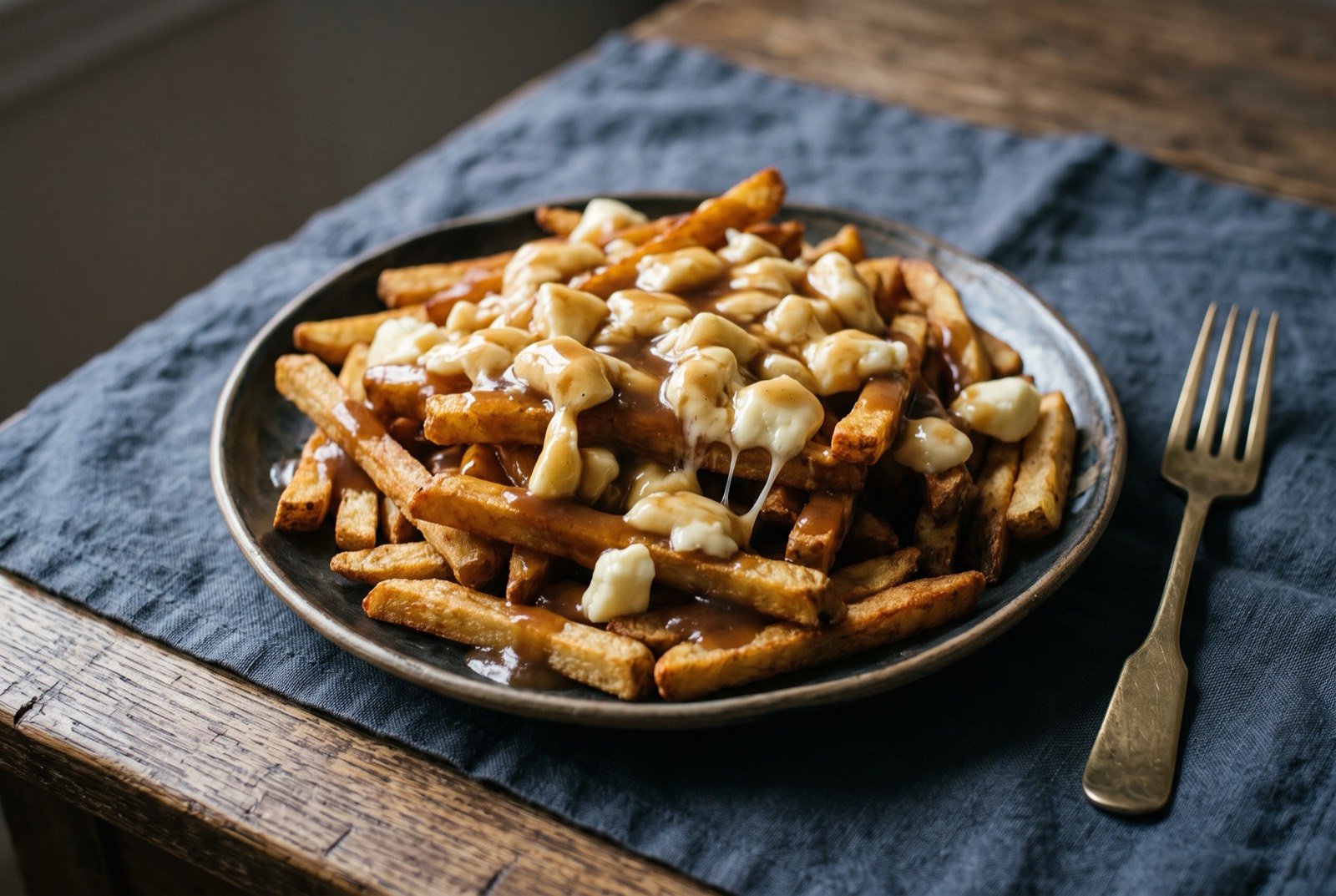
Quebec's own habitant food culture, whole-animal pork thrift, root vegetables, a Catholic feast and fasting calendar, produced tourtière, cretons and fèves au lard long before any of them had a written recipe. Poutine, the province's best-known modern dish, is genuinely rural and genuinely recent: two Centre-du-Québec towns, Warwick and Drummondville, both claim its invention, and both originators are dead, so no adjudication is possible. At Warwick's Café Idéal in 1957, owner Fernand Lachance reportedly combined fries, cheese curds and gravy in a bag at a customer's request and exclaimed something close to "Ça va faire une maudite poutine," though the exact wording is disputed. At Drummondville, Jean-Paul Roy's Le Roy de la patate added cheese curds to a "special sauce" fries order from the late 1950s, and Roy's later restaurant, Le Roy Jucep, registered the trademark "L'inventeur de la Poutine" in 1998. A Université Laval heritage inventory treats both claims as unresolved regional folklore rather than settling on one. Mobile canteens and competitive imitation spread the dish across Quebec through the 1950s and 60s; it reached Montreal only afterward, popularised rather than invented there by restaurants such as La Banquise, open since 1968.
Montreal's Jewish deli and bagel: a Romanian and Polish technique remade on Boulevard Saint-Laurent
Schwartz's Deli was founded 31 December 1928 by Reuben Schwartz, a Jewish immigrant from Romania, as the Montreal Hebrew Delicatessen. The deli states its own process directly: a dry rub of a proprietary spice blend, cured ten days, smoked overnight, then steamed throughout the day and hand-sliced to order. Ben's De Luxe Delicatessen, open from 1908 until December 2006, ninety-eight years, once advertised itself as the inventor of smoked meat, a claim cultural historians describe as debunked; it closed after a 2006 labour strike and downtown competition, and its building was demolished in 2008. Two more of the city's historic delis need their current status stated plainly, since older lists will mislead a reader: Lester's, founded 1951 in Outremont, remains open and trading in 2026, while Main Deli Steak House, open since 1974, closed suddenly in January 2023 after roughly fifty years, drawing enough attention that Canada's Prime Minister publicly commented, and must not be cited as a current address.
The Montreal bagel arrived by the same Eastern European Jewish route as the smoked meat but became something genuinely different from its New York cousin: boiled in honey-sweetened water rather than malted water, hand-rolled rather than machine-formed, traditionally unsalted, baked in a wood-fired oven, denser and sweeter than New York's version. Fairmount Bagel opened in 1919, founded by Isadore Shlafman, a Russian Jewish immigrant; St-Viateur Bagel opened in 1957, founded by Myer Lewkowicz, a Holocaust survivor who had worked at Fairmount before starting his own shop a few streets away. Both remain open and trading in 2026. A 2019 public debate over Montreal's wood-fired oven emissions produced a genuinely useful technical fact: St-Viateur is reported to run a hybrid oven, roughly 90% gas-powered, with a small wood component kept specifically for the smoke flavour rather than for heat, a detail worth carrying into a home kitchen that cannot run a coal-fired brick oven all day.
Maple sugaring: an Indigenous technology, a Quebec industry, and a formally recognised heritage
Maple sap collection at the spring thaw was practised by Indigenous peoples long before European colonisation; that origin, and its deeper Indigenous history, belongs properly to AM-30, and this chapter treats it as fact rather than re-deriving it. What belongs here is what colonists built from it and what Quebec has since made of it. Quebec produces on average roughly 72% of world maple syrup and about 90% of Canadian production, exporting to more than seventy countries, a figure that fluctuates year to year, a record harvest of 239 million lb was reported for 2024. The cabane à sucre, the sugar shack, as a social institution dates to simple wooden-plank buildings from the mid-nineteenth century, with organised sugaring parties recorded from 1868; in spring 2021 Quebec's own Ministre de la Culture et des Communications formally designated "les traditions du temps des sucres" as an element of the province's intangible cultural heritage, the strongest citation in this whole thread, a government heritage body's own record rather than a tourism board's.
Producteurs et productrices acéricoles du Québec, PPAQ, the growers' own organisation, operates the world's only strategic maple syrup reserve, created in 2000 to smooth annual weather-driven harvest swings: surplus-year syrup is pasteurised and stored in food-grade containers across three warehouses with a combined capacity of roughly 60 million kg, described by PPAQ itself as the equivalent of fifty-three Olympic swimming pools, worth over $400 million. Grading, unified continent-wide with the US since 2015, runs Doré, Ambré, Foncé and Très foncé, delicate through pronounced taste, with the old "Grade B" folded into Très foncé; colour tracks primarily how far into the season the sap was collected, not quality, syrup runs clear early and darkens as the season advances, and is classified by an optical spectrophotometer measuring light transmission through the syrup itself.
Tourtière and its own, much-argued family tree
The Encyclopédie du patrimoine culturel de l'Amérique française traces tourtière-family pies back through Mesopotamian clay tablets, Apicius and medieval European court pastry, arguing that French colonists in New France made modest meat pies rather than aristocratic layered ones. The same encyclopedia proposes, on its own authority alone, that tourtière du Lac-Saint-Jean specifically descends from the English "Sea Pie," documented in a 1796 American cookbook, which crossed into Gaspésie and was francised into "cipaille," and that the name "tourtière du Lac-Saint-Jean" itself is only as old as the 1970s. No second source corroborates this, and this chapter presents it as one heritage encyclopedia's account rather than settled fact. The popular belief that "tourtière" derives from la tourte, the passenger pigeon, extinct since the early twentieth century and historically hunted around its nesting grounds near Île d'Orléans, is widely repeated, but even Radio-Canada's own coverage sets it alongside a competing explanation, that the name instead comes from the shallow tourtière pie mould itself, and declines to settle the question. As of December 2025, a push exists to have tourtière du Saguenay-Lac-Saint-Jean recognised as Quebec intangible heritage in its own right, parallel to the temps des sucres designation.
The Flavour Arsenal
Herbes salées, the seasoning base most UK readers will never have tasted
A Bas-Saint-Laurent seasoning mix of celery, onion, carrot, parsnip, parsley, leek and chives with savory, layered with salt and left to cure for at least a year, spooned into soupe aux pois and countless other everyday dishes the way a French kitchen might reach for a bouquet garni. No UK stockist exists, and this chapter names that gap honestly rather than inventing one; it is a straightforward home preserve for a reader with a chinois and cold storage, covered fully below.
Savory (sarriette), tourtière's most argued spice
Cited repeatedly as the herb that gives tourtière its distinctive character, alongside the more universally agreed clove and cinnamon or nutmeg; different families and different regions weight the mix differently, and this chapter treats that variation as real rather than settling on one fixed spice ratio.
Cheese curds, an ingredient defined by a clock, not a recipe
Fresh cheddar curds squeak because of intact, elongated milk-protein strands held together by residual calcium; too little calcium or too much and the structure that makes the sound simply is not there. That squeak fades within about twelve hours even refrigerated, and curds are considered at their best unrefrigerated and same-day, doubtful once truly chilled. This is the single most consequential ingredient fact in the whole chapter: it is the entire reason poutine made anywhere the curd cannot arrive fresh is structurally a different dish, not an inferior version of the same one.
Maple syrup, graded by season rather than by quality
Covered in full above. The reader's own practical takeaway: Doré suits sweetening a drink, Ambré suits a crêpe, Foncé carries a caramel note into sweet and savoury dishes alike, and Très foncé, the old "Grade B," is the one to reach for when a strong maple flavour needs to survive baking or a long braise.
Pemmican, cross-linked rather than re-treated
Covered in full in AM-30. This chapter's own contribution is what Métis cooking did with it once it reached a pot rather than a trail, rubaboo, above.
The Technique Ladder
The argument, from inside
Five techniques, each explained by why it works, not only what it does.
Rung 1. Herbes salées' salt-curing preservation
Chopped celery, onion, carrot, parsnip, parsley, leek and chives layered with salt and left to cure for at least a year is doing exactly the job a dry salt cure does anywhere in this atlas, drawing water out of plant cells to concentrate flavour and inhibit spoilage, except applied to a whole vegetable-and-herb medley rather than a single ingredient, and it is the reason a spoonful of it carries so much more depth into a pot of soupe aux pois than any fresh herb could.
Rung 2. The pemmican-and-fat seal, applied to a stew rather than a bar
Rubaboo's whole logic depends on pemmican's own preservation technology, already documented in AM-30: dried meat pounded fine and sealed in rendered fat keeps for months without refrigeration, and boiling it back open in water is simply reversing that seal on demand, a genuinely elegant piece of food technology disguised as a simple stew.
Rung 3. Cheese curd's calcium-dependent squeak
Intact, elongated casein protein strands, held in tension by residual calcium, are what produce the sound; ageing, refrigeration or freezing lets moisture back into the structure and the squeak fades within hours, a real, measurable chemical clock rather than a marketing claim, and the reason freshness is this chapter's single most important sourcing lesson.
Rung 4. Rappie pie's liquid exchange, cross-linked to AM-31
Grated potato is pressed to remove its own starchy water, which is then replaced, not merely supplemented, with a flavoured stock; the technique itself is documented in full in that volume, and this chapter names it here only to mark the boundary of where Quebec's own Acadian thread sits relative to its Maritime original.
Rung 5. Maple's controlled crystallisation
Syrup boiled beyond the point at which it would set as syrup but short of maple butter or sugar, roughly 114 to 120°C, is poured onto packed snow specifically because the sudden temperature drop arrests crystallisation at exactly the point that gives tire d'érable its pliable, taffy-like set rather than a hard, sugared crack; the same syrup boiled further, without the snow's shock cooling, keeps crystallising into maple sugar instead, a single ingredient, three finished textures, purely a matter of where heat stops and cold begins.
The Ferment and Preserve Bench
This cuisine's preserve bench is a curing, potting and salting bench rather than a fermentation one, and every project on it is a real, working technique already described above.
House herbes salées. Chopped celery, onion, carrot, parsnip, parsley, leek and chives with savory, layered with fine salt at roughly equal weight to the vegetable mix, packed into a jar and left to cure at least several weeks, traditionally a year, before use; the single most useful project on this bench for a UK reader, since nothing equivalent can currently be bought here.
Potted cretons. Simmer pork with cream, breadcrumbs and spice as above until the liquid fully evaporates, then pot it warm into sterilised jars with a thin cap of its own rendered fat sealing the surface, exactly the same fat-seal preservation logic that runs through pemmican and rillettes alike, kept refrigerated for several weeks.
Rendered maple sugar. Continue reducing maple syrup past the tire d'érable stage, stirring continuously as it thickens, until it crystallises into a fine, dry sugar; store airtight, and use it as tourtière's spice partner or dusted fresh over tire d'érable itself.
Home-cured Montreal-style brisket. A dry cure of coarse salt, black pepper, coriander, mustard seed and garlic rubbed into a whole brisket and refrigerated ten days, turning it daily, follows Schwartz's own stated process closely enough to be a genuine home version rather than an approximation, ready to smoke on a Big Green Egg exactly as described above.
Sourcing in Britain
Maple syrup, no gap at all. Waitrose stocks graded No.1 Canadian Dark and No.1 Canadian Amber Rich, both live, currently listed Canada Grade A products. Ocado's St Lawrence Gold range, Dark Robust and Amber, plain and organic, states its syrup is sourced from "the top 200 maple farms in the Bas-Saint-Laurent region of Quebec," the most Quebec-region-specific labelling found on any UK shelf and the stronger of the two citations for a chapter this specific about provenance. Sainsbury's stocks a Taste the Difference Canadian Maple Syrup and a 100% Pure Canadian Red Maple Syrup, both Canada-packed, though neither carries a confirmed colour grade on its own label.
Cheese curds, a real but narrow route, not a dead end. Genuine imported Quebec curds are not viable, the product's defining freshness window is measured in hours, not shipping days, so buying "authentic" imported curd is a contradiction in terms. What is genuinely available is small UK dairies making fresh curd domestically for exactly this use case. Batch Farm Cheesemakers, Shepton Mallet, Somerset, specialise in Canadian-style cheddar curds explicitly marketed for poutine, ship UK-wide, and were named Cheese Curd of the Year by Lux Life Magazine, the single strongest find in this whole sourcing section. Kirkham's of Goosnargh, Lancashire, sold through Chorlton Cheesemongers, is a second named UK artisan alternative. Order close to the day of cooking and treat the squeak as a genuinely time-limited property, not a fixed one, exactly as it behaves in Quebec itself.
Beef brisket for smoked meat. iDevour, a specialist online butcher delivering UK-wide, sells the correct cut by its correct name, Beef Belly, Navel End Brisket, explicitly marketed for smoking, pastrami and beef bacon, alongside a separate Brisket Point and a Full Packer Brisket; this navel cut is not a traditional British butchery cut and is unlikely to be sold by that name at a generic UK butcher's counter, which is exactly why a specialist supplier matters here.
Pickling and curing spice. Coriander seed, black peppercorns and mustard seed in bulk are available from UK wholesale suppliers including Nuts in Bulk and The Spice Company; pink curing salt, Cure #1, correctly regulated and dye-free, is available through specialist UK curing suppliers and is genuinely food-safety relevant for anyone home-curing the brisket above.
Rye flour and dough for a Montreal-style bagel or deli rye. Shipton Mill stock organic dark rye (Type 1350) and organic light rye (Type 997) flours; note that rye is more relevant to a Montreal-style deli rye loaf for the smoked meat sandwich than to the bagel dough itself, which traditionally runs on strong white flour rather than rye.
Split peas, salt pork and herbes salées. Split peas, yellow and green, are unremarkable and widely stocked at Sainsbury's, Tesco and Waitrose. Salt pork or a suitable cured pork belly is available from UK specialist butchers including Swaledale Butchers and Salter & King, or a home cook can cure plain pork belly directly, arguably closer to the traditional Quebec method than buying a ready-cured product in any case. Herbes salées has no UK stockist or import route found in this research, a genuine gap this chapter states plainly rather than papering over; the honest advice is the preserve-bench recipe above, not a search for a shop that does not exist here.
Where these dishes can actually be eaten in Britain, honestly assessed. Poutine is genuinely present in London: The Poutinerie, Canadian-founded, and Poutinie both operate as market and street-food presences rather than fixed restaurants. Monty's Deli, Hoxton, is the clearest UK reference point for Montreal-style smoked meat, explicitly positioned in press coverage as introducing the technique and rivalling Schwartz's. No UK bakery, deli or shop currently selling tourtière could be verified, the one genuine gap among this chapter's flagship dishes; a UK reader wanting it will need to make it from scratch, which the brisket and pork sourcing above supports perfectly well in any case.
Voices and Sources
Named authorities and in-tradition voices. Christian Perron, named Voyageur ambassador, Festival du Voyageur, Manitoba, and descendant of fur trader Charles Chaboillez; Micheline Mongrain-Dontigny, culinary author, on pâté chinois's origin; Bernard Arcand, anthropologist, on the same; the Manitoba Métis Federation; Otipemisiwak Métis Government, the Métis Nation of Alberta, via the Rupertsland Institute's Métis Culture Cards; the Musée Acadien du Québec, Bonaventure; Ricardo Larrivée and Ricardo Cuisine, the closest thing Quebec has to a national food-media authority, cited throughout for real recipe quantities; Radio-Canada's Mordu food vertical.
Restaurants, bakeries and producers named in this chapter. Au Pied de Cochon and its Cabane à Sucre, Saint-Benoît-de-Mirabel, Martin Picard; Joe Beef, Vin Papillon and Liverpool House, Frédéric Morin and Allison Cunningham; Toqué!, Normand Laprise; Montréal Plaza, Charles-Antoine Crête; Candide, John Winter Russell; Hoogan et Beaufort, Marc-André Jetté; Mastard, Simon Mathys; Sabayon, Patrice Demers; Schwartz's, Lester's and Smoke Meat Pete; Fairmount Bagel and St-Viateur Bagel; Fromagerie Boivin and Fromagerie St-Guillaume; Citadelle, the growers' cooperative, and Escuminac, single-forest maple syrup.
Institutions and archives. Producteurs et productrices acéricoles du Québec (PPAQ); the Conseil du patrimoine culturel du Québec; the Encyclopédie du patrimoine culturel de l'Amérique française; Université Laval's Inventaire des ressources ethnologiques du patrimoine immatériel; the University of Saskatchewan's Indigenous Saskatchewan Encyclopedia; Aliments du Québec.
Things this chapter has deliberately not asserted
- That either Warwick or Drummondville is the sole, settled birthplace of poutine. Both towns' claims are genuine, both originators are dead, and Université Laval's own heritage inventory treats the question as unresolved regional folklore rather than settled fact.
- That the exact spice blend behind Schwartz's smoked meat, or the precise technical differences between it and New York pastrami, are confirmed by a named Quebec deli historian. The pastrami comparison, while widely repeated, rests on English-language secondary sourcing rather than a Quebec primary source in this chapter's research.
- That Schwartz's moved from wood to electric smoking. This claim rests on English Wikipedia alone and could not be corroborated in French-language sourcing.
- That "galette" is a fried-only version of bannock, distinct from a baked one. The strongest in-tradition and academic sources found treat galette as simply the Michif word for bannock regardless of cooking method, with beignes as the genuinely separate fried-dough dish, and this chapter presents that correction rather than the more common assumption.
- That rubaboo has a settled, exact modern recipe. No source located gives it one; every account describes the dish only procedurally, and this chapter states that gap rather than inventing quantities.
- That tourtière du Lac-Saint-Jean descends from the English "Sea Pie" via cipaille, or that its name only dates to the 1970s. This rests on a single heritage encyclopedia's account with no independent corroboration found.
- That tourtière derives its name from la tourte, the passenger pigeon. This is a widely repeated popular belief that even Radio-Canada's own coverage declines to assert over a competing explanation involving the pie mould itself.
- That Gaspésie or the Îles-de-la-Madeleine have a food tradition genuinely distinct from the wider Acadian repertoire, beyond their real, well-documented Acadian demographic history. Fricot is described everywhere as pan-Acadian rather than locally distinct, and the Islands' own best-known dish, pot-en-pot, is framed by every source as a fishing-economy dish rather than an Acadian one specifically.
- That any Montreal fine-dining restaurant beyond Au Pied de Cochon currently treats poutine, cretons or fèves au lard as a technical subject on a tasting menu. None was found in this chapter's research, and that gap is stated plainly rather than papered over with a weak citation.
- That fresh Quebec cheese curds can be genuinely imported into Britain. They cannot; the product's defining property is a freshness window measured in hours, and the honest UK route is a domestic maker such as Batch Farm Cheesemakers, not an import.
Herbes salées' salt-curing preservation
Chopped celery, onion, carrot, parsnip, parsley, leek and chives layered with salt and left to cure for at least a year is doing exactly the job a dry salt...
The pemmican-and-fat seal, applied to a stew rather than a bar
Rubaboo's whole logic depends on pemmican's own preservation technology, already documented in AM-30: dried meat pounded fine and sealed in rendered fat keeps...
Cheese curd's calcium-dependent squeak
Intact, elongated casein protein strands, held in tension by residual calcium, are what produce the sound; ageing, refrigeration or freezing lets moisture back...
Rappie pie's liquid exchange, cross-linked to AM-31
Grated potato is pressed to remove its own starchy water, which is then replaced, not merely supplemented, with a flavoured stock; the technique itself is...
Maple's controlled crystallisation
Syrup boiled beyond the point at which it would set as syrup but short of maple butter or sugar, roughly 114 to 120°C, is poured onto packed snow specifically...
The dishes
- Poutine Quebec, Canada
- Montreal smoked meat Montreal, Quebec, Canada
- Montreal bagel Montreal, Quebec, Canada
- Tourtière Quebec, Canada
- Soupe aux pois Quebec, Canada
- Pâté chinois Quebec, Canada (via Franco-American emigrants from China, Maine)
- Cretons Quebec, Canada
- Fèves au lard Quebec, Canada
- Métis bannock (galette) Métis Nation, Canada
- Tire d'érable (maple taffy on snow) Quebec, Canada
Sources and review
- Reviewed
- Not yet reviewed from inside the tradition
- Cooked
- Not yet cooked and reported
Where this volume comes from
3 research briefs on file for this volume, researched to the rules on How we research. Published 3 September 2026. Last changed 8 September 2026.
The brief's own account of its sources
Urban Quebec pass (poutine, smoked meat, bagel, pâté chinois, soupe aux pois, cretons, fèves au lard). Roughly 40% of citations are genuinely in-tradition or Quebec French-language press and broadcast: Radio-Canada and its Mordu food vertical, Ricardo, Le Roy Jucep's own site, Schwartz's own site, La Presse, La Banquise, IREPI and the Université de Sherbrooke.