The Americas · Volume 36
The Midwest and Great Lakes
The Fish Fry, the Curd and the Kettle
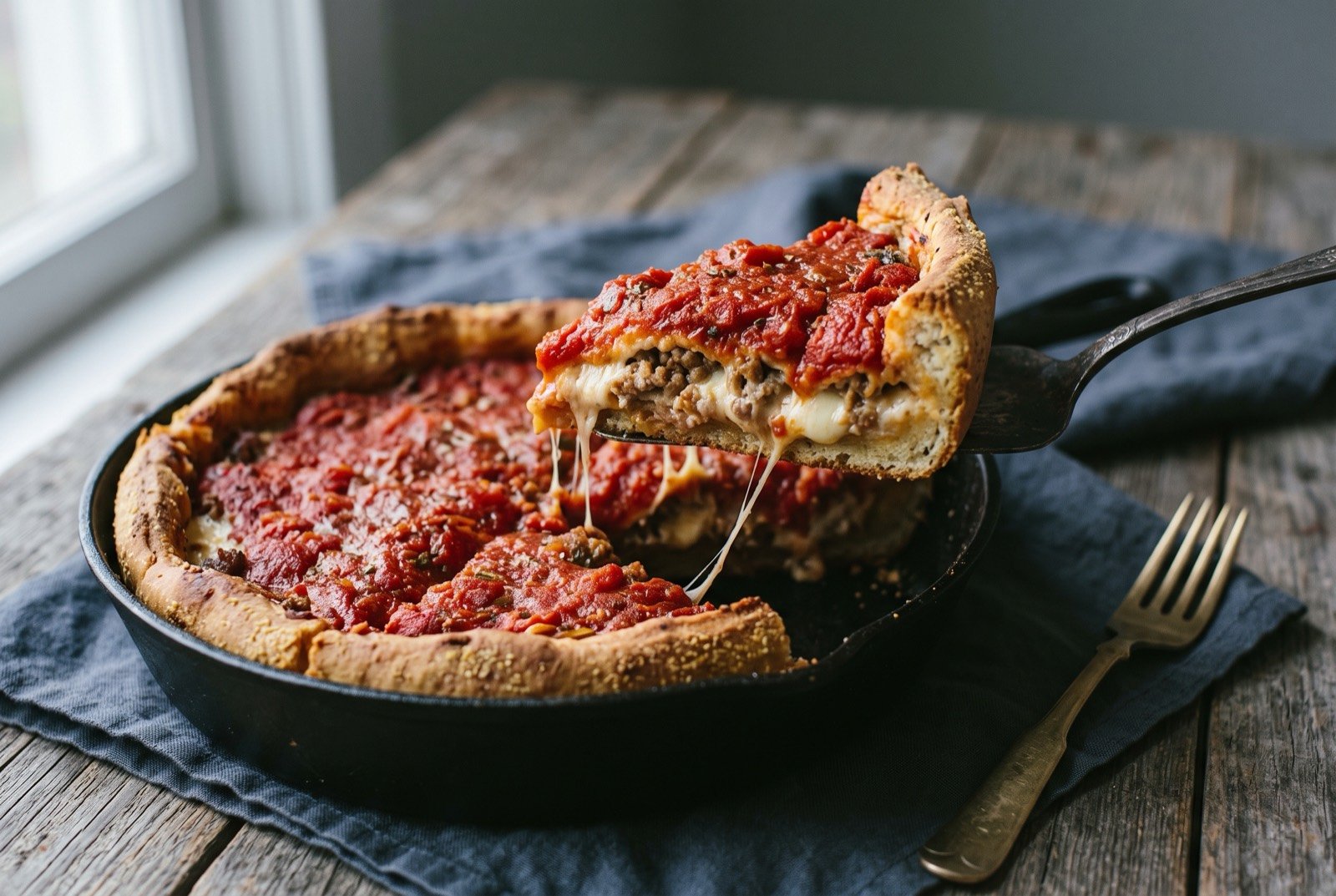
This chapter covers a food world built on two things that do not, at first glance, belong in the same sentence: a corn-and-dairy interior ecology, and roughly a century of Catholic and Lutheran immigrant table-keeping laid directly on top of it. Chicago sits at one end of it as the great immigrant kitchen, a city that took a German-Austrian sausage, a Sicilian idea of what a pie could be, and a Mexican street food, and turned each one into something recognisably its own. Wisconsin and Minnesota sit at the other end as the rural interior, where German brewers, Norwegian and Swedish farmers, Walloon Belgian settlers and Polish Catholics built a table around dairy, freshwater fish and a genuinely difficult, genuinely contested Nordic curing tradition that a churchgoing culture kept alive long after the old country itself grew ambivalent about it. A third, smaller thread runs through the volume's own southwestern corner: Kansas City, whose barbecue tradition was founded, named and carried forward by Black pitmasters and belongs to this chapter by the same logic AM-33 already applies to Carolina and Memphis, and AM-35 will apply to Texas, one regional style, one volume, the others named and cross-linked rather than re-treated. Every dish here as tradition built it, then what a modern chef would change.
Sources and review · What this chapter does not assert · How we research · Spotted something wrong?
A Sense of Place
This volume covers two food worlds that share a lake system and a century of European Catholic and Lutheran immigration but answer to genuinely different logics at the level of the plate, plus a third thread that answers to neither.
The first is the Great Lakes immigrant city, above all Chicago, but reaching out to Milwaukee, Cleveland and Detroit: an urban, industrial, largely Depression-era food economy, built by whichever immigrant community had the cheapest cut, the cheapest wheat, the cheapest fat, and turned it into something a factory worker could eat standing up. Its food is street food and tavern food before it is anything else, and its most famous dishes carry contested, commercially interested origin stories precisely because they were valuable enough, once invented, for more than one family to want the credit.
The second is the rural dairy-and-Nordic interior, Wisconsin and Minnesota above all, reaching into Michigan's Upper Peninsula and Iowa's Czech pocket around Cedar Rapids: a slower, church-and-supper-club food culture, built on dairy cattle, freshwater fish and a set of Central and Northern European traditions, German, Norwegian, Swedish, Polish, Walloon Belgian, Czech, that a wave of nineteenth-century Catholic and Lutheran settlement carried wholesale and then kept, with real fidelity, for a hundred and fifty years.
| Structural role | The Great Lakes immigrant city | The rural dairy-and-Nordic interior |
|---|---|---|
| Starch | Wheat flour, laminated pizza dough, the poppy seed hot dog bun | Riced potato (lefse), cornmeal (hot dish, goetta) |
| Fat | Rendered beef and pork, olive oil, butter in the pizza dough | Butter and cream, the whole logic of a dairy economy |
| Protein | Beef (Italian beef, the hot dog), pork sausage | Freshwater and lake fish, cheese, bratwurst |
| Defining historical event | The 1893 World's Columbian Exposition and the Great Depression's street-food economy | Catholic Lenten fasting and Lutheran church-supper fundraising |
| Signature institution | The tavern and the hot dog stand | The supper club and the church basement |
A third thread runs through the volume's own southwestern edge: Kansas City, sharing the interior's corn-and-cattle ecology but organised by an entirely different history, a barbecue tradition founded, named and carried forward specifically by Black pitmasters descending from one man's pit, Henry Perry's, in the same way this atlas has already given Carolina and Memphis their own full treatment in AM-33 and will give Texas brisket its own in AM-35. Kansas City's sweet, tomato-based sauce sits in this volume as its own regional style, named and compared against, not repeated from, its sibling volumes.
The History in Layers
An agricultural inheritance this chapter does not re-treat
Before any of the immigrant layers below arrived, this land was already a Three Sisters agricultural world, corn, beans and squash intercropped and cooked together, and a hand-harvested wild rice, manoomin, economy specific to the Ojibwe and other Great Lakes Anishinaabe nations, gathered by canoe with a push pole and knocking sticks on natural lake stands under licensing rules that, in Minnesota today, still require the traditional method. That inheritance belongs in full to Volume AM-30, Woodlands, Plains and Southwest Indigenous Foodways, and this chapter does not re-research or re-narrate it. What this chapter does say plainly, because the two products are commonly confused under one shared English name: the commercial "wild rice" in a settler dish like tater tot hot dish's wild-rice variant is a paddy-cultivated, mechanically harvested cultivar developed through University of Minnesota breeding work from the 1970s onward, genetically the same Zizania species but agriculturally and culturally a different product from hand-harvested lake rice. [Environment & Society Portal, Manoomin: The Taming of Wild Rice in the Great Lakes Region](https://www.environmentandsociety.org/arcadia/manoomin-taming-wild-rice-great-lakes-region)
Catholic fasting, and how a religious rule became a secular institution
Wisconsin's Friday fish fry is well and consistently documented as originating in Catholic Lenten fasting discipline among the state's large nineteenth-century German and Polish immigrant Catholic population, who from the 1860s onward settled thickly around Milwaukee and turned the church's Friday meat abstinence into a fish-eating custom the state's own lakes could cheaply supply, walleye, yellow perch and bluegill from inland waters, lake trout and whitefish from the Great Lakes themselves, with Atlantic cod arriving later as frozen distribution matured. Prohibition gave the custom a second, entirely secular push: with alcohol sales illegal, Wisconsin taverns turned to selling cheap fried fish plates, sometimes reportedly given away nearly free alongside a purchased beer, to keep the till moving. When the Catholic Church relaxed year-round Friday meat abstinence in the mid-1960s, retaining it only through Lent, "going out for fish" on a Friday had already become secular, statewide, everyday Wisconsin practice rather than a strictly religious one. [Travel Wisconsin, A Brief History of the Wisconsin Fish Fry](https://www.travelwisconsin.com/stories/a-brief-history-of-the-wisconsin-fish-fry)
The same immigrant wave built the supper club, an evolution of an after-church German social gathering, formalising over the twentieth century into a rural or small-town establishment built for a full slow evening, a relish tray and a brandy old fashioned on arrival, a fixed weekly rotation of specials, Friday fish, Saturday prime rib, Sunday broasted chicken. Roughly 250 to 450 Wisconsin restaurants still operate under the name today, and the Wisconsin Historical Society credits the supper club specifically with introducing the doggie bag into American dining culture. [Wisconsin Academy of Sciences, Arts and Letters, Supper Club State](https://www.wisconsinacademy.org/magazine/supper-club-state)
A Chicago pie, and who actually invented it
Deep-dish pizza's official origin story, that Ike Sewell and Ric Riccardo Sr opened Pizzeria Uno in December 1943 and invented the style together, is the version told on the restaurant's own materials and repeated across most tourist-facing writing. The most rigorous published investigation into it, by independent historian Peter Regas after twelve years of archival research into property records, partnership filings and city directories, tells a considerably more complicated story: Sewell most likely held no ownership stake when the restaurant opened, only becoming a partner after the fact, while Rudy Malnati Sr, credited by his family's popular telling, was in Regas's account the pizzeria's third manager, with no employment record placing him there before 1951. Regas's strongest documented candidate for the actual recipe is Ric Riccardo himself, an Italian-American artist who lived above the restaurant and most likely developed the dish in late 1943, with a cook named Alice Mae Redmond further reworking it in the mid-to-late 1940s before going on to help found a rival, Gino's East. [Culinary Historians of Chicago, Pizzeria Uno and the Mysterious Origins of Deep-Dish Pizza](https://culinaryhistorians.org/the-origins-of-deep-dish-pizza-whats-true-whats-false-and-whats-arguable/) This chapter states the dispute rather than repeating the marketing version as settled history, and it is worth adding the fact most tourist writing leaves out entirely: despite deep-dish's fame, most Chicagoans, most of the time, eat thin, cracker-crisp "tavern-style" pizza cut into small squares, a post-Prohibition invention built for handing round a bar on a napkin, no plate required.
The immigrant street kitchen: a hot dog, a sandwich, and the ethnic layering neither one can fully prove
Chicago's food identity was built, in large part, at one event and in its long aftermath. Vienna Beef traces its founding to the 1893 World's Columbian Exposition, where Austro-Hungarian immigrants and brothers-in-law Emil Reichel and Samuel Ladany sold homemade beef sausages from a stand on the fair's Midway Plaisance, staying on afterward to found what became the city's defining hot dog supplier. [WBEZ Curious City, From Vienna Beef To PBR](https://www.wbez.org/curious-city/2019/05/19/from-vienna-beef-to-pbr-five-food-and-drink-legacies-of-the-1893-worlds-fair) The Chicago dog, an all-beef frank on a poppy seed bun, mustard, onion, relish, tomato, pickle, sport peppers and celery salt, no ketchup, is popularly said to carry a topping-by-topping immigrant history, the bun and frank to Central European Jewish bakers and butchers, the relish to British influence, the tomato and pickle to Greek and Italian vendors, sport peppers to either Mexican immigrants or Great Migration arrivals from Louisiana and Mississippi. This chapter states that layered history as commonly told food lore rather than as an archivally sourced claim, because it was not traced to a primary source in this research; what is better evidenced is the no-ketchup rule's most repeated explanation, that vendors selling genuinely good beef had no need to mask it. [WTTW Chicago Mysteries](https://www.wttw.com/chicago-mysteries/mystery/why-dont-chicagoans-put-ketchup-on-their-hot-dogs)
Italian beef carries the same pattern, a strong family origin story sitting alongside real, documented dissent. Al Ferreri and his sister and brother-in-law, Frances and Chris Pacelli Sr, are credited with developing the sandwich in 1938 at a stand in Chicago's Little Italy, a Depression-era stretch, thin-sliced beef made to feed a crowd at Italian weddings, soaked in gravy and served on Italian bread with giardiniera. [Al's own history page](https://www.alsbeef.com/about) Chicago Sun-Times critic Pat Bruno instead traced it to the Los Angeles French dip sandwich of 1918, and a separate account places its invention with an unidentified cook at a Greek-owned Chicago coffee shop around 1948. [Red Sauce America, The History of Chicago's Italian Beef Sandwich](https://www.redsauceamerica.com/blog/the-history-of-chicagos-italian-beef-sandwich/) No version can be proven, and this chapter names all three rather than choosing.
The Belgian, German, Norwegian and Swedish interior
Belgian, and specifically Walloon, French-speaking rather than Dutch-speaking Flemish, settlement is documented in unusual detail for an American immigration story, because the sending country wrote it down: a report by Belgium's own Ministère de la Région Wallonne records more than 15,000 Belgians, largely Walloon, arriving in lower Door County between 1854 and 1855, the direct root of booyah, the region's own vast communal stew, and its name, plausibly derived from the Walloon dialect word bouyon, broth. [Wikipedia, Walloons in Wisconsin](https://en.wikipedia.org/wiki/Walloons_in_Wisconsin)
German immigration to Wisconsin arrived in three major waves between 1845 and 1900; by 1900 the state's German-born population had reached 268,384, roughly ten per cent of Wisconsin's total population and 47 per cent of its entire foreign-born population, and in Milwaukee specifically the concentration was extreme enough that by 1993 52 per cent of the metropolitan area's population still claimed German descent, the highest of any major US metro. [Max Kade Institute for German-American Studies, UW-Madison](https://mki.wisc.edu/ethnic-groups-in-wisconsin-historical-background/) Those Germans founded Milwaukee's brewing dynasties within a single generation, Jacob Best's brewery in 1844, later Pabst; Georg Krug's 1849 operation, later Schlitz under Joseph Schlitz from 1858; Frederick Miller's brewery in 1855. A German-language regional-history source from the Rhineland-Palatinate archive, searched directly for this chapter, adds a layer English-language sources miss entirely: the men who built Pabst, Schlitz and Anheuser-Busch alike came overwhelmingly from that one specific German wine-and-beer region, many trained first as coopers, a detail that sharpens "German brewers" into something much more precise. [Regionalgeschichte.net](https://www.auswanderung-rlp.de/ziele-der-auswanderung/auswanderung-nach-nordamerika/19-jahrhundert/handwerk-bierbrauerei-und-weinbau.html)
Norwegian emigration to North America is conventionally dated from 4 July 1825, when the sloop Restauration sailed from Stavanger; by 1905 more than 250,000 Norwegians lived in Minnesota alone, settling in three distinct waves that MNopedia, the Minnesota Historical Society's own encyclopedia, traces in detail, family farmland-seekers, then rural village-recreators who transplanted entire Old World bygder into specific counties, then, from 1875, urban workers arriving as Norway's own economy modernised. [MNopedia, Norwegian Immigration to Minnesota](https://www.mnhs.org/mnopedia/search/index/norwegian-immigration-minnesota) Swedish settlement built Minneapolis's own Swedish American Institute around the life of Swan Turnblad, a Swedish immigrant publisher who commissioned the châteauesque mansion that later became the museum. [Wikipedia, Swan Turnblad](https://en.wikipedia.org/wiki/Swan_Turnblad)
Lutefisk, and a myth this chapter will not repeat
Lutefisk sits at the emotional centre of the Upper Midwest's Nordic-American identity, and its popular American origin story, that a burning storehouse of dried fish was doused with lye-laden ash and found, afterward, to be edible, is treated even by Norway's own standard encyclopedia, Store Norske Leksikon, as folklore, not documented history. That same source states plainly that lutefisk "has no demonstrable regional origin" within Norway. [Store Norske Leksikon, lutefisk](https://snl.no/lutefisk) Searched directly in Swedish for this chapter, a second complication appears: the earliest documented reference to the dish, from 1555, was written by Olaus Magnus, a Swedish clergyman, and the Swedish source Svenska Högtider argues the preparation technique itself, lye-curing dried whitefish, actually originates in the Netherlands and northern Germany, reaching Scandinavia through medieval Catholic fasting-period fish trade rather than being a native Norwegian invention at all. [Svenska Högtider](https://svenskahogtider.com/2014/12/22/varfor-ater-vi-lutfisk-vid-jul/) Both Norway and Sweden have a long, real culinary claim on the dish; neither has a clean, uncontested one, and this chapter states that honestly rather than picking a side.
What is unambiguous is what the Upper Midwest did with it. Lutefisk suppers at Lutheran churches remain a real, current fundraising institution, not a folk memory: Emmons Lutheran Church in Minnesota has run one for more than 60 years, serving close to 800 guests; Northland Lutheran Church in Waupaca County, Wisconsin, marked its own supper's centennial for a church founded in 1907. [Zeffy, 2025 Emmons Lutheran Church Lutefisk Supper](https://www.zeffy.com/en-US/ticketing/2025-emmons-lutheran-church-lutefisk-supper) The Olsen Fish Company of north Minneapolis, the world's largest lutefisk processor since 1910, still produces roughly half a million pounds a year, though press reporting documents a real, steady decline as the generation most committed to the dish ages and dies, with younger Scandinavian-Americans mostly simply not taking it up, a decline treated as newsworthy in the Minneapolis press precisely because it has become unusual for anyone young to care.
Kansas City: a Black pitmaster's founding, a sweet sauce invented later than the legend suggests
Henry Perry is the acknowledged founder of Kansas City barbecue, arriving in the city in 1907 and selling barbecued meats on its streets from 1908, whole cuts slow-cooked over hickory and oak near what is now the historic 18th and Vine district. [KCUR, Meet Henry Perry](https://www.kcur.org/arts-life/2021-02-13/kansas-city-barbecue-bbq-henry-perry-gates-arthur-bryants-history) Two of his apprentices carried the tradition forward into the city's two oldest surviving barbecue names, Arthur Bryant's Barbeque and Gates Bar-B-Q, both founded in 1946. The dish now most identified with the city, burnt ends, began as a giveaway, the ragged, heavily bark-crusted brisket trim considered unusable for slicing and handed to regulars for free, until food writer Calvin Trillin's 1972 Playboy piece on Arthur Bryant's turned it into a sought-after, paid menu item. [Wikipedia, Burnt ends](https://en.wikipedia.org/wiki/Burnt_ends) A correction worth making plainly: Henry Perry's own sauce was probably thin, vinegary and hot, not sweet; the thick, molasses-and-tomato sauce now understood as Kansas City's defining trait only became dominant from the 1970s onward, via the rise of KC Masterpiece, a comparatively recent development laid over a much older tradition rather than an unbroken century-old style. [America's Test Kitchen, All About Kansas City-Style Barbecue Sauce](https://www.americastestkitchen.com/taste_tests/2551-why-we-love-kansas-city-style-barbecue-sauce)
The modern moment
Chicago's own chef-driven movement, led by Paul Kahan's One Off Hospitality group from the 2000s onward, gave Midwestern charcuterie and whole-animal butchery a serious culinary programme rather than treating it as a novelty, and James Beard Foundation recognition across the wider region in the last decade, Loryn Nalic's Bosnian-rooted Balkan Treat Box in St Louis (2026), Christina Nguyen's Hai Hai in Minneapolis (2024), Jonathon Sawyer's Ohio-farm-driven Trentina in Cleveland (2015), reflects a region whose fine dining increasingly runs on the same immigrant-layering logic as its street food always did. Iliana Regan's Michelin-starred Elizabeth, built entirely on foraged and home-grown Midwestern ingredients, earned her Chicago Magazine's own description, "The Queen of Midwestern Cuisine," the clearest single match this research found for what this volume is actually arguing. [Chicago Magazine, The Queen of Midwestern Cuisine](https://www.chicagomag.com/Chicago-Magazine/August-2015/Iliana-Regan/) Sean Sherman's Owamni, an Indigenous-led restaurant belonging properly to AM-30's subject rather than this chapter's, is worth naming as a live 2026 story regardless: it is relocating into Minneapolis's Guthrie Theater and rebranding as Indígena by Owamni, roughly doubling its footprint.
The Flavour Arsenal
Starches
Wheat flour carries the city half of this volume, the laminated, croissant-style dough of a deep-dish pizza crust, the poppy seed hot dog bun. Riced potato carries the rural half, the base of lefse, where potato moisture content, not the recipe, is the entire variable between success and a dough that tears or cracks. Cornmeal appears twice, dusted into a deep-dish pan for texture, and, further south, as the base of goetta, the German-immigrant pork-and-grain sausage of Cincinnati and Northern Kentucky, substituted for the buckwheat or barley its makers would have used at home.
Fats
Butter and cream define the dairy interior in the most literal sense: Wisconsin has held the title of largest cheese-producing US state continuously since 1910. Rendered beef and pork fat define the city kitchen, the dripping gravy an Italian beef sandwich is served soaked in, the fat a bratwurst releases into its own beer bath.
Proteins
Lake whitefish, now making up roughly 85 per cent of the entire commercial Great Lakes catch by volume, is a fishery in real, documented trouble, Michigan's commercial whitefish catch down roughly 70 per cent since 2009 as invasive quagga and zebra mussels strip the water of the small crustacean the fish once fed on. [Bridge Michigan / Great Lakes Now, Whitefish waning](https://www.greatlakesnow.org/2026/05/27/whitefish-waning-should-michigan-have-commercial-trout-walleye-catches/) Walleye and yellow perch, the fish fry's other two named species, face their own pressure, Lake Erie's yellow perch population down roughly 20 per cent in 2026, the lowest since the mid-1990s. Ojibwe commercial fishing on the Great Lakes rests on real, litigated treaty law rather than custom: the 1837 and 1842 treaties explicitly reserved hunting, fishing and gathering rights on ceded land, rights the state of Wisconsin contested for over a century until the 1983 Voigt decision confirmed them, leading directly to the founding of the Great Lakes Indian Fish and Wildlife Commission, which co-manages treaty fishing today. Fresh cheese curds, the unpressed, unaged solid portion of cheddar caught mid-transformation, squeak against the teeth for only 24 to 48 hours after production, a freshness marker rather than a permanent property. Bratwurst, traditionally pork and veal seasoned with marjoram, ginger, nutmeg and coriander, carries southern German origin directly into Sheboygan, Wisconsin's self-declared "Bratwurst Capital of the World" since 1953.
Aromatics and seasonings
Marjoram is bratwurst's defining spice. Celery salt finishes a Chicago hot dog, tied to the city's own historic celery-growing trade. Molasses and brown sugar thicken and sweeten a Kansas City sauce, a comparatively late twentieth-century addition over an earlier, sharper, vinegar-forward style.
Sweeteners and the wet-harvest crop
Wisconsin cranberries anchor the region's one major fruit crop, nearly 5.5 million barrels in 2024, roughly 61 per cent of the entire US crop, harvested wet, growing beds flooded and mechanically agitated so the berries, each carrying four internal air pockets, float free of the vine. [Wisconsin Farmer, Wisconsin cranberry production](https://www.wisfarmer.com/story/news/2025/08/20/for-over-30-years-in-a-row-wisconsin-has-led-all-state-in-cranberry-production/85719992007/) Ho-Chunk people harvested the same marshland's wild cranberries long before European settlement, and Euro-American settlers were already buying from them by 1829.
The Technique Ladder
The argument, from inside
Six rungs, each a real mechanism specific to this volume's two food worlds, explained by what it is actually doing rather than asserted by reputation.
Rung 1. Reverse the pizza's build order, and understand why the reversal exists
Deep-dish's defining technical feature is cheese laid directly against the raw dough, not the sauce, with a chunky, barely cooked tomato sauce spooned over the very top. This is not decoration: the cheese layer acts as a moisture barrier, stopping the crust turning soggy under the sauce through what is a considerably longer bake than a conventional pizza needs, while the sauce, not the cheese, is what browns and reduces on top. What a cook does with this rung. Build the dough the way a laminated pastry is built, butter folded and rolled into the dough in stages rather than simply creamed in, giving a flaky, structurally strong crust able to hold the weight pressed up the sides of a deep pan; dust the pan itself with cornmeal before the dough goes in, for both colour and genuine textural insurance.
Rung 2. Treat the boil-over as controlled violence, not spectacle for its own sake
The Door County fish boil's signature moment, kerosene thrown on the fire beneath the pot once the fish's released oils rise to the surface, is a sudden, deliberate increase in convective turbulence that carries surface fat and foam over the rim, a genuine skimming mechanism rather than the oil being burned off, even though it began as tourist theatre rather than functional necessity. What a cook does with this rung. A home version without kerosene achieves the same skimming through the same principle: bring the pot to a hard, sudden boil once the fish is in and the fat has visibly risen, rather than a gentle simmer throughout, so the surface turbulence itself carries the fat away.
Rung 3. Poach a fresh sausage before it ever meets direct heat
Sheboygan's own beer-bath bratwurst tradition, poaching the sausage in beer and onions before or after grilling, is a documented twentieth-century Wisconsin invention, not an imported German technique, catalysed specifically by a vendor named Bill Sperling serving beer brats at Milwaukee County Stadium from 1954. The poach brings the interior to temperature gently and evenly; only the final grill needs to deliver colour and casing snap. What a cook does with this rung. Poach the sausage low, never above a bare simmer, until just cooked through, then finish hot and fast for Maillard colour alone, treating the two stages as two entirely separate jobs rather than trying to cook the sausage through on the grill and risking a split casing before the interior catches up.
Rung 4. Understand lutefisk's alkaline cure as controlled chemistry, not a defect to be masked
Dried whitefish, rehydrated over five to six days, then soaked for a further two in a lye solution at a pH of roughly 12 to 13, undergoes real alkaline hydrolysis: the lye breaks the fish's peptide bonds and forms new chemical crosslinks between amino acid chains, which is what produces the dish's distinctive gelatinous, translucent texture, not a soapy off-flavour from insufficient rinsing. What a cook does with this rung. Treat the texture the cure produces as the entire point, chemically closer to what a strong ceviche cure or a century egg does to protein than to ordinary fish cookery, and build the rest of the dish, traditionally butter, white sauce, boiled potatoes, lefse, around complementing that specific texture rather than fighting it.
Rung 5. Build a béchamel by hand, and understand exactly what the tinned version is trying to fake
The entire structural difference between a poor tater tot hot dish and a properly built one is whether the sauce is an actual roux-thickened béchamel, flour and butter cooked out, dairy added gradually and genuinely emulsified, or a canned condensed soup standing in for that step; canned cream-of-mushroom soup is itself a starch-thickened dairy sauce with mushroom flavouring, a béchamel analogue manufactured to a shelf-stable, oversalted formula. What a cook does with this rung. Make the béchamel from scratch, a genuine roux cooked to a pale blond stage before the milk goes in gradually, and understand that doing so is not introducing a foreign French technique, it is doing, deliberately and by hand, the exact operation the tinned product mimics badly.
Rung 6. Glaze Kansas City sauce late, and understand why a thick sauce cannot be a basting liquid
Kansas City's thick, sugar-heavy sauce would scorch and blacken if applied early in a long, high-heat smoke the way a thin Texas mop can be; that is a practical, chemical reason it functions as a late-stage glaze and table condiment rather than a basting liquid worked into the meat throughout the cook, the way Carolina's vinegar-pepper mop or Texas's thin, drippings-based baste are used elsewhere in this atlas. What a cook does with this rung. Smoke the meat low and slow with no sauce at all until close to done, then apply the sauce as a final glaze in the last stretch of cooking or purely at the table, letting the smoke and bark do their own work first rather than masking an undersmoked cut in sweetness.
The Ferment and Preserve Bench
1. Cheddar, from curd to block
Fresh cheese curds are cheddar caught mid-transformation, before pressing and ageing dry out and firm the casein protein network into what becomes a block of cheddar. Named Wisconsin producers ageing that same cheddar for years rather than hours, Hook's Cheese Company's 5, 7 and 10 year cheddars among them, show the other end of the same single process: the same milk, the same starting curd, taken to opposite extremes of time.
2. Lutefisk's lye cure, a preservation technology inverted
Dried stockfish is itself a preservation technology, moisture removed entirely for indefinite keeping; lutefisk's lye treatment then reverses part of that preservation deliberately, rehydrating and chemically transforming the dried fish back toward an eatable, if radically altered, state. It sits in this atlas's ferment-and-preserve tradition as a rare example of a preservation method whose entire modern purpose is ceremonial rather than practical, since refrigeration has long since removed the original need to dry the fish in the first place.
3. Sauerkraut, the everyday German ferment
Long fermented cabbage, brought directly by nineteenth-century German settlement and described by the Wisconsin Historical Society as, alongside beer and bratwurst, simply ubiquitous in the state, appearing equally at a Bavarian-style beer garden and a Lambeau Field car park on a Sunday. Structurally the same lactic-fermentation logic as any cabbage ferment anywhere else in this atlas, worth naming here as this region's own everyday version of a near-universal technique.
Sourcing in Britain
Verified September 2026. Where a supplier could not be fully confirmed, that is said rather than smoothed over.
The ranked list: what decides great from grim
1. Real Great Lakes fish, walleye, yellow perch and lake whitefish, cannot be bought in the UK at all. No retailer stocking any of the three was found. For walleye, the closest genuine substitute is zander (Sander lucioperca), sharing the genus Sander with walleye; The Fish Society lists a dedicated zander collection, though current stock and price could not be confirmed directly. Yellow perch has no honest UK substitute; European perch exists in British waters but only as a recreational catch, not a commercial food fish. For lake whitefish, UK-farmed rainbow trout is the closest workable stand-in, mild, flaky and widely sold smoked. State this gap plainly rather than pretending any UK "whitefish" for sale, a generic marine term for cod and haddock, has anything to do with the Great Lakes species of the same English name. 2. Genuine Wisconsin, or any American, artisan cheese is essentially unavailable in Britain. Jen Grimstone-Jones, a Certified Cheese Professional at The Pangbourne Cheese Shop, is quoted directly saying of American artisan cheeses, "it's impossible to import them." Fresh squeaky cheese curds are the one genuine exception: Batch Farm Cheesemakers, a British creamery, makes a Squeaky Cheese Curd using the same fresh-pressed technique, priced £8.99 to £13.55, and this is a real, working British equivalent rather than an import gap. 3. Real hand-harvested Great Lakes wild rice has no confirmed UK stockist. Sous Chef sells a "Wild Rice 1kg" labelled Origin: USA, but describes the species as Zizania aquatica, not the Great Lakes Zizania palustris, an unresolved discrepancy this chapter does not paper over. What is sold in Britain as wild rice is real wild rice botanically, but is very unlikely to be the specific hand-harvested lake product this chapter describes. 4. Lutefisk cannot be bought in Britain at all, tinned or otherwise. Both ScandiKitchen and Totally Swedish, the UK's two leading Scandinavian specialists, return zero results for it on a direct site search. 5. Sorghum, cornmeal and general regional pantry gaps aside, everything else in this chapter's dish list is genuinely buyable. KC Masterpiece barbecue sauce is available via Amazon UK. German Deli, with a stall inside Borough Market and full online delivery, and The Village Butchers, an online British butcher making a genuinely traditional-recipe bratwurst, both cover the bratwurst and sauerkraut end of the list. Lingonberry products, distinct from lutefisk, are widely and easily available through ScandiKitchen and even IKEA UK.
Everyday ingredients: no real gap
Beef mince, brisket and beef shin are all standard British butcher's cuts. Corn tortilla-style masa is not needed anywhere in this chapter, unlike several Mesoamerican volumes, and every starch used, wheat flour, potato, cornmeal, sits comfortably within normal British baking supplies. Cheddar itself, in an ordinary aged British block, is an entirely honest ingredient for the modernist hot dish, sharing its exact lineage with the Wisconsin curds this chapter cannot import.
Kit
A Big Green Egg, configured for genuine low-and-slow indirect heat, is the closest domestic equivalent to a real Kansas City offset smoker for burnt ends, and doubles for the bratwurst's own high-heat finishing stage. A sous vide setup handles the lutefisk's precise low-temperature cook, the beer brat's even poach, and the burnt ends' brisket stage with a control no stovetop or oven offers reliably. A spice grinder is what the Cincinnati chili's toasted whole spices actually need, and a chinois is what turns that same chili's sauce, or a reduced Kansas City glaze, genuinely smooth.
Voices and Sources
From inside the tradition
- Iliana Regan, chef of the Michelin-starred Elizabeth (Chicago, 2012 to 2020) and now Milkweed Inn in Michigan's Upper Peninsula, described by Chicago Magazine as "The Queen of Midwestern Cuisine," the closest match this research found for an elevated, foraging-led Midwest regional programme. - Jonathan Manyo, chef of Morel in Milwaukee, sustaining a menu of nearly 100 per cent Wisconsin-sourced ingredients for five years running, French sauce technique applied directly to foraged and farmed Wisconsin produce. - Jonathon Sawyer, James Beard Award winner 2015 for Trentina in Cleveland, an Italian-inspired restaurant built explicitly on Ohio farm sourcing, the same argument this atlas makes about elevation, run in reverse. - Sean Sherman, Oglala Lakota, founder of Owamni, relocating and rebranding in 2026 as Indígena by Owamni; his full body of work belongs to Volume AM-30, but his restaurant's live evolution is worth naming as part of this region's current fine-dining landscape. - Peter Regas, independent historian whose twelve years of archival research for the Culinary Historians of Chicago is the strongest single piece of scholarship behind this chapter's deep-dish section. - Calvin Trillin, whose 1972 Playboy piece on Arthur Bryant's turned Kansas City burnt ends from a free giveaway into the city's own signature dish.
Institutions and archives
- The Max Kade Institute for German-American Studies, University of Wisconsin-Madison, and the Wisconsin Historical Society, both genuinely academic sources for the state's German settlement history. - MNopedia, the Minnesota Historical Society's own encyclopedia, and Vesterheim, the National Norwegian-American Museum in Decorah, Iowa, and the American Swedish Institute in Minneapolis, all serious, primary cultural institutions for the region's Nordic settlement. - The Great Lakes Indian Fish and Wildlife Commission (GLIFWC), the tribal body existing because of the 1983 Voigt decision, and the direct source for this chapter's treaty-rights material. - Store Norske Leksikon and Svenska Högtider, Norway's and Sweden's own standard reference sources, read directly in their own languages for this chapter's lutefisk section, materially improving its honesty over what English-language sources alone would support.
The gap, named plainly
No specific, named Michigan or Wisconsin chef doing a documented, elevated version of booyah was found in this research. No specific named Detroit chef or restaurant with a stated programme of elevated Great Lakes regional cuisine, as distinct from simply being a well-regarded Detroit restaurant, could be confirmed. A named Sheboygan sausage maker beyond the general sourcing this chapter draws on could not be independently verified and is not asserted here.
Things this chapter has deliberately not asserted
- That Ike Sewell personally invented deep-dish pizza. The strongest independent archival research favours Ric Riccardo, with Sewell only formalising an ownership stake after the restaurant opened, and Rudy Malnati's own role beginning years later than his family's popular telling claims.
- The specific national origin of each individual Chicago hot dog topping. Repeated consistently across popular food writing, but not traced to a primary or archival source in this research.
- A single settled origin for the Italian beef sandwich. The Al's family account, the French dip theory and the Greek coffee shop story all circulate without one being provable.
- A single Scandinavian nationality for the Door County fish boil's origin. Every source found simply says "Scandinavian settlers" without narrowing further.
- A single settled etymology for "booyah." The Walloon bouyon derivation is the most repeated explanation, but standard French bouillon is an equally plausible direct source, and this chapter has not chosen between them.
- That lutefisk is straightforwardly or exclusively Norwegian in origin. The earliest documented reference was written by a Swedish clergyman, a Swedish source argues the curing technique itself is Dutch or north German in origin, and Norway's own standard encyclopedia states plainly that the dish has no demonstrable regional origin within Norway.
- That the Wisconsin beer-bath bratwurst tradition is an imported German practice. It is a documented twentieth-century Wisconsin invention, catalysed specifically in 1954, layered onto an older German sausage.
- That Kansas City barbecue sauce has always been thick and sweet. Henry Perry's own early sauce was probably thin, vinegary and hot; the now-dominant sweet, tomato-heavy style only rose to dominance from the 1970s onward.
- A single clean national or ethnic label for the Kiradjieff brothers of Cincinnati chili. Sources genuinely conflict between Macedonian, Bulgarian American and Greek, reflecting real, unresolved complexity in Ottoman-era Macedonian identity.
- That any UK retailer currently, reliably stocks real walleye, yellow perch, lake whitefish, genuine Great Lakes hand-harvested wild rice, lutefisk, or any American artisan cheese. None could be confirmed, and each gap is stated as such above rather than papered over.
- That the commercial Great Lakes wild rice used in a settler dish and the Indigenous hand-harvested manoomin tradition are the same product under two names. They share a species and a name, not a production method, a culture or an economy; the Indigenous tradition itself belongs to Volume AM-30 and is not re-treated here. --- Volume AM-36, North America, Not Just Stew. Research briefs: `AM-36-tradition.md` and `AM-36-modernist-sourcing.md`. Sourcing verified September 2026.
Reverse the pizza's build order, and understand why the reversal exists
Deep-dish's defining technical feature is cheese laid directly against the raw dough, not the sauce, with a chunky, barely cooked tomato sauce spooned over the...
Treat the boil-over as controlled violence, not spectacle for its own sake
The Door County fish boil's signature moment, kerosene thrown on the fire beneath the pot once the fish's released oils rise to the surface, is a sudden...
Poach a fresh sausage before it ever meets direct heat
Sheboygan's own beer-bath bratwurst tradition, poaching the sausage in beer and onions before or after grilling, is a documented twentieth-century Wisconsin...
Understand lutefisk's alkaline cure as controlled chemistry, not a defect to be masked
Dried whitefish, rehydrated over five to six days, then soaked for a further two in a lye solution at a pH of roughly 12 to 13, undergoes real alkaline...
Build a béchamel by hand, and understand exactly what the tinned version is trying to fake
The entire structural difference between a poor tater tot hot dish and a properly built one is whether the sauce is an actual roux-thickened béchamel, flour...
Glaze Kansas City sauce late, and understand why a thick sauce cannot be a basting liquid
Kansas City's thick, sugar-heavy sauce would scorch and blacken if applied early in a long, high-heat smoke the way a thin Texas mop can be; that is a...
The dishes
- Chicago Deep-Dish Pizza Chicago, Illinois
- Italian Beef Sandwich Chicago, Illinois
- Door County Fish Boil Door County, Wisconsin
- Fried Cheese Curds Wisconsin
- Booyah Door and Kewaunee counties, Wisconsin
- Sheboygan Beer Bratwurst Sheboygan, Wisconsin
- Lutefisk and Lefse Minnesota and Wisconsin
- Kansas City Burnt Ends Kansas City, Missouri
- Tater Tot Hot Dish Minnesota
- Cincinnati Five-Way Chili Cincinnati, Ohio
Sources and review
- Reviewed
- Not yet reviewed from inside the tradition
- Cooked
- Not yet cooked and reported
Where this volume comes from
3 research briefs on file for this volume, researched to the rules on How we research. Published 3 September 2026. Last changed 8 September 2026.
The brief's own account of its sources
This brief draws on a genuine mix of source quality across both sections, and the split is worth stating honestly. This is a North America volume, so CLAUDE.md's mandatory foreign-language search table (which applies to the African volumes) does not itself require non-English searching here; Section B nonetheless searched directly in Norwegian, Swedish and German, and it mattered, materially changing how the chapter frames lutefisk's origin.