The Americas · Volume 33
Lowcountry, Gullah Geechee and the Deep South
The Rice Coast, the Corridor and the Delta
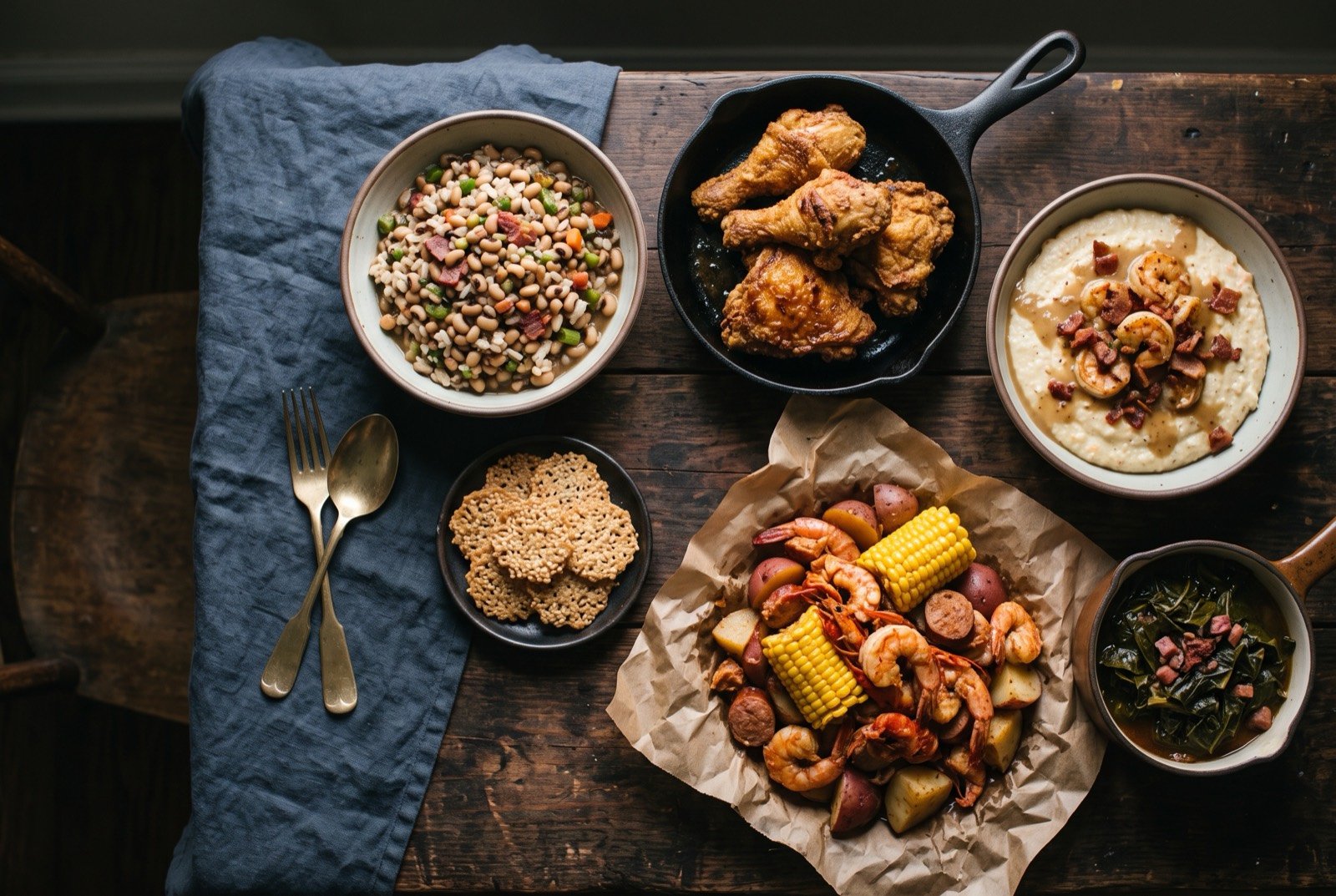
This chapter opens on the coast rather than the interior on purpose. Gullah Geechee cooking is treated here the way this atlas treats any diaspora foodway with a direct, traceable technical lineage: as its own subject, not as a regional flavour of a wider category called "soul food." The rice that built the Lowcountry's antebellum wealth was grown with knowledge carried specifically from West Africa's own Rice Coast, the same coastline this atlas has already covered in Volume AF-01, Senegal and Gambia, and Volume AF-02, Guinea, Sierra Leone and Liberia. The fanner basket that winnows Carolina Gold rice today is not a resemblance to a Senegambian tool. It is the same tool. Beyond the Sea Islands, the chapter widens into the interior Deep South and the Mississippi Delta, a second, related but distinct table, soul food as a named political act of the 1960s laid over a much older cooking tradition, and a genuinely under-known piece of food history in the Delta's own Mexican-Black hot tamale line. Running through both halves is an argument this chapter does not soften: contemporary Charleston fine dining's rediscovery of this food has, by the account of its own Black historians, too often credited the wrong hands. Every dish as tradition built it, then what a modern chef would change.
Sources and review · What this chapter does not assert · How we research · Spotted something wrong?
A Sense of Place
This volume covers two food worlds that share a national border and a plantation-economy history but very little else at the level of the plate, and it treats them as two rather than collapsing one into the other.
The first is the Lowcountry and Gullah Geechee coast: the tidal marsh and barrier-island ecology running roughly from Wilmington, North Carolina, down through coastal South Carolina and Georgia to northern Florida, the exact stretch the federally designated Gullah Geechee Cultural Heritage Corridor now covers. [NPS, Gullah Geechee Cultural Heritage Corridor](https://www.nps.gov/places/gullah-geechee-cultural-heritage-corridor.htm) This is a rice ecology before it is anything else: brackish tidal rivers whose twice-daily rise and fall were harnessed, by enslaved engineers, to flood and drain rice fields on command. Its people are the Gullah Geechee specifically, descendants of enslaved West and Central Africans who, isolated on Sea Islands under a uniquely intense and uniquely long plantation regime, retained unusually strong continuities with African language, craft and cooking. Gullah, the creole language itself, is still spoken today, not merely remembered.
The second is the wider interior Deep South and the Mississippi Delta: inland South Carolina and Georgia, Alabama, Mississippi and the Delta specifically, and western Tennessee. This is drier, flatter, cotton and hog country rather than rice and tidewater, and its food culture runs on a different clock, reaching a defining moment not under plantation slavery but a century later, in the political vocabulary of the 1960s, when "soul food" became a name.
| Structural role | Lowcountry and Gullah Geechee coast | Interior Deep South and Delta |
|---|---|---|
| Starch | Carolina Gold rice, grown in a one-pot pilau tradition | Cornmeal and biscuit flour, cornbread and cathead biscuits |
| Fat | Pork fat, historically rendered at the household level | Pork fat and lard, the same source, a drier kitchen |
| Vegetable base | Okra, its own mucilage the thickener | Collard, mustard and turnip greens, simmered with pork |
| Protein | Shrimp, blue crab, oysters from the tidal marsh itself | Fried chicken, catfish, increasingly farmed rather than wild |
| Defining historical event | Enslaved rice engineering, 1690s to 1865 | The Great Migration, 1910 to 1970, and the Black Power movement's 1960s naming of "soul food" |
A single ethnic and cultural map does not serve both halves honestly. The Gullah Geechee are a specific, named people with a living language and a federally recognised heritage corridor; the interior Deep South's Black foodways are shared, contested and argued over even by the historians who study them, as the naming debate below shows. This chapter gives each half its own weight rather than forcing one table.
The History in Layers
Rice as imported knowledge, not imported seed
Two rice species were theoretically available to Carolina's earliest colonists: African rice, Oryza glaberrima, and Asian rice, Oryza sativa. Colonists themselves believed their rice was of African origin, and a widely repeated story has a storm-damaged ship from Madagascar limping into Charleston harbour in 1685, leaving behind a small quantity of seed rice. [S.C. Sea Grant Consortium](https://www.scseagrant.org/african-roots-carolina-gold/) That story has no documentary source behind it and this chapter treats it as folk etymology, not history. What is not disputed is that Oryza glaberrima did cross the Atlantic with enslaved people, confirmed when French botanists recovered African rice varieties growing in Cayenne, French Guiana, in the 1930s. [PLOS One](https://journals.plos.org/plosone/article?id=10.1371%2Fjournal.pone.0203508) But the rice sold today as Carolina Gold is botanically Oryza sativa, first documented as a distinct variety in South Carolina in the 1780s, a century after the earliest plantings.
The resolution most historians now favour is that the essential imported technology was knowledge, not literal seed stock. West Africans from the Rice Coast possessed millennia of expertise growing rice under tidal, inland-swamp and rain-fed conditions that European colonists simply did not have, and planters explicitly sought out "skilled Africans from the Rice Coast above all others" from the 1720s onward, paying a premium for them. [S.C. Sea Grant Consortium](https://www.scseagrant.org/african-roots-carolina-gold/) Judith Carney's Black Rice: The African Origins of Rice Cultivation in the Americas (Harvard University Press, 2001) is the dominant scholarly framework for this argument, inverting a conventional narrative that credited Europeans with directing the industry. It is not, however, unchallenged: in 2010 David Eltis, Philip Morgan and David Richardson published a substantial critique in the American Historical Review, arguing there is no solid evidence Carolina planters preferentially bought or valued enslaved people specifically for rice expertise, and that Carney understates English hydraulic-engineering knowledge. [Eltis, Morgan and Richardson, American Historical Review 115.1](https://academic.oup.com/ahr/article-abstract/115/1/151/15637) This chapter states the safer version: West African cultivation knowledge as the essential technology transfer is well evidenced; the specific claims about preferential purchasing and the balance of credit for irrigation design remain a live historians' argument, not settled fact.
The tidal rice economy, and its collapse
By the mid-nineteenth century more than 75,000 acres of Lowcountry land were under rice, yielding around 160 million pounds a year; on the eve of the Civil War South Carolina produced roughly 70 per cent of the nation's rice crop. [S.C. Encyclopedia, Rice](https://www.scencyclopedia.org/sce/entries/rice/) Emancipation removed the unpaid labour the tidal system depended on. Output fell from almost 120 million pounds in 1859 to about 30 million pounds by 1889, a roughly 75 per cent decline. A run of destructive hurricanes struck the coast between 1893 and 1911, wrecking the earthen banks, trunks and dikes that tidal cultivation needed, with no captive labour force left to rebuild them; upstream cotton farming silted the rivers, and mechanised rice production on the flat, dry fields of Louisiana, Texas and Arkansas, terrain the marshy Lowcountry could not offer a machine, finished the industry off. By 1919 South Carolina's rice production had collapsed to about 4 million pounds, roughly 3 per cent of its antebellum peak. [S.C. Encyclopedia, Rice](https://www.scencyclopedia.org/sce/entries/rice/) Commercial cultivation of Carolina Gold effectively ended by the Great Depression, and did not return for six decades.
Revival, with names and dates
In the mid-1980s, South Carolina ophthalmologist and duck hunter Dr Richard Schulze sourced 14 pounds of viable seed from Charles N. Bollich at the USDA Rice Research Laboratory in Beaumont, Texas, and planted it at his Turnbridge Plantation in Hardeeville. In 1988 Clemson entomologist Merle Shepherd founded the Carolina Gold Rice Foundation to formalise preservation. [Post and Courier](https://www.postandcourier.com/news/special_reports/nav-3/saving-carolina-gold-rice-first-revival/article_0e328fd9-2e52-41f5-98c7-1d1f8d8572ef.html) A decade later, in 1998, Glenn Roberts founded Anson Mills in Columbia, South Carolina, funding it by selling most of his possessions, explicitly to repatriate lost foods of the antebellum and colonial Southern pantry; his first real Carolina Gold harvest came in 2000. [Food Republic](https://www.foodrepublic.com/2015/04/06/anson-mills-boss-glenn-roberts-is-the-guy-to-know-for-heirloom-grains-in-america/) Roberts is now president of the Carolina Gold Rice Foundation as well as Anson Mills' owner, and Anson Mills manages heirloom grain fields across Georgia, North and South Carolina and Texas with over 30 growers. Current plantings are growing roughly 10 per cent a year, though the centre of gravity has shifted north: a North Carolina operation, Tidewater Grain Company, is now the largest single grower of the variety globally, while the Lowcountry itself sustains a much smaller acreage, around 149 acres of pure heirloom Carolina Gold, largely for specialist mills. [Post and Courier](https://www.postandcourier.com/news/special_reports/nav-3/saving-carolina-gold-rice-race-against-time/article_87760e91-cb83-4ef1-8a59-aa395f3b20fc.html)
Gullah Geechee culture: living, not historical
The Gullah Geechee Cultural Heritage Corridor was designated a federal National Heritage Area by act of Congress on 12 October 2006, sponsored by Congressman James E. Clyburn, running roughly 12,000 miles of coastal land and waterway from Pender County, North Carolina, to St. Johns County, Florida. [NPS](https://www.nps.gov/places/gullah-geechee-cultural-heritage-corridor.htm) Gullah, an English-lexified creole that developed among enslaved West and Central Africans on Lowcountry rice plantations in the eighteenth century, is a living, if endangered, language: Lorenzo Dow Turner's 1949 study Africanisms in the Gullah Dialect documented over 300 African-language loanwords still in use, and current estimates put roughly 5,000 people still speaking Gullah, with as few as 300 estimated true first-language speakers as of 2021.
This is not a settled, historical inheritance. Hog Hummock on Sapelo Island, Georgia, is the last intact historically Gullah Geechee community on a Georgia sea island, and its land is under active pressure today. In September 2023 the McIntosh County Commission voted to rezone Hog Hummock, more than doubling the maximum permitted house size, against overwhelming community opposition fearing it would price out descendants of families who have held the land for generations; litigation followed, and in October 2025 the Georgia Supreme Court ruled unanimously in the residents' favour. [CNN](https://www.cnn.com/2023/09/13/us/sapelo-island-zoning-gullah-geechee/index.html); [Georgia Public Broadcasting](https://www.gpb.org/news/2023/10/19/hogg-hummock-residents-challenge-zoning-in-court/) The underlying mechanism repeats across the whole Corridor: communal "heirs' property" inheritance, which made Gullah Geechee families among the first African-descended landowners in North America at scale, is now exploited by developers through partition-sale lawsuits and delinquent tax auctions, since any single heir, or a purchaser of one heir's fractional share, can force a sale of the whole parcel. On Hilton Head Island, once a Gullah stronghold, Gullah-descended residents now make up less than 6 per cent of the population. [Wake Forest Law Review](https://www.wakeforestlawreview.com/2021/04/the-gullah-geechee-struggle-to-preserve-ancestral-lands-why-heirs-property-ownership-is-displacing-local-communities-along-the-southeastern-shores/) This is directly a foodways crisis: it is the loss of the land base that sustains subsistence fishing, oystering and small-plot cultivation of rice, benne and okra, not a distant land-rights footnote.
Fried chicken, and how much of its history is actually settled
The standard scholarly synthesis, made directly by historian Adrian Miller, holds that fried chicken emerged as a fusion: Scottish settlers brought a tradition of frying poultry in fat rather than roasting or boiling it, while enslaved West African cooks running plantation kitchens supplied the seasoning, battering and deep-frying technique that made the dish distinctive. [Adrian Miller, BBC Travel](https://adrianemiller.com/check-out-my-fried-chicken-%F0%9F%8D%97-article-for-bbc-travel/) The Smithsonian repeats this account of Mary Randolph's 1825 The Virginia Housewife, the first printed fried chicken recipe in America, noting Randolph, a white plantation-owning author, is credited historically only because she wrote it down, when "enslaved kitchen workers... perfected the dish." [Smithsonian Magazine](https://www.smithsonianmag.com/smart-news/first-printed-fried-chicken-recipe-america-180963854/)
This synthesis has a real, checkable challenge, though not from a peer-reviewed source. A self-published critic has argued that flour-dredge-and-fry-in-fat technique already appears in seventeenth and eighteenth century English cookbooks predating Randolph's recipe, and that Abby Fisher's 1881 What Mrs. Fisher Knows About Old Southern Cooking, written by a formerly enslaved South Carolina-born woman and one of the first cookbooks published by a Black American, gives a fried chicken recipe seasoned only with salt and pepper, cutting against a distinctively African seasoning contribution at that date. This chapter holds the honest middle position: that enslaved cooks did the labour, held the skill and controlled Southern plantation kitchens is well evidenced; that a specifically African seasoning tradition, as opposed to labour and technical control, produced the dish's characteristic flavour is thinner ground, and Abby Fisher's own plain recipe does not straightforwardly support the elaborate version of that story.
What is exceptionally well documented is Gordonsville, Virginia, the "Chicken Bone Express." From the mid-nineteenth century, formerly enslaved and free Black women, "waiter carriers," sold fried chicken, biscuits and pies to train passengers at the platform, since early trains had no dining cars; many of these women achieved documented financial independence and property ownership through the trade. Once dining cars existed, Jim Crow barred Black passengers from them, and Black travellers developed the "shoebox lunch," cold fried chicken fried hard in heavy grease to survive the heat, packed for a long, segregated journey. [HMDB historical marker](https://www.hmdb.org/m.asp?m=295832); [29News](https://www.29news.com/2025/11/03/we-people-women-who-made-gordonsville-fried-chicken-capital-world/)
Soul food: a name, dated precisely, laid over an older cuisine
Adrian Miller's Soul Food: The Surprising Story of an American Cuisine, One Plate at a Time (2013, James Beard Foundation Book Award for Reference and Scholarship, 2014) traces "soul food" to the Black Power movement of the mid-1960s, building on a "soul" vocabulary already circulating a decade earlier in Black jazz musicians' language for a gospel-rooted sound white musicians could not easily imitate; as Black Power took hold as identity politics, the word extended to food, "a line of demarcation between white Southern culture and Black culture." [Chicago Reader](https://chicagoreader.com/blogs/seeing-the-soul-food-in-american-cuisines-mirror-with-author-adrian-miller/) Toni Tipton-Martin, author of the James Beard Award-winning The Jemima Code and Jubilee (2019), pushes back against letting the term stand in for the whole of Black Southern cooking, arguing two centuries of Black cookbook authors reflect "immensely broad culinary interests" the 1960s political label tends to erase. [LA Review of Books](https://lareviewofbooks.org/article/beyond-soul-food/) Michael Twitty, whose The Cooking Gene (2017) won the James Beard Book of the Year in 2018, rejects the binary altogether: soul food is "the memory cuisine of the great and great-great-grandchildren of enslaved people," and "Southern is soul and soul even outside of the South is Southern." [Michael Twitty, "Southern or Soul?"](https://afroculinaria.com/2016/08/11/southern-or-soul/) This chapter treats "soul food" as a real, dateable act of naming applied retroactively to a much older cooking tradition, while being honest that its own leading Black historians disagree about how sharp the line to "Southern food" actually is.
The Mississippi Delta hot tamale, and a genuine cross-pollination
Mexican labourers, many displaced by the Mexican Revolution of 1910 to 1920, came to the Mississippi Delta in significant numbers in the early twentieth century as cotton labour; a Catholic priest in Clarksdale reported roughly 5,000 "Mexicans" picking cotton on Delta plantations by the autumn of 1925. [Southern Foodways Alliance](https://www.southernfoodways.org/interview/hot-tamales-the-mississippi-delta/) Delta sharecroppers, working alongside them, adopted tamales because they were portable, spicy and could be prepared ahead for a quick meal in the cotton fields. The Great Depression ended significant Mexican migration into the Delta, but the tamale remained, carried forward specifically by the Black community: "today, African Americans in the Delta are the primary keepers of the tamale-making tradition." The Delta tamale differs from a Mexican one in real, specific ways: cornmeal rather than nixtamalised masa, simmered or boiled rather than steamed, smaller, and considerably spicier, usually with cayenne. Robert Johnson recorded "They're Red Hot" in 1936, and musical references to hot tamales go back to at least 1928, indicating the dish was a recognisable Delta cultural marker well before mid-century.
The Great Migration, and where this food went
Roughly six million Black Southerners moved north between 1910 and 1970, and soul food restaurants proliferated in Chicago, Detroit, New York and Philadelphia as migrants carried recipes and technique with them. Isabel Wilkerson's The Warmth of Other Suns (2010) describes migrants' departure coolers "packed with lunches, sandwiches, cold fried chicken, delicate deviled eggs and buttery pound cake," corroborating the shoebox-lunch tradition directly. [Wikipedia](https://en.wikipedia.org/wiki/The_Warmth_of_Other_Suns) The best-documented named case of the Migration producing an urban soul food institution is Sylvia's Restaurant of Harlem: Sylvia Woods moved from Hemingway, South Carolina, to Harlem in 1944 to escape Jim Crow, and opened Sylvia's in 1962, its founding moment coinciding with "soul" becoming a mainstream cultural term. [Wikipedia](https://en.wikipedia.org/wiki/Sylvia's_Restaurant_of_Harlem)
Fanner Baskets, Tidal Trunks and Mortar-Pounded Rice: the West African Rice Coast, Named Precisely
This section exists because the atlas's own rule, that a shared history is content rather than a problem to route around, is nowhere more concretely true than here. Volume AF-01, Senegal and Gambia, and Volume AF-02, Guinea, Sierra Leone and Liberia, already cover the African side of exactly this coast. What follows are the specific, nameable continuities, not a general gesture at "African roots."
Tidal irrigation and hydraulic engineering. Carolina and Georgia tidal rice cultivation depended on an intricate system of earthen levees, dams, dikes, floodgates and drains harnessing the rise and fall of tidewater rivers, cleared and built by enslaved labourers. "Rice trunks," the wooden sluice-gate boxes set into the dikes, are believed by the contemporaneous planter and historian David Doar to derive their name and design principle from the tree-trunk plugs used in West African mangrove-swamp rice fields; Judith Carney herself described the resulting Carolina mechanism as "the hybridized product of both African and European inventiveness," a fair, appropriately hedged claim rather than a one-sided one. [S.C. Encyclopedia, Rice Trunks](https://www.scencyclopedia.org/sce/entries/rice-trunks/)
Fanner baskets, the single clearest one-to-one transfer in this entire volume. Enslaved Africans from Senegambia, the Mano River region of Sierra Leone and Liberia, and Angola-Congo brought the West African technique of coiled sweetgrass basket-making. The wide, shallow fanner basket used to winnow rice, tossing threshed grain in the air so wind carries off the chaff while the heavier grain falls back, is documented as common to both Senegambia and the Lowcountry. Fanner baskets are still made and used in Sierra Leone today; the National Museum of African American History and Culture holds a rice fanner basket made in Senegal specifically as a comparandum piece. Sweetgrass basket-making by Gullah artisans, centred on Mount Pleasant, South Carolina, remains a living, generationally transmitted craft directly descended from this rice-processing tool. [NMAAHC](https://nmaahc.si.edu/object/nmaahc_2014.96.2); [S.C. Encyclopedia, Lowcountry Baskets](https://www.scencyclopedia.org/sce/entries/lowcountry-baskets/)
Mortar-and-pestle hulling. Hand-pounding paddy rice in a wooden mortar to loosen and remove the husk is the traditional method across West Africa, and was the method used on Lowcountry plantations before mechanised mills, performed above all by enslaved women. This maps directly onto mortar-and-pestle grain processing documented across Senegambia and the Guinea coast in the earlier African volumes.
Benne, the same seed, the same word. "Benne" is a West African word for sesame, most often traced to the Mende language of Sierra Leone. Enslaved West Africans carried sesame seeds across the Atlantic and grew benne in personal garden plots on Lowcountry plantations; plantation owners also grew it commercially for oil, a cheaper substitute for imported olive oil. [Charleston County Public Library](https://www.ccpl.org/charleston-time-machine/benne-seeds-lowcountry) A reader of AF-01 or AF-02 who has already met sesame in a Senegambian or Sierra Leonean stew is meeting the same seed here under its own preserved African name, not a coincidental parallel.
Three named dishes, one lineage. Hoppin' John, peas-forward; Charleston red rice, a tomato-forward version of the same one-pot rice cookery explicitly linked by Lowcountry food writers to Senegambian thieboudienne; and purloo or perloo, the broader umbrella name for the one-pot rice-and-whatever family, structurally the same pilaf tradition found across the whole Rice Coast. [Wikipedia, Charleston red rice](https://en.wikipedia.org/wiki/Charleston_red_rice) Three distinguishable dishes, one traceable ancestor.
The Flavour Arsenal
Starches
Carolina Gold rice. A medium-grain, aromatic, non-glutinous Oryza sativa, historically husked by hand and, once mechanised, by steam-powered pounding mills. Grown today in far smaller volume than its antebellum peak, and concentrated among a handful of named growers and mills (see Sourcing below). A reader working with genuine Carolina Gold should expect a fluffier, more distinctly flavoured grain than a supermarket long-grain rice, with a starch profile suited to absorbing broth rather than staying separate.
Cornmeal. The Deep South's divide between white and yellow cornmeal, and between sugared and unsugared cornbread, is widely described as carrying real social and regional meaning, though this chapter did not find a single authoritative source pinning the exact racial and class lines of that divide, and states the claim no more strongly than that. Stone-ground cornmeal, coarser and more flavourful than industrially milled meal, is what serious grits and cornbread both want.
Proteins
Blue crab, shrimp and oysters, drawn straight from the tidal marsh, are the coastal protein base; wild-caught South Carolina and Georgia shrimp is now a certified, branded product, "Buy Wild American Shrimp," specifically because imported farmed shrimp has captured the majority of the US market and mislabelling in restaurants is severe. [americanshrimp.com](https://americanshrimp.com/about-our-shrimp/buy-american/) Country ham, dry salt-cured and aged six months to over a year, developing a proteolytic, concentrated flavour comparable to prosciutto, is the interior's defining cured protein, distinct from wet-cured, rapidly processed "city ham." [Wikipedia, Country ham](https://en.wikipedia.org/wiki/Country_ham). Catfish, once a wild river fish, became the basis of a major farmed aquaculture industry centred in the Mississippi Delta from the 1960s onward.
The vegetable base
Okra, both a vegetable and, through its own mucilage, a thickener: the word "gumbo" itself derives from Bantu words for okra, ki ngombo, most directly traced to Kimbundu or Umbundu, languages of Angola. [VOA](https://learningenglish.voanews.com/a/many-food-names-in-english-come-from-africa/4236534.html) But "gumbo" as a named, roux-based dish belongs properly to Louisiana Creole cooking, home to Volume AM-32. That chapter's own research is worth citing back here rather than assuming: it distinguishes gumbo févi, the okra-thickened gumbo, from gumbo z'herbes, the Lenten greens gumbo, and finds no source tying either dish, as a named recipe, to one specific documented West African antecedent, only a shared root word and a wider category. AM-32 states plainly that the sourced West African connection runs through that shared word and category, not a recipe-to-recipe lineage, exactly the caution this chapter also takes below. What this volume has, independently documented, is Lowcountry okra soup, a tomato-based soup thickened by the okra's own mucilage rather than a French roux, the Gullah Geechee, rouxless cousin of gumbo. [Carolimas](https://www.carolimas.com/okra-soup-vs-gumbo-a-lowcountry-perspective) Collard, mustard and turnip greens, simmered long with pork, yield pot likker, the cooking liquor itself, widely but not always rigorously sourced as carrying more of the greens' nutrition than the leaves left behind.
Seeds and aromatics
Benne (sesame), the West African seed described above, ground for wafers or worked into savoury cooking; Sea Island benne is a tan, hulled heirloom strain with a stronger, nuttier flavour than commodity sesame. Field peas and black-eyed peas, cowpeas domesticated in West Africa, the Hoppin' John base. The holy trinity of the interior kitchen, onion, celery and bell pepper, is a Louisiana-adjacent formulation more than a strict Lowcountry one; the Lowcountry's own aromatic base runs closer to onion, garlic and the vegetable itself doing the work.
Sweeteners
Sorghum syrup, pressed and boiled from sorghum cane, is the interior South's traditional sweetener, distinct in flavour from molasses or golden syrup, a genuine UK sourcing gap discussed below. Pecans, Georgia's defining nut crop by the 1950s and still typically a third of US national production, carry a canonical pie tradition that this chapter is careful not to overstate as ancient: the earliest documented pecan pie mention is 1886, but its national canonisation is squarely a 1930s Karo corn syrup marketing campaign, not a colonial or antebellum dish. [Slate](https://slate.com/news-and-politics/2022/11/pecan-pie-history-karo-corn-syrup.html)
The Technique Ladder
The argument, from inside
Six rungs, each a real Lowcountry or Deep South mechanism, explained by what it is doing, not asserted by reputation.
Rung 1. Cook rice as a one-pot pilau, not a boil-and-drain side
Hoppin' John, red rice and purloo are all structurally the same West African one-pot pilau tradition: rice cooked in its own seasoned liquid, absorbing flavour as it absorbs water, rather than boiled separately and combined afterwards. What a cook does with this rung. Toast the rice briefly in rendered pork fat before adding liquid, exactly as the tradition does, so the grain's surface starch sets slightly and the finished dish holds separate, distinct grains rather than a mush. Measure liquid to rice by absorption, not by a fixed boil-and-drain timer, since Carolina Gold's specific starch profile behaves differently from a supermarket long-grain.
Rung 2. Treat okra as its own thickener, not a bland vegetable waiting for a roux
Okra's mucilage, the sticky compound released when it is cut and cooked, is a genuine, self-sufficient thickening mechanism, entirely separate from the flour-and-fat roux that defines Louisiana gumbo. What a cook does with this rung. Slice okra thinly and add it earlier rather than later in a soup's cooking time, giving the mucilage time to release and thicken the liquid on its own terms; resist the instinct, trained by French technique, to reach for a roux as well, which mutes rather than compliments okra's own thickening. A dehydrator can concentrate sliced okra into a powder that thickens without any of the vegetable's characteristic sliminess, a genuine modern option with no claimed tradition behind it, offered here as an idea the reader's kit makes possible.
Rung 3. Brine, then fry, understanding what each stage is actually doing
Sean Brock's own published fried chicken method, a twelve-hour sweet tea brine, a five-fat frying medium, and a lidded cast iron skillet, is a real, citable technique built from years spent researching antebellum-era method. [The Splendid Table](https://www.splendidtable.org/story/2019/10/28/fried-chicken-from-sean-brocks-south) The brine seasons the meat through and keeps it moist under high heat; the lidded skillet traps steam early in the cook, helping the interior finish gently while the exterior crusts. What a cook does with this rung. Brine overnight in a sweetened, salted tea rather than a plain saltwater brine, for genuine seasoning depth rather than surface salt alone. A sous vide pre-cook to a safe internal temperature before a short, hot flash-fry is a plausible extension of this logic, not a technique attributed to any named Lowcountry chef in the sources for this chapter, and is offered as an idea rather than a discovered tradition.
Rung 4. Cure a whole hog the way the country ham tradition and Rodney Scott's barbecue both do
Country ham's proteolytic depth comes from dry salt curing over months, not a quick brine; whole-hog barbecue, exemplified today by James Beard Award-winning pitmaster Rodney Scott, whose own family history in Hemingway, South Carolina, ties directly to this lineage, is built on whole-animal butchery and long, low, indirect heat. [Rodney Scott, Wikipedia](https://en.wikipedia.org/wiki/Rodney_Scott_(pitmaster)) What a cook does with this rung. A Big Green Egg configured for genuine indirect heat, deflector plate in, fire held low and stable over many hours, reproduces the pit's own logic far more closely than a hot, direct grill. A dehydrator, run at a controlled low temperature, can dry-cure a smaller cut of pork at home along the same salt-and-time principle a full country ham uses, a realistic domestic version of a process that normally needs a smokehouse and months.
Rung 5. Toast and grind benne the way its West African ancestor seed is treated in AF-01 and AF-02
Benne's flavour is unlocked by dry toasting before grinding, exactly as sesame is treated in the Senegambian and Sierra Leonean cooking already covered in this atlas's African volumes. What a cook does with this rung. Toast benne seed in a dry pan until visibly darkened and fragrant, never skipping this step, then grind in a dedicated spice grinder while still warm, for a paste or dust with real depth rather than the flat, raw flavour of untoasted seed straight from the packet.
Rung 6. Build a clarified, considered stock, then decide the crust and the interior as two separate problems
She-crab soup and okra soup both live or die on the quality of the underlying stock, and a dish like sopa paraguaya's crust-versus-crumb logic, treated at length in this atlas's Paraguay volume, applies just as directly to a fried or baked Lowcountry dish. What a cook does with this rung. Build a properly skimmed, clarified stock as its own separate stage, rather than the cloudier by-product of a single simmered pot; for baked dishes such as sopa-adjacent cornbreads, judge the interior's set by a gentle wobble and finish the crust separately under a hot grill, rather than hoping both happen at once in a single bake.
The Ferment and Preserve Bench
1. Country ham, salt curing as the whole tradition's founding technology
The entire distinction between a genuine country ham and a supermarket ham is preservation logic: dry salt cure, months of aging, no refrigeration required once cured. Named producers Allan Benton, Col. Bill Newsom's and S. Wallace Edwards & Sons all work this same basic method, varying mainly in aging time and smoke. A cook attempting this at home should understand it as a long, patient process, not a recipe that finishes in a day, and a dehydrator's controlled low humidity is the nearest realistic domestic tool for the drying stage.
2. Chow-chow, the everyday Southern pickle
A relish of chopped cabbage, green tomato and pepper, pickled in vinegar and sugar, kept through the winter and served alongside beans, greens and cornbread. Structurally the same preservation logic as any vinegar pickle anywhere in this atlas, worth naming here because it is the Deep South's own version of a near-universal technique rather than a borrowed one.
3. Benne oil, a preserved fat before it was a flavouring
Benne was grown commercially on Lowcountry plantations for its oil as well as its seed, a cheaper substitute for imported olive oil; pressing and storing the oil is itself a preservation act, converting a seasonal seed crop into a fat that keeps.
Sourcing in Britain
Verified September 2026. Where a supplier could not be fully confirmed, that is said rather than smoothed over.
The ranked list: what decides great from grim
1. Genuine Carolina Gold rice, if it can be found at all. No mainstream UK specialist retailer stocks it; what exists is general international-marketplace reselling, Etsy UK, eBay UK and Ubuy UK, an India-based cross-border marketplace listing Geechie Boy Mill and Carolina Plantation rice, none of them a specialist food retailer with confirmed reliable stock, and real import-duty exposure. [Ubuy UK](https://www.u-buy.co.uk/product/22TY7MMI-carolina-plantation-rice-gold-32-ounce). A good UK long-grain or basmati rice, cooked by the absorption method in Rung 1, is the honest working substitute; it will not carry Carolina Gold's specific character, and this chapter says so rather than pretending otherwise. 2. Genuine coarse, stone-ground grits or cornmeal, a real and current UK gap. Sous Chef UK does not stock corn grits or stone-ground cornmeal; the closest product, Italian Polenta Bramata, is marketed by the retailer itself as "or 'grits' in the USA," but most UK polenta is a finer, differently processed product than true hominy grits. Fine "instant grits" are available at Panzer's Deli in St John's Wood, London, but this is the fast-cook, de-germed style rather than the coarse artisan grind this chapter's dishes actually want. 3. True Sea Island benne is unavailable in the UK. Ordinary hulled, toasted white sesame seed is widely available (Sous Chef, Grape Tree, Spice Mountain) and works for the recipes in this chapter, botanically the same species, a milder-flavoured commodity strain rather than the oil-rich heirloom Sea Island seed. 4. Genuine American country ham cannot be confirmed as importable to the UK at all. US pork products generally face severe import restrictions into the UK and EU, and no producer's own site stated a UK shipping policy. The honest substitute is UK-made dry-cured ham from artisan producers using comparably long dry-cure, hang-and-age methods, such as Swaledale's dry-cured York-style ham. Neither this nor any UK ham replicates the specific proteolytic, aged funk of a six-to-twelve-month Southern country ham, and this chapter states that gap plainly. 5. Sorghum syrup has no UK stockist found. Black treacle, dark and bitter, is a nearer flavour match than golden syrup, lighter and more honey-like, but neither reproduces sorghum's distinctive grassy, tangy character; state the substitution gap honestly rather than presenting either as equivalent.
Everyday ingredients: no real gap
Okra is reliably available fresh from UK Afro-Caribbean and African grocers, concentrated in areas such as Peckham, Tottenham and Brixton in London, and increasingly from online African and Caribbean grocery specialists shipping nationally. Dried black-eyed peas and field peas are more reliably found via these same grocers than via British heritage-grain millers, whose own dried pea ranges are a related but botanically distinct pulse. Buttermilk is widely stocked at UK supermarkets, though availability is reported inconsistent store to store. Pecans are easy and widely available.
Kit
A Big Green Egg, configured for genuine indirect heat, is the closest domestic equivalent to both the low, slow pit logic behind whole-hog barbecue and country ham curing, and to a cast iron skillet's own thermal mass for cornbread and fried chicken. A dehydrator stands in for the drying stage of country ham curing and for concentrating okra into a thickening powder, at domestic scale and speed rather than the weeks or months a real smokehouse takes. A spice grinder does the work benne's dry-toasting step needs.
Voices and Sources
From inside the Gullah Geechee tradition
- BJ Dennis (Benjamin Dennis IV), Charleston-born personal chef and caterer, the leading contemporary authority and advocate for Gullah Geechee cuisine specifically, working directly with Black farmers on heritage seed-saving and hosting pop-up dinners rather than running a fixed restaurant. [Southern Foodways Alliance](https://www.southernfoodways.org/interview/bj-dennis/) - Emily Meggett (1932 to 2023), of Edisto Island, published Gullah Geechee Home Cooking in 2022, a New York Times bestseller with a posthumous James Beard Award nomination. [Wikipedia](https://en.wikipedia.org/wiki/Emily_Meggett) - Sallie Ann Robinson, sixth-generation Gullah of Daufuskie Island, and Vertamae Smart-Grosvenor, whose 1970 Vibration Cooking first put Gullah Geechee cultural identity before a national audience. - Kevin Mitchell and David S. Shields, co-authors of Taste the State: South Carolina's Signature Foods, Recipes, and Their Stories (2021), and organisers of the 2015 Nat Fuller's Feast recreation, bringing BJ Dennis and Sean Brock into the same kitchen.
From the wider Deep South and the Delta
- Michael Twitty, whose The Cooking Gene (2017, James Beard Book of the Year 2018) traces his own family history from Sierra Leone to the Lowcountry through food, and whose Afroculinaria writing anchors this chapter's "soul food versus Southern food" discussion. - Adrian Miller, two-time James Beard Award winner, for Soul Food (2013) and Black Smoke (2021); Toni Tipton-Martin, for The Jemima Code and Jubilee; Jessica B. Harris, for High on the Hog. - Edna Lewis (1916 to 2006), born in Freetown, Virginia, whose The Taste of Country Cooking (1976) is foundational to the entire New Southern movement. - Georgia Gilmore, Montgomery, Alabama, whose "Club from Nowhere" fried chicken sandwiches funded the carpool system sustaining the 1955 to 1956 Montgomery Bus Boycott. - Ed Scott Jr., who in 1983 became the first non-white owner and operator of a catfish plant in US history, after being refused stock ownership at existing white-owned processors, and Doe's Eat Place, Greenville, one of the earliest integrated establishments in segregated Mississippi.
The authorship critique
Sean Brock's Husk-era research into Lowcountry technique, and his heirloom grain partnerships with Anson Mills and Marsh Hen Mill, are real and citable. So is the criticism of how that work was received. In an open letter, "Dear Sean, We Need to Talk" (2016), Michael Twitty wrote that media coverage of Brock's own research trip to Senegal framed a white chef as "discovering the African roots of Southern cuisine for all of us," when Twitty and other Black culinarians had already done comparable work without comparable coverage, describing Black food historians as being "taxed out of the intellectual real estate that is our inheritance." [Afroculinaria](https://afroculinaria.com/2016/03/23/dear-sean-we-need-to-talk/) This chapter names both halves of that record rather than choosing between the technique and the critique. Mashama Bailey of The Grey, Savannah, and BJ Dennis are named above as figures whose own, less amplified work sits alongside Brock's more widely covered version of the same project.
The gap, named plainly
No Deep South or Lowcountry-proper artisanal country ham producer of comparable renown to Benton's, Newsom's or Edwards was found in this research, all three of them upland South or mid-Atlantic operations used by Lowcountry chefs rather than native Lowcountry products; this may be a genuine feature of the tradition, whole-hog and shoulder curing rather than a hind-leg specialism, rather than a research gap, but this chapter states it as an open question rather than silently patching it. A Post and Courier piece disputing the historicity of the 1865 Nat Fuller's Feast as an act of interracial reconciliation could not be read in full during this research, only confirmed to exist; the chapter does not present the original 1865 dinner as settled fact of reconciliation. A Charleston City Paper characterisation of Michael Twitty's views on genetics is not corroborated anywhere else in his own writing consulted for this chapter and is not repeated here.
Things this chapter has deliberately not asserted
- That the 1685 Madagascar shipwreck story is the documented origin of Carolina rice seed. No primary source was found; it is folk etymology.
- That Carolina planters preferentially purchased or paid a premium for enslaved people specifically for documented rice expertise. This is Judith Carney's claim, seriously disputed by other historians in the American Historical Review.
- That she-crab soup's crab-roe innovation was made specifically to impress President Taft. Described in the sources themselves as local legend.
- That "gumbo" and Lowcountry "okra soup" are the same dish under different names. They share a common West African okra technique but are structurally distinct, one built on a French-derived roux the other does not use.
- That a specifically African seasoning tradition, as opposed to enslaved cooks' labour and technical control of Southern kitchens, produced fried chicken's characteristic flavour. This is contested, and Abby Fisher's own 1881 recipe, salt and pepper only, does not straightforwardly support the elaborate-seasoning version of the story.
- That the cornbread white-versus-yellow, sugared-versus-unsugared divide tracked race and class in a specific, citable way. Widely asserted, not pinned to a single authoritative scholarly source in this research.
- That pot likker's nutritional value being deliberately withheld from enslaved people is a documented historical fact rather than a widely repeated but loosely sourced claim.
- That pecan pie is a colonial or antebellum Southern dessert. Its national canonisation is a 1930s Karo corn syrup marketing campaign; neither Fannie Farmer nor The Joy of Cooking included a recipe before 1940.
- That Sean Brock or any named Lowcountry chef sous-vide-brines fried chicken specifically. A plausible extension of his documented method, not an attributed practice.
- That any UK retailer currently, reliably stocks genuine Carolina Gold rice or genuine American country ham. Neither could be confirmed, and both gaps are stated as such above rather than papered over.
- That gumbo z'herbes, or gumbo févi, descends from one specific, named West African dish. Volume AM-32's own research, cited above, finds the sourced connection runs through the shared root word "gumbo" and its wider category, not a documented recipe-to-recipe lineage; this chapter takes the same caution with Lowcountry okra soup's West African root. --- Volume AM-33, North America, Not Just Stew. Research briefs: `AM-33-tradition.md` and `AM-33-modernist-sourcing.md`. Sourcing verified September 2026.
Cook rice as a one-pot pilau, not a boil-and-drain side
Hoppin' John, red rice and purloo are all structurally the same West African one-pot pilau tradition: rice cooked in its own seasoned liquid, absorbing flavour...
Treat okra as its own thickener, not a bland vegetable waiting for a roux
Okra's mucilage, the sticky compound released when it is cut and cooked, is a genuine, self-sufficient thickening mechanism, entirely separate from the...
Brine, then fry, understanding what each stage is actually doing
Sean Brock's own published fried chicken method, a twelve-hour sweet tea brine, a five-fat frying medium, and a lidded cast iron skillet, is a real, citable...
Cure a whole hog the way the country ham tradition and Rodney Scott's barbecue both do
Country ham's proteolytic depth comes from dry salt curing over months, not a quick brine; whole-hog barbecue, exemplified today by James Beard Award-winning...
Toast and grind benne the way its West African ancestor seed is treated in AF-01 and AF-02
Benne's flavour is unlocked by dry toasting before grinding, exactly as sesame is treated in the Senegambian and Sierra Leonean cooking already covered in this...
Build a clarified, considered stock, then decide the crust and the interior as two separate problems
She-crab soup and okra soup both live or die on the quality of the underlying stock, and a dish like sopa paraguaya's crust-versus-crumb logic, treated at...
The dishes
- Hoppin' John Lowcountry and Gullah Geechee coast, South Carolina
- Charleston red rice and purloo Lowcountry and Gullah Geechee coast, South Carolina
- Shrimp and grits Lowcountry coast, South Carolina, and Chapel Hill, North Carolina
- She-crab soup Charleston, South Carolina
- Lowcountry okra soup Lowcountry and Gullah Geechee coast, South Carolina
- Benne wafers Charleston, South Carolina
- Frogmore stew (Lowcountry boil) St Helena Island, near Beaufort, South Carolina
- Fried chicken Interior Deep South, and Gordonsville, Virginia
- Collard greens with pork, and pot likker Interior Deep South
- Skillet cornbread Interior Deep South
- Mississippi Delta hot tamales Mississippi Delta
Sources and review
- Reviewed
- Not yet reviewed from inside the tradition
- Cooked
- Not yet cooked and reported
Where this volume comes from
3 research briefs on file for this volume, researched to the rules on How we research. Published 3 September 2026. Last changed 8 September 2026.
The brief's own account of its sources
This brief draws on a substantial core of in-tradition and serious scholarly sources: Judith Carney's *Black Rice*, contested by Eltis, Morgan, Richardson and Hawthorne in the *American Historical Review*; Adrian Miller, Toni Tipton-Martin, Michael Twitty and Jessica B.