The Americas · Volume 34
Appalachia and the Upland South
The Hollow, the Ridge and the Mill Town
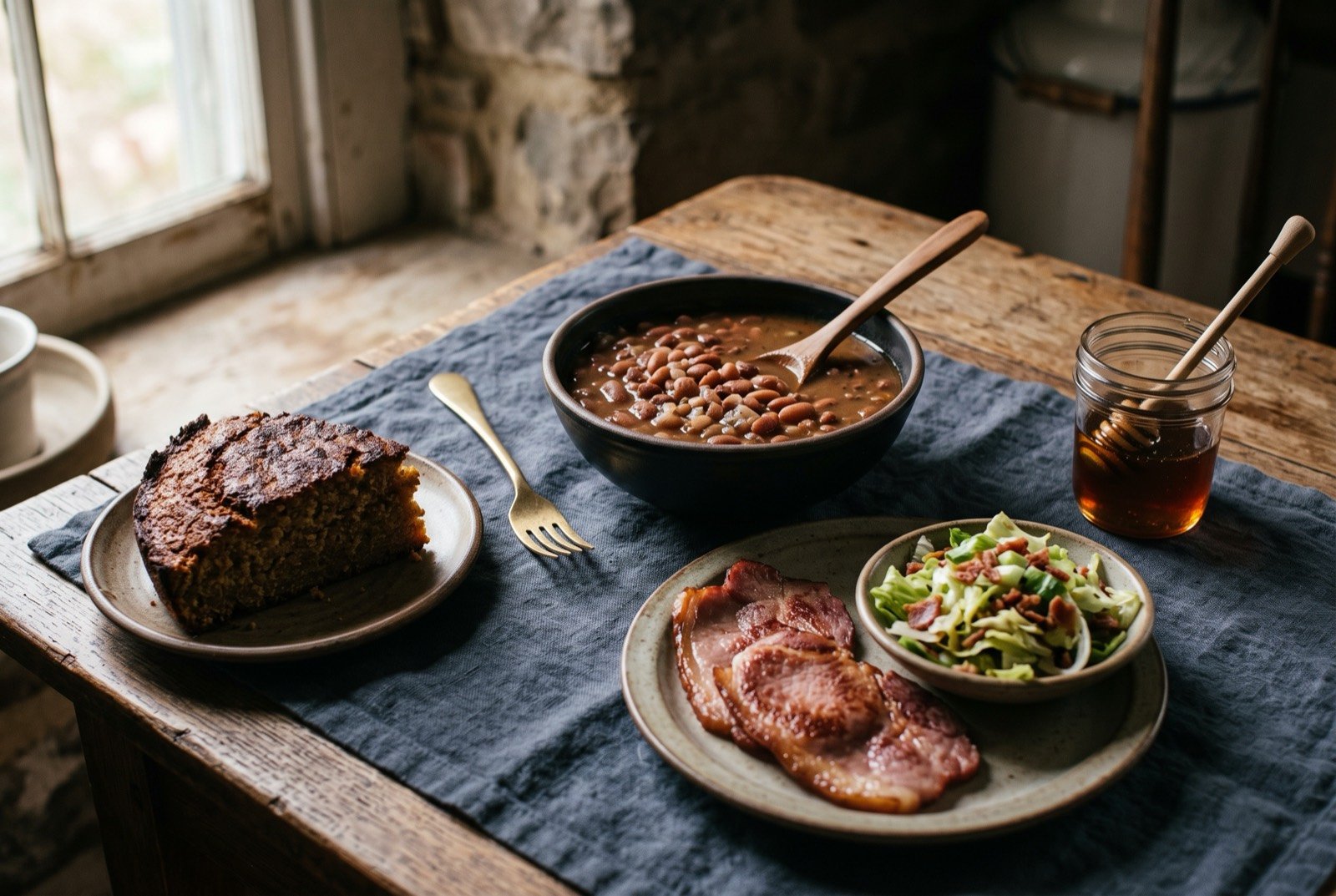
This chapter covers two food worlds that share a settlement history and very little else. The first is the deep-mountain core: eastern Kentucky, West Virginia, and the Tennessee and western North Carolina highlands, a subsistence hill-farming and foraging economy shaped by steep, limited land rather than by plantation agriculture, and by a coal economy that layered wage work on top of the garden without ever quite replacing it. The second is the wider Upland South foothills, the Piedmont of Georgia and the Carolinas, a red-clay plateau between the mountains and the coastal plain, its own cotton-and-tobacco smallholding economy turned, over a single century, into a textile mill-town economy. Both were settled largely by Scots-Irish, English and German migrants moving overland rather than through a coastal port, which is the one thing genuinely holding this volume together. What the mountains and the foothills do not share is ecology, and this chapter treats them as two tables rather than forcing one onto the other. Running under both halves is this atlas's animating argument in its plainest form yet: a chef curing a ham the way Allan Benton's grandparents did, or drying beans on a string the way a Foxfire informant once showed a schoolchild, is not inventing a technique. They are doing, deliberately and well, what the hollow and the ridge already knew. Every dish as tradition built it, then what a modern chef would change.
Sources and review · What this chapter does not assert · How we research · Spotted something wrong?
A Sense of Place
This volume covers two food worlds that share a national settlement route and almost nothing else at the level of the plate, and it treats them as two rather than collapsing one into the other.
The first is the deep-mountain core: eastern Kentucky, West Virginia, and the Tennessee and western North Carolina highlands, steep, forested terrain unsuited to large-scale cash-crop agriculture, settled from the early 1700s by Scots-Irish, English and German migrants who moved into the mountain interior rather than the fertile coastal lowland. [Fiveable, Appalachian Studies](https://fiveable.me/hs-appalachian-studies/unit-3/scots-irish-immigration/study-guide/5NnR0UwGkidT4m7U) Its economy was subsistence farming on small, diversified plots, corn, beans and garden vegetables, supplemented by hunting, fishing and foraging, and, from the late nineteenth century, coal. Coal did not simply replace the garden with a wage: company towns commonly provided space for keeping a garden and stock alongside the company store, so the mining household's plate stayed rooted in home-grown beans, home-cured pork and foraged greens even as cash and scrip entered the picture. [e-WV, "Foodways"](https://www.wvencyclopedia.org/entries/1957)
The second is the Piedmont and foothill Upland South: the red-clay plateau of Georgia and the Carolinas, between the Blue Ridge and the coastal plain, opened to the same Scots-Irish and German settlement wave, but arriving down the Great Wagon Road to take up small farms growing corn for the house and wheat, tobacco and cotton for market, a smallholding economy rather than mountain subsistence. [NCpedia, "Settlement of the Piedmont, 1730 to 1775"](https://www.ncpedia.org/history/colonial/piedmont) As continuous row-cropping exhausted the clay, the Piedmont turned from farm to fall-line mill town through the late nineteenth and early twentieth centuries, textile manufacturing built on the same rivers that had once only turned a grist wheel. [South Carolina Encyclopedia, "Piedmont"](https://www.scencyclopedia.org/sce/entries/piedmont/)
| Structural role | Deep-mountain core | Piedmont and foothill South |
|---|---|---|
| Starch | Cornmeal, unsweetened skillet cornbread, and the dried bean | Cornmeal, wheat for market, and rice at the region's eastern edge |
| Fat | Hog fat, home-rendered, home-cured | Hog fat, and lard-based baking in the mill-town kitchen |
| Vegetable base | Dried and string-preserved beans, foraged spring greens | Row-crop vegetables, boiled peanuts, dooryard grapes |
| Protein | Country ham, home-butchered pork, mountain trout, squirrel | Pit-cooked pork shoulder, squirrel, poultry |
| Defining historical event | The coal economy, 1880s onward, layered onto subsistence farming | The shift from cotton and tobacco smallholding to the textile mill village, 1880s to 1920s |
A single ethnic and economic map does not serve both halves honestly. The mountain core kept its food culture rooted in the household garden and the hunting season for far longer than the foothills did, where the factory whistle, not the growing season, eventually set the working day. This chapter gives each half its own weight.
The History in Layers
Settlement, and the myth of isolation
Scots-Irish immigrants began arriving in large numbers in the early 1700s, settling first in Pennsylvania before moving south into the Appalachian frontier and, further south again, down the Great Wagon Road into the Piedmont; English and German settlers, particularly German-descended farmers in what became West Virginia and in the Carolina Piedmont's Dutch Fork, were part of the same migration. [Fiveable, Appalachian Studies](https://fiveable.me/hs-appalachian-studies/unit-3/scots-irish-immigration/study-guide/5NnR0UwGkidT4m7U) The popular idea of the mountains as uniquely isolated, self-sufficient and unchanging does not survive contact with Appalachian historians' own scholarship. Ronald D. Eller, in Uneven Ground: Appalachia since 1945, traces the "idea of Appalachia" to urban journalists writing after the Civil War, who built the region into a counterpoint to their own definition of progress; his central argument is that "Appalachia was not different from the rest of America; it was in fact a mirror of what the nation was becoming," its poverty produced by the same industrial capitalism reshaping the rest of the country, not by isolation or peculiarity. [University Press of Kentucky](https://www.kentuckypress.com/9780813142463/uneven-ground/) This chapter treats that pushback as the correct starting frame, not a caveat to be added later.
Coal, the company store, and the garden that did not disappear
Coal companies built company towns where the only store was typically company-owned, paying miners partly or wholly in scrip, private notes usable only there, a practice widespread in the Appalachian coalfields until the late 1950s; miners often never fully paid off their store debt, since prices there ran high. [Appalachian History, "Company Store Scrip"](https://www.appalachianhistory.net/2018/09/company-store-scrip.html); [West Virginia Mine Wars Museum](https://wvminewars.org/16tons) What the coal economy did not do was erase the household garden. Coal towns "commonly provided space for gardening, and often even for the keeping of stock," and through the Depression especially, mining families leaned on vegetable gardens, poultry, pigs and, in the New River area, wild game and fish to stretch a wage that the company store had already partly clawed back. [e-WV, "Foodways"](https://www.wvencyclopedia.org/entries/1957) This is why soup beans, cornbread, ramps and hog-killing dishes stayed central to mountain households well into the twentieth century, even in families who worked underground for a cash wage: the garden and the mine ran side by side, not one after the other.
From smallholding to mill village: the Piedmont's own industrial turn
The Piedmont's story runs on a different clock. Its red clay, the Cecil soil series covering 1.6 million acres of North Carolina alone, gave good farmland for cotton, tobacco, corn and small grains, but drained poorly and eroded fast under nineteenth-century clean-tilled row cropping, famously running the rivers red with sediment. [NCpedia, "Geography of North Carolina: The Piedmont Region"](https://www.ncpedia.org/geography-part-3-piedmont-region) As that soil wore out, the region turned to the many fall-line rivers that had powered its earliest grist mills, damming them for textile power and then hydroelectricity. By 1880 roughly 40 per cent of South Carolina's textile mills already sat in its upper Piedmont counties; by the 1910s more than 70 per cent did. [South Carolina Encyclopedia, "Piedmont"](https://www.scencyclopedia.org/sce/entries/piedmont/) In Georgia, mills clustered along the same fall line, Columbus, LaGrange, Manchester, Thomaston and Griffin all growing as textile towns from the 1830s through the 1920s, fed in part by a post-Civil War cotton tenancy and sharecropping system worked by a predominantly Black labour force. [New Georgia Encyclopedia, "Textile Industry"](https://www.georgiaencyclopedia.org/articles/business-economy/textile-industry/)
Mill villages built entire company towns, with employment contracts signed by whole families to lock in a stable workforce, and mill households, like their mountain counterparts, kept gardens and pastured cows and pigs behind the house. [South Carolina Encyclopedia, "Mill villages"](https://www.scencyclopedia.org/sce/entries/mill-villages/) But the factory whistle, not the growing season, now governed the day. An oral history of North Carolina mill worker Herman Newton Truitt, recorded by UNC Chapel Hill's Documenting the American South, describes weekday meals built around dried beans and fatback, packed lunches of bologna, cheese and crackers, and Sunday dinner, chicken most often, as the week's one treat; as mills pushed from a lunchtime shutdown toward continuous operation, children began carrying lunch pails to parents on the factory floor, and mills began running "dope carts" selling sandwiches on the line. [UNC Chapel Hill, Documenting the American South, interview H-0054](https://docsouth.unc.edu/sohp/H-0054/excerpts/excerpt_4184.html) A ten- to twelve-hour, six-day week, opened and closed by a factory whistle with half an hour for lunch and no cafeteria in the earliest period, is the direct cause of the "dinner pail" itself, a multi-compartment carrier with a hot drink at the bottom to keep a meat-and-potatoes course and a dessert warm on the walk from home to mill.
Moonshine, and the road that became a race track
Illicit distilling in the mountains dates to the region's earliest Scots-Irish settlers, who brought home-distilling knowledge with them, and to the Whiskey Tax of 1791, which provoked the Whiskey Rebellion and, once that rebellion was militarily suppressed, simply drove production underground rather than ending it. [Appalachian State University Library, "Moonshine and Auto Racing"](https://guides.library.appstate.edu/moonshine-and-racing) In a cash-poor, subsistence economy, distilling corn into whiskey was a practical way to turn a bulky, low-value surplus crop into something worth the haul over difficult mountain terrain. [Appalachian State University Department of Anthropology field-school](https://anthro.appstate.edu/research/field-schools/ethnographic-and-linguistic-field-schools/summer-2007-alleghany-county/its) National Prohibition made the trade dramatically more profitable, some operations running roughly six hundred gallons a day to markets as distant as Chicago, and it persisted through the Depression, when for many mountain families moonshining was, in the words recorded by Appalachian State's own field school, "simply no way outside of moonshining to earn any cash."
The connection between this trade and NASCAR is real and specifically documented, not folklore dressed up as history. Bootleggers running mountain roads at night modified their cars for speed and load, stripping seats for cargo space, fitting heavy-duty rear suspension so a full load would not visibly sag to a watching patrolman, adding armour such as a steel radiator plate, modifications that shaped the earliest stock cars directly. [Smithsonian Magazine](https://www.smithsonianmag.com/travel/how-moonshine-bootlegging-gave-rise-nascar-180962014/) On 14 December 1947, former bootlegger Bill France Sr convened the meeting that gave stock car racing standardised rules and founded NASCAR; Red Byron, a bootlegger, won its first sanctioned race, and Junior Johnson, another named bootlegger-driver, went on to a 50-race NASCAR career and a place in its inaugural Hall of Fame class, having learned to evade revenue agents on the same roads he later raced. [NPR, "NASCAR Legend And Bootlegger Junior Johnson Dies At 88"](https://www.npr.org/2019/12/23/790687272/nascar-legend-and-bootlegger-junior-johnson-dies-at-88)
From dismissed mountain fare to a named revival
Ronni Lundy, a founding member of the Southern Foodways Alliance and author of Victuals: An Appalachian Journey, James Beard Book of the Year in 2017, has said plainly why she spent a career on this food: looking properly at real Southern mountain cooking gives "a vivid picture of a region and its people that had little in common with their most prevalent and demeaning stereotypes." [Southern Foodways Alliance, Ronni Lundy interview](https://www.southernfoodways.org/interview/ronni-lundy/) A contemporary chef revival, still recent and still building, has taken up that argument at the stove: John Fleer's "Foothills Cuisine" manifesto, written at Blackberry Farm and carried forward at his own Rhubarb in Asheville; Travis Milton's coalfield garden project in southwest Virginia, restoring more than a hundred heirloom varieties his own great-grandparents grew before strip-mining closed off the land; and Mike Costello and Amy Dawson's Lost Creek Farm in West Virginia, whose stated project is sovereignty over the story, not rescue from it: "the story behind the food isn't about a well-intentioned farmer or a cherished family recipe; it's about sovereignty." [The Bitter Southerner](https://bittersoutherner.com/a-new-look-at-appalachian-food-with-chef-mike-costello-of-lost-creek-farms) Chef Ashleigh Shanti, first at Fleer's Benne on Eagle and now at her own Good Hot Fish, cooks under a name coined specifically to correct the record further still: "Affrilachian," coined by Dr Frank X Walker "to dispel a lot of the myths that exist in the area of southern Appalachia," the myth of a "largely white region of uneducated people that are barefoot and hillbilly," naming instead the Black influence already present in the region's art, music and food. [WV Public Broadcasting](https://wvpublic.org/story/arts-culture/meet-the-chef-bringing-affrilachian-food-to-asheville/) This chapter treats that correction as load-bearing, not decorative.
Ramps, Sochan and Who Actually Has the Rights to Forage Them
This section exists because the atlas's own rule, that a shared history is content rather than a problem to route around, applies here to land and law as much as to technique. Ramps and sochan are Cherokee foods before they are anything a restaurant menu calls them, and the legal history of who may gather them on what is now federal land is recent, contested and still moving.
Sochan (Rudbeckia laciniata, green-headed coneflower), a Cherokee traditional food plant comparable in use to spinach, and ramps (Allium tricoccum, wild leek) were both, in effect, made illegal to gather from federal park land once the National Park Service was established in 1916. In 2016 the NPS opened a route for federally recognised tribes to apply for traditional gathering rights, and in May 2019 the Eastern Band of Cherokee Indians became the first in generations to legally collect sochan within Great Smoky Mountains National Park, permitted one bushel per week from March to May, on condition of sharing a portion with other tribal members. [Smithsonian Magazine](https://www.smithsonianmag.com/science-nature/cherokee-indians-harvest-sochan-national-park-180973089/) Eastern Band citizens' own ramp-harvesting rights in the same park had been revoked outright in 2007; the 2016 federal rule reopened the possibility for ramps too, though a finalised agreement specifically for ramps was not confirmed in this research. Tommy Cabe, the Eastern Band's forest resource specialist, frames the whole question directly: "Ultimately we're talking about food sovereignty. Tribes have inherited rights to this." Tyson Sampson, a tribal community researcher, adds: "This is us sharing our identity to preserve our identity. And that identity is the plants." [North Carolina Health News, "Mending a Native Food Web"](https://www.northcarolinahealthnews.org/2016/10/10/mending-a-native-food-web/) This chapter could not find a named contemporary Cherokee chef or food-sovereignty organisation working at the same public profile as the settler-descended revival chefs named above, a real gap rather than an oversight, and states it as such rather than filling it with an unsourced claim.
The same wild leek is now under real ecological pressure from the opposite direction: restaurant demand. Chef interest in ramps rose sharply from the early 1990s, and urban menu prices can reach $25 a pound or more; as demand has grown, chefs have pressured suppliers to deliver ramps before they are locally in season, with early "sprout" sales flagged as a particularly damaging recent trend. [Civil Eats](https://civileats.com/2017/04/12/can-we-eat-our-ramps-and-have-them-too/) Ramps are slow-growing, seven to ten years to reach maturity, and the recommended sustainable harvest is roughly 10 per cent of a wild population once every ten years; harvesting as little as 5 per cent can still damage a patch. Nearly a fifth of Quebec's documented wild ramp populations have disappeared, leading to a commercial ban there; the USDA lists ramps as a species of special concern, Tennessee lists them as threatened, New York as endangered. [Civil Eats, "Helping Ramps Flourish Through Forest Farming"](https://civileats.com/2025/05/28/helping-ramps-flourish-through-forest-farming/); [United Plant Savers](https://unitedplantsavers.org/ramps/) The Appalachian Beginning Forest Farmer Coalition, formed in 2015, now trains growers to cultivate ramps and other woodland botanicals under a forest canopy rather than stripping them from the wild, a direct response to exactly this pressure. Because Allium tricoccum ranges well beyond Appalachia into the upper Midwest and Canada, everything in this paragraph, the slow maturity, the sustainable-harvest maths, the chef-demand problem, applies without adjustment to Volume AM-36, the Midwest, once that volume is written; only the state-by-state legal status will need rechecking there.
The Flavour Arsenal
Starches
Cornmeal. The region's staple grain, ground stone or steel, white more often than yellow in the mountain and Piedmont South. Traditional Appalachian and Piedmont cornbread is widely reported as unsweetened, coarse and made with little or no wheat flour, against a sweeter, finer, more cake-like Northern style; the pattern itself is well and consistently reported, though the specific causal stories offered for it, that steel roller mills stripped natural sweetness from some regions' cornmeal, or that post-emancipation sugar cost shaped a Black Southern preference for unsweetened bread, rest only on generalist food writing in this chapter's research and are treated here as plausible folk explanation, not settled history.
Pinto beans, "soup beans." Became essential to mountain cooking from the early twentieth century, and were, tellingly, usually bought dried rather than grown: cheap, store-bought pintos were not worth the trouble of home cultivation, a detail worth keeping precisely because it corrects the more romantic story of an entirely self-grown mountain larder. [Southern Foodways Alliance, "Soup Beans"](https://www.southernfoodways.org/a-helping-of-gravy-soup-beans/)
Half-runner and greasy beans. A genuinely separate tradition from the pinto above: pole bean varieties with real, named Appalachian provenance, the Mountaineer Half Runner, descended from a West Virginia heirloom associated with German-descended families, the Bill Stumbo Half-Runner of Floyd County, Kentucky, and the Pineville Half-Runner, strung whole and dried for winter as leather britches, or cooked fresh as green beans with fatback.
Proteins and fats
Country ham. Dry-salt-cured, typically smoked, and considerably saltier and denser than a British or European air-dried ham; where prosciutto or jamón serrano are cured to be eaten raw, thin-sliced, country ham is cured to be cooked, pan-fried, soaked or simmered to draw out salt first. The nearer point of comparison for a British reader is not prosciutto at all but a wet-cured supermarket gammon, since country ham's whole character is what happens when that same cut is instead dry-salted for months rather than brined for days.
Sorghum syrup, sometimes carelessly called "sorghum molasses" in the region itself, though the two are not the same thing. Sorghum syrup is sweet sorghum cane, a different plant from sugar cane, pressed and boiled directly down to syrup with nothing removed. Molasses proper is a by-product of sugar refining, the liquid left once crystallised sugar has been extracted, a genuinely different process. A commercial product actually called "sorghum molasses," a blend of the two, also exists and compounds the confusion; this chapter uses "sorghum syrup" throughout for the genuine article. [Heart to Hearth Cookery, "Sorghum Syrup vs Sorghum Molasses"](https://hearttohearthcookery.com/2011/03/03/sorghum-syrup-vs-sorghum-molasses/)
Foraged and seasonal
Ramps. Covered at length above; the whole plant, bulb and leaf, is used, traditionally scrambled with eggs, fried with potatoes, or parboiled as a side.
Poke sallet, named but not given as a recipe here. Pokeweed (Phytolacca americana) is genuinely toxic in its roots, berries, seeds and mature stem and leaf; as little as half a teaspoon of root, or more than about ten berries, can produce a dangerous dose. The traditional method for young leaves is to parboil at least twice, discarding the water each time, on the understanding that the toxins are water-soluble. A Tennessee poison control centre states plainly that despite this, "there are several reports of people developing gastrointestinal symptoms following this cooking method," so the traditional preparation does not reliably remove all risk. [Vanderbilt University Medical Center / Tennessee Poison Center](https://www.vumc.org/poison-control/toxicology-question-week/june-10-2002-what-toxicity-pokeweed) This chapter names poke sallet as a real and historically important dish and declines to give it as one of the recipes below, for the same reason earlier volumes have declined a recipe for an ingredient that cannot be made reliably safe in a home kitchen.
Boiled peanuts. Green, freshly dug, raw peanuts, not roasted or cured ones, boiled for the better part of an hour in heavily salted water. The practice is traced to enslaved West Africans, peanuts having crossed the Atlantic on slave ships as provisions; the popular Confederate-rations origin story is explicitly disputed by historians. [Charleston City Paper, "A Brief History of the Boiled Peanut"](https://charlestoncitypaper.com/a-brief-history-of-the-boiled-peanut)
Muscadine. A grape native to the southeastern United States and gathered wild long before European contact; its bronze-green scuppernong variant, cultivated in coastal North Carolina from the seventeenth century, is described by the state's own historical encyclopedia as the first grape actively cultivated in what is now the United States, though that specific claim belongs to the coastal plain, not the Piedmont itself. [NCpedia, "Scuppernong Grape"](https://www.ncpedia.org/scuppernong-grape)
The Technique Ladder
Rung 1. Rung 1, the long simmer and the potlikker it leaves behind
A pound of dried beans, simmered gently for the better part of two hours with a piece of seasoning meat, is not simply cooked, it is reduced into a second ingredient: the starch shed by the beans thickens the cooking liquor into "potlikker," a savoury, porky stock worth keeping and serving in its own right rather than draining away. Salt goes in late, since salting dried beans too early toughens their skins before they can soften.
Rung 2. Rung 2, string-drying and the umami it builds
Leather britches, whole green bean pods threaded on a string and air-dried for two months or more away from direct sun, are not merely preserved, they are transformed: slow enzymatic activity during drying concentrates flavour compounds in a way Ronni Lundy herself has called "Appalachian umami." Rehydration by overnight soak, then a long simmer, brings the beans back with a depth fresh green beans never had in the first place.
Rung 3. Rung 3, dry salt curing
A country ham is cured by weight and time, not by eye: salt penetrates raw pork at roughly an inch per week, so a large ham needs months, not days, before it is safe, dense and intensely flavoured. This is a controlled dehydration and concentration, the same principle behind any dry-cured meat anywhere in the world, applied here with mountain-grown pork, brown sugar and black pepper rather than European aromatics.
Rung 4. Rung 4, low and slow indirect wood smoke
Piedmont barbecue's pork shoulder, cooked over hickory coals for hours at a low, steady temperature, works by giving tough collagen-rich muscle enough time to break down into gelatin before the exterior dries out, smoke adhering all the while to the meat's moist surface. It is the same mechanism a whole hog uses further east, applied to a cheaper, more practical cut.
Rung 5. Rung 5, open-pan cane reduction
Sorghum syrup is made by boiling sweet sorghum juice straight down in an open pan, roughly five hours over direct heat, with nothing removed and nothing refined out. This is the opposite process to sugar refining, which extracts crystallised sugar and leaves molasses as a by-product; boiling the whole juice down keeps compounds a refinery would otherwise strip away, which is exactly why sorghum tastes nothing like either refined sugar or true molasses.
Rung 6. Rung 6, layered rest and moisture migration
An apple stack cake is assembled from thin, deliberately dry cake layers with a moist dried-apple filling spread between them, then left to rest, a minimum of a day, ideally two or three, before cutting. Nothing happens in the oven that finishes this cake; what finishes it is the filling's moisture migrating slowly into the dry layers afterward, the whole point of the technique being patience rather than heat.
The Ferment and Preserve Bench
Chow-chow relish. A chopped, pickled preserve of end-of-season vegetables, commonly green tomato, cabbage, onion and pepper, sweet and tangy, traditionally served alongside soup beans. Its origin is genuinely contested rather than settled: American Southern, Acadian-Canadian by way of the 1755 Expulsion, and Chinese-railroad-worker stories all circulate, and no source found in this chapter's research adjudicates between them. Present it, as this chapter does, as a real and beloved condiment with a disputed name, not a single settled story.
Sorghum syrup. Covered fully above under the Flavour Arsenal and the Technique Ladder; keeps for months at room temperature once bottled, and is as much a pantry preserve as a sweetener.
Country ham itself is, in effect, this cuisine's preserve bench in miniature: a single, months-long dry cure that turns a perishable cut of pork into something that keeps, unrefrigerated, for a year or more.
Sourcing in Britain
Verified September 2026. Where a supplier could not be fully confirmed, that is said rather than smoothed over.
The ranked list: what decides great from grim
1. Genuine American country ham cannot currently be confirmed as importable to the UK, and there is a specific, identifiable reason. The UK does not permit pork produced using ractopamine, a growth-promoting feed additive still legal and common in US pork production, following the same precautionary line the EU takes and that the UK has kept post-Brexit; this mechanism is well documented internationally, though no UK government source stating the restriction in these exact terms for named country ham brands was found, and that gap is stated honestly rather than presented as a direct regulatory quote. What surfaces instead is general cross-border marketplace reselling, Etsy UK listings and the like, which carries import-duty exposure and is not a reliable route. The nearest UK equivalent in spirit is Trealy Farm Charcuterie (Monmouthshire, Wales), whose long, obsessive air-dried cures Hugh Fearnley-Whittingstall has called the best artisan charcuterie in the UK; but the comparison is about producer ethos and long-cure commitment only, since Trealy Farm's product is European-style, eaten thin-sliced and raw, genuinely different from the salt-forward, cook-before-eating American tradition. 2. Genuine sorghum syrup has no UK stockist found. Black treacle is the practical nearest substitute, but it is, by the category distinctions in the Flavour Arsenal above, actually closer to true cane molasses, a sugar-refining by-product, than to true sorghum syrup, a directly boiled-down whole juice; it will change the dish, not just its name, and this chapter says so rather than presenting the two as interchangeable. 3. Genuine coarse, stone-ground grits or cornmeal remains a real UK gap, confirmed again in this volume's research after Volume AM-33 first found it. Sous Chef does not stock corn grits or true stone-ground cornmeal; its closest product, Italian Polenta Bramata, is marketed by the retailer itself as "or 'grits' in the USA," and most UK polenta is a finer, differently milled product. Fine "instant grits," the fast-cook, de-germed style, are available at Panzer's Deli, St John's Wood, London, but this is not the coarse artisan grind this chapter's cornbread and grits genuinely want. 4. True ramps cannot be sourced in the UK; they are simply a different species from British wild garlic. UK wild garlic, or ramsons (Allium ursinum), genuinely foraged each spring, typically March to May, is the honest substitute, but it has narrower, more pointed leaves, a slenderer bulb, and a milder, grassier flavour without ramps' onion punch; present it as a related genus cousin, not a like-for-like stand-in. 5. True half-runner or greasy beans, fresh or home-dried, were not found from any UK retailer. Ordinary dried pinto beans are unremarkable to source, Sous Chef stocks Suma Organic Pinto Beans and general wholefoods retailers carry them as a commodity item; the heirloom half-runner cultivar itself is a heritage-seed matter this research did not chase down, and a reader wanting to grow the real thing will need a dedicated seed-catalogue search.
Corn whiskey, for a taste of the base spirit
Mellow Corn (Heaven Hill Distillery), a genuine straight corn whiskey, minimum 81 per cent corn mash bill, aged a minimum of four years and bottled-in-bond, is available in the UK via Amazon UK and specialist retailer Spiritly UK. Royal Mile Whiskies, a serious UK spirits specialist, stocks a dedicated "American: Corn" category including Balcones, a small Waco, Texas distillery. Neither is literally unaged white moonshine, and whether any of the actual tourist-brand moonshine labels, Ole Smoky, Sugarlands, Midnight Moon, are stocked by name in the UK was not confirmed in this research.
Kit
A Big Green Egg, fitted with a cold smoke generator, is the closest home equivalent to both a country ham's smoking stage and a Piedmont pit's low, steady hickory heat; used for cooking rather than curing, its own ceramic thermal mass holds a steady low temperature far more reliably than an open fire. A dehydrator stands in directly for the leather britches tradition, turning weeks of string-drying into a controlled overnight process. A sous vide setup is genuinely useful for sorghum reduction at a domestic scale, and for cooking Brunswick stew's meats to a precise texture before they join the pot. Curing salt containing potassium nitrate, Cure #2 in American charcuterie terms, is the correct, food-safe choice for a long, uncooked, air-dried home ham analogue, and should be handled precisely if attempted.
Voices and Sources
From the deep-mountain core
- Ronni Lundy, author of Victuals: An Appalachian Journey, with Recipes (2016), James Beard Book of the Year 2017, a founding member of the Southern Foodways Alliance and co-founder of the Appalachian Food Summit (2013, with Lora Smith, Travis Milton and Kendra Bailey Morris). - John Egerton, author of Southern Food: At Home, on the Road, in History (1987) and editor of the Cornbread Nation anthology series. - The Foxfire book series, begun in Rabun County, Georgia, in 1967 by teacher Eliot Wigginton and his students, twelve volumes of collected oral history and traditional-skills documentation, including the string-drying method behind leather britches. - The West Virginia Encyclopedia (e-WV), published by the West Virginia Humanities Council, the single most useful institutional source in this chapter's research.
The contemporary revival
- John Fleer, whose "Foothills Cuisine" manifesto, written during his years at Blackberry Farm, now continues at his own Rhubarb in Asheville; credited with pioneering Allan Benton's country ham as a chef's ingredient. - Travis Milton, whose coalfield garden project in southwest Virginia restores more than a hundred heirloom varieties his own family grew before the area's strip-mining, now cooking at Hickory at Nicewonder Farm & Vineyards, a 2024 James Beard semi-finalist for Best Chef, Mid-Atlantic. - Mike Costello and Amy Dawson, Lost Creek Farm, West Virginia, whose explicit project is sovereignty over the region's own story: "the story behind the food isn't about a well-intentioned farmer or a cherished family recipe; it's about sovereignty." - Ashleigh Shanti, first at Benne on Eagle, now at her own Good Hot Fish in Asheville, cooking under the Affrilachian name coined by Dr Frank X Walker; James Beard Rising Star Chef of the Year, 2020, and James Beard Media Award winner, 2025, for Our South: Black Food Through My Lens. - Tommy Cabe and Tyson Sampson, of the Eastern Band of Cherokee Indians, whose work securing sochan and ramp gathering rights within Great Smoky Mountains National Park is the clearest documented Cherokee foodways story this chapter found; no named contemporary Cherokee chef or food-sovereignty organisation working at a comparable public profile could be located, and that gap is stated here rather than papered over.
From the Piedmont and foothill South
- Marcie Cohen Ferris, Professor of American Studies, UNC Chapel Hill, former Southern Foodways Alliance board president, author of The Edible South and editor of Edible North Carolina, which names the Piedmont as one of the state's distinct food regions. - John Shelton Reed, co-author of Holy Smoke: The Big Book of North Carolina Barbecue, the clearest source connecting Piedmont barbecue's geography to German Lutheran settlement. - Robert F. Moss, Contributing Barbecue Editor at Southern Living, author of Barbecue: The History of an American Institution. - Wayne Monk, "the Honeymonk," who founded Lexington Barbecue in 1962 after training under pitmaster Warner Stamey, named an America's Classic by the James Beard Foundation in 2003.
Named producers
- Allan Benton, Benton's Smoky Mountain Country Hams, Madisonville, Tennessee: "I made a decision early on in my country ham business that I would try to not make more hams; I would try to make better hams." James Beard Foundation Who's Who of Food & Beverage, 2015. - Nancy Newsom, "The Ham Lady," Col. Bill Newsom's Aged Kentucky Country Hams, Princeton, Kentucky, curing without climate control or industrial preservatives. - Muddy Pond Sorghum Mill, Tennessee, and Townsend's Sorghum, Kentucky, both still boiling cane down each autumn on family land held for generations.
Things this chapter has deliberately not asserted
- That Appalachian pinto "soup beans" were passed down as heirloom seed stock for generations. The clearest source found states the opposite, that pintos were typically store-bought; this is kept explicitly distinct from the genuinely heirloom half-runner and greasy bean tradition.
- That leather britches originated with the southeastern Indigenous tribes rather than German settlers, or the reverse. Both origin claims circulate and this chapter's research found the question genuinely, and explicitly, contested.
- That the apple stack cake "each wedding guest brings a layer" story is documented history rather than repeated folklore. Every source found repeating it in this chapter's research was generalist recipe or food media, not an in-tradition or academic source.
- That the causal mechanisms offered for the sweetened-North, unsweetened-South cornbread divide, steel roller mills, or post-emancipation sugar cost, are established food history. The pattern is well and widely reported; these specific explanations for it are not corroborated beyond generalist food writing.
- That chow-chow relish has a single settled origin. American Southern, Acadian-Canadian and Chinese-railroad-worker stories all circulate with no source adjudicating between them.
- That poke sallet, prepared even by the traditional double-parboiling method, is reliably safe. A Tennessee poison control centre states directly that people have become ill despite following that method; this chapter names the dish and declines to give it as a recipe.
- That any UK retailer currently, reliably stocks genuine American country ham or genuine sorghum syrup. Neither could be confirmed, and both gaps are stated plainly above rather than smoothed over.
- That the UK's restriction on ractopamine-treated pork has been found stated, by name, against American country ham specifically, in a UK government source. The underlying mechanism is well documented internationally; its precise application to named country ham brands is this chapter's own reasonable inference, not a quoted regulation.
- That "Affrilachian" cuisine, as a named practice, belongs to any chef in this chapter besides Ashleigh Shanti, who cooks explicitly under that name; it is not extended here to other revival chefs whose own work, while related in spirit, was not found described in those terms by themselves.
- That a named, contemporary Cherokee chef or food-sovereignty organisation works at a public profile comparable to the settler-descended revival chefs profiled in this chapter. This chapter's research did not find one, despite dedicated searching, and states that as a real gap rather than filling it with an unsourced claim.
- That chicken bog belongs to this volume. It is a Pee Dee, coastal-plain dish, adjacent to but not part of the Piedmont proper, and is named here only to mark that boundary rather than to claim the dish. --- Volume AM-34, North America, Not Just Stew. Research briefs: `AM-34-tradition.md` and `AM-34-modernist-sourcing.md`. Sourcing verified September 2026.
Rung 1, the long simmer and the potlikker it leaves behind
A pound of dried beans, simmered gently for the better part of two hours with a piece of seasoning meat, is not simply cooked, it is reduced into a second...
Rung 2, string-drying and the umami it builds
Leather britches, whole green bean pods threaded on a string and air-dried for two months or more away from direct sun, are not merely preserved, they are...
Rung 3, dry salt curing
A country ham is cured by weight and time, not by eye: salt penetrates raw pork at roughly an inch per week, so a large ham needs months, not days, before it...
Rung 4, low and slow indirect wood smoke
Piedmont barbecue's pork shoulder, cooked over hickory coals for hours at a low, steady temperature, works by giving tough collagen-rich muscle enough time to...
Rung 5, open-pan cane reduction
Sorghum syrup is made by boiling sweet sorghum juice straight down in an open pan, roughly five hours over direct heat, with nothing removed and nothing...
Rung 6, layered rest and moisture migration
An apple stack cake is assembled from thin, deliberately dry cake layers with a moist dried-apple filling spread between them, then left to rest, a minimum of...
The dishes
- Soup Beans and Cornbread Central Appalachia, United States
- Leather Britches Beans Appalachia, United States
- Ramps and Eggs Appalachia, United States
- Country Ham with Red-Eye Gravy Appalachia and the Upland South, United States
- Killed Lettuce Salad Appalachia, United States
- Apple Stack Cake Appalachia, United States
- Lexington-Style Piedmont Barbecue Lexington, North Carolina Piedmont, United States
- Brunswick Stew Brunswick County, Virginia and Brunswick, Georgia, United States
- Boiled Peanuts The Upland South, United States
- Moravian Sugar Cake Winston-Salem, North Carolina Piedmont, United States
Sources and review
- Reviewed
- Not yet reviewed from inside the tradition
- Cooked
- Not yet cooked and reported
Where this volume comes from
3 research briefs on file for this volume, researched to the rules on How we research. Published 3 September 2026. Last changed 8 September 2026.
The brief's own account of its sources
Across both sections of this brief, the strongest sourcing sits with state encyclopedias and humanities-council institutions (the West Virginia Encyclopedia, the South Carolina Encyclopedia, the New Georgia Encyclopedia, NCpedia), university-hosted oral history and academic staff (UNC Chapel Hill's Documenting the American South, Appalachian State University's library and anthropology department, a Tennessee poison control centre for the poke sallet toxicity claim), and the Southern Foodways Alliance.