The Americas · Volume 31
New England, the Mid-Atlantic and Atlantic Canada
Salt Pork, Scrapple and the Cold Atlantic Table
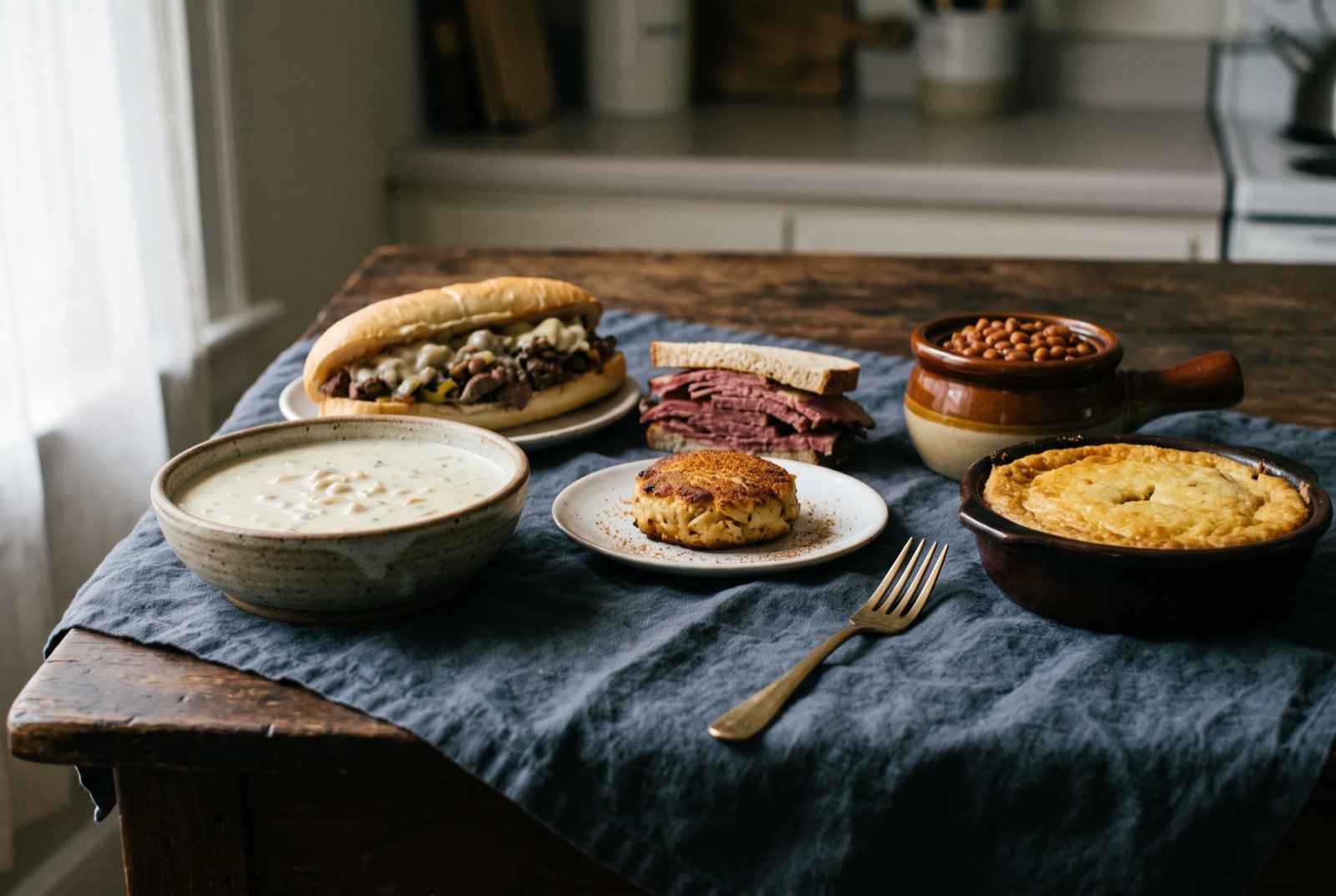
One ocean, three food worlds sharing its coast rather than one cuisine wearing three names. New England's Yankee thrift, built on cod that collapsed and lobster that rose to replace it. The Mid-Atlantic's immigrant-city abundance, Philadelphia's Italian steak culture and New York's Jewish deli a short train ride from Pennsylvania Dutch farm country that has nothing to do with the Netherlands. Atlantic Canada's harder table, salt cod and hardtack rather than resort seafood, still shaped by a fishery collapse the region has not fully recovered from. What binds them is not flavour but history: English Puritan, German Palatine, Irish, Italian and Eastern European Jewish migration, all landing on the same cold, shellfish-rich coast, and a molasses trade running straight back to the Caribbean sugar economy this atlas has already written. Every dish as tradition built it, then what a modern chef would change.
Sources and review · What this chapter does not assert · How we research · Know this better? Tell us
A Sense of Place
New England, the Mid-Atlantic and Atlantic Canada sit inside one binding because they share a single cold-water Atlantic ecology and because the same waves of migration, English, German, Irish, Italian, Eastern European Jewish, landed on both sides of the modern Canada-US border and built recognisably related food cultures out of it. They are not one cuisine, and this chapter's first job is to keep three genuinely distinct worlds legible rather than blur them into a single "New England" postcard.
Three worlds, one coast
New England runs on the Gulf of Maine, a distinct, semi-enclosed cold-water ecosystem that has warmed faster than 99.85% of the world's oceans since 2004. Cod once dominated it and preyed on juvenile lobster; the cod fishery collapsed through twentieth-century overfishing, some spawning runs effectively fished out by the 1940s, stocks at an all-time low by the mid-1990s. As cod fell, lobster surged: Maine landings passed 30 million lb in 1991 and over 63 million lb by 2002. English Puritan settlers built this cuisine's base layer, adapting eastern-English baking technique to New England ingredients, cornmeal, squash, cranberries standing in for what England had. It is worth stating plainly, because it corrects a common assumption: the Puritans did not prize lobster, oysters, salmon or fiddleheads. Multiple sources agree they largely avoided all four as beneath contempt, eating them only when hardship forced it. Lobster's status as luxury food is a later invention, not an original one.
The Mid-Atlantic runs on urban immigrant abundance rather than coastal thrift or outport subsistence. Philadelphia and New York took in Italian, Jewish and German communities arriving with more meat and more choice than they had left behind, and built a food culture around that surplus. Pennsylvania Dutch country, a short drive inland from Philadelphia, is a genuinely separate, rural logic again: whole-animal thrift on German Palatine farms, and a name that has nothing to do with the Netherlands. "Pennsylvania Dutch" anglicises "Deitsch," Pennsylvania German for German, cognate with Deutsch, and describes Palatine German and Swiss settlers who were at the time separately distinguished as "High Dutch" against New York's Netherlandic settlers, "Low Dutch." Two entirely different European origins, one confusing English label.
Atlantic Canada shares New England's ecology but not its abundance. Newfoundland, Nova Scotia and Prince Edward Island built their food culture around a poorer, longer, more isolated fishery: salt cod and hardtack as the durable staples of outport life, not resort seafood. The single defining rupture in this region's food history, covered in full below, is the 1992 Canadian cod moratorium, a fishery collapse the region has still not fully recovered from.
Indigenous foodways, named by who is speaking
Following this atlas's own rule, this chapter attributes Indigenous claims to named voices rather than folding them into a generic origin story. New England's research turned up genuinely strong in-tradition sourcing: Rachel Beth Sayet, Mohegan Nation, a Harvard-trained anthropologist working for the Mohegan Tribal Library, on corn: "Corn was not only nourishment, but also had a spiritual component," and on variety specificity, "Amongst my tribe and the Narragansett tribe... we share a corn variety, the Narragansett White Flint Corn. We really only make our johnnycakes with that particular corn variety." Chef Joseph Robbins, Penobscot Nation, a 2024 James Beard semifinalist working on Wabanaki cooking, on beanhole beans: "One of the easiest ways to feed a lot of people on a budget is by cooking in the ground, because we didn't really have ovens... beanhole beans was the one that came forward... the church documented this." And Paula Marcoux, a Plymouth-based food historian and archaeologist, on the actual direction of early culinary transmission: "Nobody had to come from among the Wampanoag Nation and show them how to plant corn... if someone hadn't shown them how to do it, they probably would have starved."
The defining logic, by sub-region
| Element | New England (Yankee coast) | Mid-Atlantic (Philadelphia, NYC) | Pennsylvania Dutch country | Atlantic Canada |
|---|---|---|---|---|
| Fat | Salt pork, butter, cream | Beef fat, schmaltz, cream cheese | Lard, pork fat | Salt pork (scrunchions), butter |
| Starch | Potato, cornmeal, wheat roll | Italian roll, rye bread, bagel | Wheat noodles, cornmeal, potato | Hardtack, potato, turnip |
| Aromatic base | Thyme, onion, salt pork | Garlic, oregano, dill, caraway | Onion, celery seed, mustard | Onion, black pepper |
| Everyday protein | Clams, cod, lobster, corned beef | Griddled beef, cured beef and salmon | Whole-animal pork, offal | Salt cod, salt beef |
| Defining preserving technique | Salting and canning | Corning, smoking, pickling | Scrapple's offal rendering | Salting and drying cod |
The History in Layers
The clambake, or appanaug, an Indigenous technology renamed a New England tradition
This is the volume's single most important origin claim to get right, and it deserves a first-person source rather than a settler retelling. Joan Tavares Avant, known as Granny Squannit, a Mashpee Wampanoag tribal historian, has written specifically to correct the record: clambakes are routinely mislabelled "traditional New England" when their true origin is Indigenous, and the Wampanoag term for the practice is appanaug. Her account of the pre-contact method is precise: dig a pit, line it with stones, burn a fire for two to three hours or more until the rocks run red-hot, brush away the ashes, quickly layer rockweed, its air-filled fronds carrying both moisture and salt, place seafood, corn and vegetables on the rockweed, cover with more rockweed and mats to trap the steam, and cook for roughly an hour. A traditional Indigenous clambake left almost no trace; the tide reclaimed the rocks and rockweed within a day.
The mechanics survived the journey into a settler and, later, commercial institution remarkably intact, pit, stones, fire duration, rockweed, even where the framing did not: organised social clambakes trace to the Old Colony Club's 1769 "Forefathers' Day" feast in Plymouth, and the shift into a paying, commercial event is credited by several retellings to Rhode Island's Narragansett-registered Kinnecomm family, running clambakes at Buttonwoods Beach for paying crowds by the 1840s, though this specific claim could not be traced to a primary nineteenth-century source and is repeated here with that caveat. Multiple settler-era and secondary accounts state that the Wampanoag historically used lobster as bait rather than food; this chapter attributes that claim to those accounts rather than asserting it as settled fact, since no Wampanoag-authored primary source confirming it turned up in this chapter's research.
Puritan adaptation: what Indian pudding and succotash actually are
English "hasty pudding," boiled wheat flour, became Indian pudding once cornmeal, called "Indian flour" at the time, substituted for scarce wheat, English pudding tradition merging with the Indigenous nasaump. Benjamin Franklin's 1722 mention in the New England Courant is the earliest documented reference. Succotash's name derives directly from the Narragansett sahquttahhash, broken corn kernels, and the Three Sisters method, corn, beans and squash grown and eaten together, was taught to Plymouth and Massachusetts Bay settlers in the 1600s: an ingredient list and a growing method both handed to English arrivals who would otherwise not have survived the first winters.
Boston, molasses, and the trade route this atlas has already followed once
Boston's role as a major eighteenth and nineteenth-century molasses and rum port ties this cuisine directly back to the Caribbean sugar and slave trade already covered in this atlas's earlier volumes. Cheap, abundant molasses made possible by that trade is the thread running through Boston baked beans, Indian pudding, steamed brown bread and Pennsylvania Dutch shoofly pie: not a coincidence of taste, but a specific, traceable commodity flow, the same trade route that carried cassareep's Caribbean cousin, sugar, north rather than south.
Philadelphia's cheesesteak: an Italian invention, and a cheese history nobody agrees on
Pat's King of Steaks was founded in 1930 by Italian-American brothers Pat and Harry Olivieri, who ran a hot dog stand at Ninth, Wharton and Passyunk in South Philadelphia. The standard, widely corroborated story: tired of eating their own hot dogs, the brothers grilled chopped beef with onions instead; a cab driver asked for one, told Pat to stop selling hot dogs and sell that. The original sandwich had no cheese at all; provolone arrived only in the 1940s at Pat's Ridge Avenue location, and Cheez Whiz followed in the mid-1950s, adopted mainly, per Frank Olivieri Sr.'s own 1985 account, because its liquid texture was quick to apply under grill conditions.
The Pat's-versus-Geno's rivalry, Geno's opening directly across the intersection in 1966, is genuinely disputed and this chapter does not adjudicate it. Philadelphia Inquirer critic Craig LaBan, the most authoritative named local voice on the cheese question, has written, "Provolone is for aficionados, extra-sharp for the most discriminating among them," while Geno's own founder Joey Vento maintained, "We always recommend the provolone. That's the real cheese," evidence that even the shop associated with Whiz never uniformly championed it. The two families are reported on cordial terms despite decades of tourist-driven "which is better" argument, and this chapter treats the whole rivalry as exactly that: a good-natured local argument, not a question with a correct answer. Amoroso's Baking Company, founded 1904 in Camden, New Jersey, moved to Philadelphia in 1914, predating the cheesesteak's invention by roughly thirty years, and remains the most-cited roll, a claim that is partly the bakery's own history page but is independently corroborated by Philadelphia food writers. The hoagie, the city's Italian sub, traces by most local historians to World War One-era Italian shipyard workers at Hog Island, whose sandwiches were dubbed Hog Island sandwiches, shortened to hoggies, then corrupted to hoagies, a second, less-favoured theory tying the name instead to South Philadelphia slang for a broke man's scrap sandwich; the Philadelphia Inquirer's own reporting attributes both without adjudicating between them, and this chapter follows that lead.
The Jewish deli: a Romanian technique remade on cheap American beef
Pastrami arrived with Jewish immigration from Romania and Bessarabia from the 1870s onward. In Romania the technique had been applied to goose; in America, cheaper beef navel replaced it. The essential named authority here is Ted Merwin, then a Judaic studies professor at Dickinson College, Pennsylvania, whose Pastrami on Rye: An Overstuffed History of the Jewish Deli won the 2015 National Jewish Book Award and is the first full-length scholarly history of the form. Merwin's central, chapter-relevant thesis complicates a simple immigrant-nostalgia story: the deli reached its cultural peak not in the immigrant generation itself but in the interwar era, when American-born children of immigrants ate at theatre-district delis as a marker of having arrived. There were over 1,500 kosher delis in New York in 1931; fewer than twenty survive today.
Katz's Delicatessen's founding date is genuinely contested, and this chapter does not repeat "since 1888" as settled fact. Food historian Robert F. Moss found immigration records showing the Iceland brothers, credited with founding Katz's in that year, only arrived in America in 1902, making 1888 chronologically impossible; his research instead dates the deli, then "Iceland & Katz," to around 1911. Katz's own current marketing still uses 1888, and this chapter names both dates rather than choosing one. Russ & Daughters, a related but distinct institution, an appetizing store selling smoked and cured fish and dairy rather than a kosher meat deli, was founded by Polish Jewish immigrant Joel Russ, who began peddling herring and Polish mushrooms from a pushcart around 1905, renamed the shop for his three daughters, Hattie, Anne and Ida, in 1933, a notably progressive move for the era, and remains family-run into its fourth generation.
Bagels arrived from seventeenth-century Poland, "beygel," carried by Eastern European Jewish immigrants; New York's Bagel Bakers Local 338, founded 1915, controlled bagel-making methods and membership for decades, a genuinely guild-like institution around what is, at bottom, a boiled-then-baked bread technique. Knishes arrived the same way: Yonah Schimmel, a Romanian Jewish immigrant, began peddling them from a pushcart on the Lower East Side in 1890, settling into his current East Houston Street storefront in 1910, one of the few explicitly Jewish businesses left on a street that has otherwise almost entirely turned over.
Pennsylvania Dutch food, and the honest question of what is actually old
The essential named authority for this whole section is William Woys Weaver, an internationally recognised food historian of Pennsylvania Dutch descent, author of over twenty books including Pennsylvania Dutch Country Cooking, Country Scrapple: An American Tradition and, most relevant here, As American as Shoofly Pie: The Foodlore and Fakelore of Pennsylvania Dutch Cuisine. Weaver's central argument is load-bearing for this chapter's honesty and is stated plainly rather than smoothed over: a meaningful share of what tourists, and even some cookbooks, present as authentic Pennsylvania Dutch food was invented or amplified by the twentieth-century tourist industry rather than handed down whole, and he is critical of a genuinely diverse cuisine flattened to "soggy-noodle chicken pot pies, funnel cake, and whoopee pie." Fried scrapple served in tourist contexts, and some shoofly pie variants specifically, are named by Weaver as tourist-trade inventions rather than deep tradition.
This chapter's own research turned up an honest gap worth stating in its own right: no Amish or Mennonite voice writing for outside publication on Pennsylvania Dutch food could be found, beyond one informally credentialed, Amish-raised blogger writing under the name Anna at Amish Heritage. Weaver himself is an academic authority of Pennsylvania Dutch descent, not a practising Amish or Mennonite voice, and the distinction matters: this chapter is drawing on the best available scholarship about a community that, almost by religious conviction, does not write for the outside world about itself.
Scrapple traces to sixteenth-century Germany, "panhas" or "pawnhos," pan rabbit, originally made with buckwheat rather than cornmeal, unavailable in Europe; German immigrants to Pennsylvania added cornmeal, producing the American form, and Weaver himself argues the word "scrapple" conflates German panhaskroppel, slice of panhas, with the English word. Shoofly pie's wet-bottom-versus-dry-bottom split is a real, sourced regional argument rather than an invented one, and is specifically a Lancaster County argument: wet-bottom pours a hot, dissolved molasses syrup over unbaked pastry so it soaks fully in, leaving a barely visible crust beneath a crumb top; dry-bottom folds the same ingredients differently to keep the pastry crisp. Pennsylvania Dutch chicken pot pie is confirmed, and worth stating clearly because it corrects a common assumption: it is not a pastry-crust pie at all, but a stewed dish, shredded chicken and root vegetables in broth, thickened and bulked with hand-cut flat egg-noodle squares. In the dialect it is called "bott boi," anglicised over time to "pot pie."
Old Bay, and the crab-picking tradition behind it
Old Bay's history is documented and genuinely moving, not marketing copy. It was created around 1940 by Gustav Brunn, a German-Jewish spice merchant and Buchenwald survivor who fled Nazi Germany after arrest and imprisonment in 1938, emigrated to Baltimore smuggling his hand-cranked spice grinder in his luggage, and founded his own shop opposite Baltimore's wholesale fish market after reportedly being dismissed from a prior spice-industry post for being Jewish. His seasoning was renamed Old Bay after the Old Bay Line steamship company that ran Chesapeake Bay passenger routes; McCormick & Co, the very company said to have fired him, bought the brand in 1990. The crab-cake filler debate is genuinely old rather than a modern invention: a Baltimore Sun columnist ran a multi-column reader argument over Maryland deviled crab in the early 1940s, and "all lump" crab cakes were already advertised by restaurants before the decade was out. Behind both debates sits real, gendered, racialised Chesapeake labour: Crisfield, Maryland's Eastern Shore had roughly four hundred crab pickers, predominantly African-American women, as of 1980, paid around $1.15 per pound of picked meat, and this chapter names that history rather than treating "the picking tradition" as folksy abstraction.
Newfoundland's outport staples and the moratorium that ended a way of life
Fish and brewis, hard bread soaked overnight then boiled soft, served with reconstituted salt cod and scrunchions, rendered salt pork cracklings, is rooted directly in the outport fishery: hard bread and salt cod were the two most durable, storable staples for long voyages and lean seasons. Jiggs dinner's name is genuinely resolved, not folk etymology: it derives from "Jiggs," the Irish-American lead character of the newspaper comic strip Bringing Up Father, whose favourite meal was corned beef and cabbage, entering Newfoundland vernacular by the 1920s for the local variant made with salt beef, boiled with potato, carrot, turnip and cabbage and served with pease pudding, a reflection of Newfoundland's substantial Irish settlement. Cod tongues are not, anatomically, a tongue at all, but a small muscle from the fish's throat and underside, historically a byproduct fishermen discarded and children salvaged for pocket money, its status shifting from waste to coveted treat as cod grew scarce.
The 1992 cod moratorium is essential context for this entire sub-region, and it has a genuinely significant, live update. Announced 2 July 1992 after northern cod spawning biomass fell roughly 93%, from 1.6 million tonnes in 1962 to between 72,000 and 110,000 tonnes in 1992, it put roughly 30,000 people, about 12% of the province's labour force, out of work directly and devastated hundreds of outport communities. It is described by CBC, Memorial University's own Heritage Newfoundland and Labrador project and Canadian academic writing not merely as an economic shock but as the death of a lifestyle, younger generations losing access to the salting, drying and outport fishing rhythms that had structured Newfoundland identity for centuries. As of June 2024 Canada reopened the commercial northern cod fishery after thirty-two years, against the Department of Fisheries and Oceans' own scientific advice, which had recommended keeping the moratorium in place; the quota more than doubled again in June 2025 as the stock status moved from "critical" to "cautious," though independent modelling cited in the same reporting put the risk of the stock falling back into the critical zone by 2027 at 62 to 76%. This chapter attributes the reopening's optimism to industry and political leadership and the risk warning to the government's own scientists, rather than declare either side right.
Prince Edward Island's lobster suppers, younger than they look
PEI's communal lobster supper is a mid-twentieth-century, church-and-community-fundraiser institution, not an ancient one, and this chapter says so plainly. Two competing, both genuine origin claims exist: St Ann's Church, Hope River, where Pastor Denis Gallant began church lobster suppers in 1964 to pay off a mortgage and provide local employment; and New Glasgow, where a Junior Farmers group bought a canteen building in 1958 and held a lobster fundraiser to help pay for it, growing into a weekly event by 1963. This is specifically a Prince Edward Island, and to a lesser extent New Brunswick, institution; Nova Scotia has its own separate lobster culture rather than sharing this exact one.
Acadian rappie pie: a tradition younger than its own legend
Rappie pie's name derives from French patates râpées, grated potatoes. Grated potato is pressed hard to remove nearly all its own liquid, which is then replaced, not merely supplemented, with hot meat stock, producing a distinctively dense, gelatinous texture once baked with meat layered through it. A genuinely interesting, non-obvious finding, comparable to the shoofly-pie fakelore point above: the technique most likely dates only to after the Great Expulsion of 1755, not to pre-Expulsion Acadian cuisine. The grating-and-pressing method may have been learned from German or Swiss communities Acadians encountered during their exile, some in Massachusetts, and only became fixed as an Acadian dish once displaced families resettled the Maritimes, when potato was one of the few crops reliably viable in the reclaimed land. This chapter presents rappie pie as a tradition younger than it looks, not as ancient pre-colonial Acadian food. Rappie pie belongs to this volume; Quebec's own, separate francophone cuisine, shaped by continuous settlement rather than expulsion and resettlement, poutine, tourtière, the cabane à sucre, belongs to the not-yet-written AM-38, Quebec and Francophone Canada, and this chapter names the connection without attempting to research it. Maple syrup and sugaring's own deep history sits similarly outside this chapter's scope: its Indigenous origin belongs to AM-30, Woodlands, Plains and Southwest Indigenous Foodways, and its commercial French-Canadian expression to AM-38; this chapter treats New England's own maple industry only in passing, as a genuine but secondary regional product, not as the origin story.
The Flavour Arsenal
Salt pork, the one fat that crosses every sub-region
Rendered before the onion goes into a pot of clam chowder, scored and set atop a crock of Boston baked beans, cubed and fried crisp into Newfoundland scrunchions: salt pork is this volume's genuine constant, a preserving technology first and a flavouring second, doing in three unconnected sub-regions exactly the job cassareep and palm oil do elsewhere in this atlas.
Jacob's Cattle beans
A white bean splashed with maroon, also called Trout or Appaloosa beans, the traditional Maine baking bean, dense and meaty enough to hold its shape through a long, slow bake. Its history is tied directly to the Passamaquoddy people of Maine, who gifted seeds to early settlers in the 1600s, a genuinely good, locally sourced fact that extends this atlas's own thesis, that every technique has an indigenous ancestor, to an ingredient as well.
Wild Maine blueberries
Maine grows over 95% of America's wild, lowbush blueberries, genuinely the only state with significant commercial wild blueberry production. Ninety-nine per cent of the crop is frozen immediately rather than sold fresh; a mechanical harvester developed at the University of Maine in the 1970s now handles over 80% of it, though hand-raking persists on the blueberry barrens of Washington and Hancock counties and draws seasonal migrant labour to this day.
Cranberries
Henry Hall of Dennis, Massachusetts is credited with first cultivating cranberries in 1816. Cape Cod's acidic peat, sand and water suit the crop; over 90% is now wet-harvested, the bog flooded and berries beaten loose to float free, rather than the older dry-picked method that survives only for whole fresh-market berries.
Old Bay seasoning
Celery salt, paprika, black and red pepper and a proprietary spice mix, built specifically around the Chesapeake blue crab trade by a Buchenwald survivor rebuilding a life in Baltimore, its origin as concrete and traceable as any spice blend in this atlas.
Cornmeal, not cassava
The Caribbean volumes already in this atlas run on cassava; this coast runs on cornmeal instead, Indian pudding, steamed brown bread, scrapple, and on potato, chowder, crab cakes, rappie pie. A genuine ecological difference worth naming rather than assuming continuity with the tropical coast just to the south.
Molasses
The thread connecting Boston baked beans, Indian pudding, steamed brown bread and Pennsylvania Dutch shoofly pie is Boston's own role as a major eighteenth and nineteenth-century molasses and rum port, tied directly to the Caribbean sugar and slave trade this atlas's earlier volumes have already documented. Cheap, abundant molasses made this cuisine's sweet, dark, long-baked dishes possible precisely where and when they were forming, a trade-history link this chapter treats as fact rather than coincidence.
The Technique Ladder
The argument, from inside
Seven techniques, each explained by why it works, not only what it does.
Rung 1. Chowder's dairy-off-heat emulsion
Milk or cream goes into the pot only once it is off the boil, sometimes after a deliberate rest, because a hard boil will split dairy against the acid and salt already present. This is a real, existing emulsion-protection step, not something an elevation needs to invent, and it is the clearest single proof in this volume that tradition was already doing the technique correctly.
Rung 2. Appanaug's steam-and-mineralise layering
Rockweed laid directly on white-hot stones does two jobs at once: it flash-generates steam from its own moisture, and it seasons everything cooking above it with a genuine marine salinity that no added table salt replicates. A real, indigenous double-function technique that predates the idea of a steam oven by centuries.
Rung 3. Molasses reduction
Molasses, brown sugar and mustard, simmered down into baked beans or into shoofly pie's syrup layer, is doing the same concentration and colour work as a French gastrique, developed independently on a Caribbean trade-molasses base rather than on wine and vinegar.
Rung 4. Pastrami's three-stage cure
A brine cure for colour, moisture and safety; a coarse pepper-and-coriander rub for crust; then a multi-day, low, steady smoke. A genuinely three-stage technical process, directly transferable to a home smoker or a Big Green Egg run low and long.
Rung 5. Scrapple's whole-offal rendering
Pork scraps and offal are simmered for hours to extract both meat and a gelatin-rich broth, which is then bound with cornmeal and buckwheat flour into a loaf firm enough to slice and fry, a real nose-to-tail preservation technology rather than a novelty breakfast meat.
Rung 6. Salt cod and salt beef rehydration
Fish and brewis and Jiggs dinner both depend on a long, deliberate overnight soak, judged by taste rather than a fixed recipe, to draw salt back out of a preserved protein before cooking, genuine technical skill built around a preservation method rather than a fresh ingredient.
Rung 7. Rappie pie's liquid exchange
Grated potato is pressed to remove its own starchy water, which is then replaced, not merely supplemented, with a flavoured stock, a deliberate substitution at the cellular level that produces a texture no other potato dish in this atlas achieves.
The Ferment and Preserve Bench
This cuisine's preserve bench is a curing and smoking bench rather than a fermentation one, and it is worth building as its own project alongside the recipes above.
House pastrami cure. A wet brine of water, salt, sugar, pink curing salt, black peppercorns, mustard seed, bay leaf and coriander seed, the beef submerged five to fourteen days depending on thickness, penetrating roughly a quarter-inch per day, followed by the coarse pepper-and-coriander crust and a low, multi-day smoke described in the technique ladder above. This is the single most transferable project on this bench for a UK kitchen already running a Big Green Egg as a smoker.
Corned beef. The same brine principle as pastrami, without the smoke stage, the brisket simmered instead once cured, five to fourteen days depending on the cut's thickness, judged the same way.
Scrunchions and rendered salt pork fat. Cubed salt pork or fatback, rendered slowly until every cube is crisp and the fat itself runs clear, keeps for weeks refrigerated and is the fastest route into both Newfoundland and New England cooking in this chapter, since it underlies chowder, baked beans and fish and brewis alike.
Salt cod. Fresh cod, heavily salted and dried under refrigeration or in a dehydrator run cool, over several days, is the base ingredient for fish and brewis and a genuine, low-risk home project given a UK kitchen's existing dehydrator.
Sourcing in Britain
Lobster, the single decision that matters most. Real, checked routes exist for the actual species: The Fish Society (thefishsociety.co.uk) sells Whole Wild Raw American Lobster, 500g, £26.10, and Wild Raw Canadian Lobster Tails, £16.80, both genuinely Homarus americanus, the same species as Maine's, reaching the UK via Canada rather than the US, since Canadian export infrastructure dominates. Waitrose has stocked a comparable North Atlantic MSC lobster tail. Buying a genuinely live Maine-caught lobster in Britain is not, on the evidence found, a real option; frozen Canadian is the honest route to the correct species. Homarus gammarus, the native European lobster sold fresh by Scottish, English and French suppliers, is a genuinely different species, thicker shell, white-tipped claw spines, and this chapter treats it as the honest domestic substitute rather than an inferior stand-in, so long as the reader knows which one he is buying. A genuine caution on sustainability claims: the Gulf of Maine lobster fishery's Marine Stewardship Council certification was suspended twice and formally withdrawn in February 2023 over North Atlantic right whale entanglement risk, and Seafood Watch has separately red-listed it; do not assume an MSC label on Maine lobster today, since there currently is not one to find.
Chesapeake blue crab, a genuine gap, worth stating plainly. No UK retailer of real Callinectes sapidus meat was found. What is sold in Britain as "blue crab meat," through specialists such as Passionate About Fish, is almost certainly Portunus pelagicus, the blue swimming crab, farmed across Southeast Asia and sold pasteurised in tins, a different genus, similar in size and use. UK brown crab, Cancer pagurus, is the honest local substitute, sweeter and less brothy than the real thing but not an inferior animal, only a different one. A genuinely striking irony worth knowing: Callinectes sapidus is now an aggressively expanding invasive species in the Mediterranean, having devastated Venice's lagoon clam production entirely by 2024, arguably closer and more "local" to a British reader than Chesapeake Bay itself.
Old Bay seasoning is cheaply and widely available, Amazon UK, Morrisons, Tesco, Sous Chef, no gap at all.
Scrapple and shoofly pie, honestly, are not obtainable in Britain, no importer or specialist stockist was found for either. What is fixable is the molasses itself: Meridian Organic Blackstrap Molasses, unsulphured, is widely stocked and closer to true dark cane molasses than British black treacle, which comes from a different refining stage and carries a more bitter edge.
Pink curing salt. Home Curing UK sells a correctly regulated, dye-free Cure #1, essential and genuinely food-safety-relevant for anyone home-curing pastrami or corned beef from this chapter's preserve bench.
Rye bread with caraway has no single dominant named UK bakery; the most realistic route is the UK's large, well-established Polish deli network, which stocks genuine caraway rye sourdough as a matter of course.
Smoked salmon as the lox substitute is not an apology. True lox is a raw, brine-cured product rather than a smoked one, and what most delis actually serve alongside bagels is cold-smoked, Nova-style, salmon. Scottish oak-smoked salmon, slow-cured over several days, is widely regarded as matching or exceeding the standard American deli product, a genuinely legitimate swap. London's own Brick Lane Beigel Bake, open since 1974, and its neighbour The Beigel Shop, claiming roots to 1855, are worth knowing as a parallel British-Jewish beigel tradition in their own right, not a substitute for the New York deli story but a related one running alongside it.
Maple syrup is easy and cheap in Britain, Sainsbury's own dark "Maple Crest" and Taste the Difference amber grades, Ocado's Maple Shack and St Lawrence Gold ranges. Note the 2015 US and Canadian regrading: old "Grade B," prized by bakers for its strong flavour, is now labelled "Very Dark, Strong Taste" under the current, colour-based Grade A system, useful to know when a recipe still calls for the old term.
Cranberries, fresh and dried, are both readily available, fresh seasonally in autumn and winter, dried year-round.
Wild Maine blueberries carry a real conflation risk worth flagging. What UK shops sell as "wild blueberries," particularly via Scandinavian and Polish grocers, is very likely Vaccinium myrtillus, the European bilberry, a related but genuinely different fruit from Maine's own Vaccinium angustifolium. Treat true North American wild blueberry as thin and unconfirmed for ongoing UK retail, and cultivated blueberries, universally available, as the honest, different substitute.
PEI mussels, a genuine reframing rather than a gap. The Marine Stewardship Council's own UK guidance names Scottish and Irish rope-grown mussels, not any Canadian import, as the dominant UK source. This is not a compromise: Scottish rope-grown mussels are the superior local option, not a substitute for something better sourced from Prince Edward Island.
Voices and Sources
Named authorities and in-tradition voices. Joan Tavares Avant (Granny Squannit), Mashpee Wampanoag tribal historian; Rachel Beth Sayet, Mohegan Nation; Chef Joseph Robbins, Penobscot Nation; Paula Marcoux, food historian and archaeologist; Jasper White, 50 Chowders; Ted Merwin, Pastrami on Rye: An Overstuffed History of the Jewish Deli; Robert F. Moss, independent food historian; William Woys Weaver, As American as Shoofly Pie and Pennsylvania Dutch Country Cooking; John Shields, The Chesapeake Bay Cookbook; Craig LaBan, restaurant critic, Philadelphia Inquirer.
Restaurants and producers named in this chapter. Jasper's and Barbara Lynch's Boston group (both now closed), Fore Street (Portland, Maine), Eventide Oyster Co., The Lost Kitchen, Oyster House (Philadelphia), Gertrude's and Faidley's Seafood (Baltimore), Katz's Delicatessen, Russ & Daughters and Yonah Schimmel's Knish Bakery (New York), Jeremy Charles and Portage (St John's, Newfoundland), Fogo Island Inn, Bar Kismet and Tribute (Halifax), the New Glasgow Lobster Suppers (Prince Edward Island).
Institutions and archives. The Jewish Food Society; Memorial University's Heritage Newfoundland and Labrador project; the University of Maine Cooperative Extension; the James Beard Foundation; Canada's 100 Best; the Marine Stewardship Council's own fisheries database; the Chesapeake Bay Foundation.
Things this chapter has deliberately not asserted
- That Jeremy Charles is a currently practising restaurateur in the present tense. Raymonds, the restaurant that built his reputation, closed permanently in 2020; his current public work is a cookbook, occasional pop-ups and guest appearances, and this chapter treats him as a foundational, past-tense figure whose kitchen's influence continues through Portage rather than through Raymonds itself.
- That Maine lobster carries a live Marine Stewardship Council sustainability certification. It does not, as of this chapter's research: the certification was suspended twice and formally withdrawn in February 2023, and Seafood Watch has separately red-listed the fishery.
- That the Wampanoag historically treated lobster only as bait rather than food. This claim exists in multiple settler-era and secondary accounts but could not be confirmed against a Wampanoag-authored primary source, and is not asserted here as settled fact.
- That the Kinnecomm family's 1840s commercial clambakes at Buttonwoods Beach are documented against a primary nineteenth-century source. The claim is repeated across secondary retellings but could not be traced further in this chapter's research.
- That Katz's Delicatessen was founded in 1888. Food historian Robert F. Moss's redating to around 1911, based on immigration records, is treated here as at least as credible as the shop's own marketing date, and both are named rather than one chosen.
- That any restaurant, in Nova Scotia, New Brunswick or Prince Edward Island, is doing deliberate, technique-forward elevation of Acadian food specifically. None was found, despite searching, and this chapter states that gap rather than inventing an example to fill it.
- That any tasting-menu restaurant is doing deliberate, technique-forward elevation of Pennsylvania Dutch food specifically. None was found either, beyond tourist-facing buffet restaurants, and William Woys Weaver's own scholarship suggests this gap may be structural rather than an oversight of this chapter's research.
- That real Chesapeake blue crab, or true North American wild blueberries, are readily obtainable in Britain. Neither is; the honest substitutes are named plainly above rather than quietly assumed.
- That rappie pie is an ancient, pre-colonial Acadian dish. The stronger evidence points to a technique adopted only after the 1755 expulsion, and this chapter presents it that way.
- That oyster stew's Christmas Eve tradition is specifically a New England custom. The sourcing found ties it to Irish Catholic practice more broadly, avoiding meat on holy days, rather than to a distinctly Yankee one.
Chowder's dairy-off-heat emulsion
Milk or cream goes into the pot only once it is off the boil, sometimes after a deliberate rest, because a hard boil will split dairy against the acid and salt...
Appanaug's steam-and-mineralise layering
Rockweed laid directly on white-hot stones does two jobs at once: it flash-generates steam from its own moisture, and it seasons everything cooking above it...
Molasses reduction
Molasses, brown sugar and mustard, simmered down into baked beans or into shoofly pie's syrup layer, is doing the same concentration and colour work as a...
Pastrami's three-stage cure
A brine cure for colour, moisture and safety; a coarse pepper-and-coriander rub for crust; then a multi-day, low, steady smoke.
Scrapple's whole-offal rendering
Pork scraps and offal are simmered for hours to extract both meat and a gelatin-rich broth, which is then bound with cornmeal and buckwheat flour into a loaf...
Salt cod and salt beef rehydration
Fish and brewis and Jiggs dinner both depend on a long, deliberate overnight soak, judged by taste rather than a fixed recipe, to draw salt back out of a...
Rappie pie's liquid exchange
Grated potato is pressed to remove its own starchy water, which is then replaced, not merely supplemented, with a flavoured stock, a deliberate substitution at...
The dishes
- New England Clam Chowder New England, United States
- The Clambake (Appanaug) Wampanoag and the southern New England coast
- Boston Baked Beans Boston, Massachusetts
- The Maine Lobster Roll Maine, United States (format traced to Milford, Connecticut)
- Philadelphia Cheesesteak Philadelphia, Pennsylvania
- Pastrami on Rye New York (Katz's Delicatessen); Romanian Jewish deli tradition
- Maryland Crab Cake Maryland, United States
- Scrapple Pennsylvania Dutch country
- Newfoundland Fish and Brewis Outport Newfoundland, Atlantic Canada
- Jiggs Dinner Newfoundland, Atlantic Canada
- Acadian Rappie Pie Acadian communities, Nova Scotia, Atlantic Canada
Sources and review
- Researched
- Researched from 45 sources in the brief
Where this volume comes from
4 research briefs on file for this volume, researched to the rules on How we research. Published 3 September 2026. Last changed 15 September 2026.
The brief's own account of its sources
New England. The strongest sourcing in this whole brief is the Indigenous-foodways material: named, credentialed Wampanoag, Mohegan and Penobscot voices, Joan Tavares Avant, Rachel Beth Sayet, Joseph Robbins, were locatable and central, not absent, a genuinely better result than most English-language New England food writing achieves. Regional press, the Boston Globe, Portland Press Herald, GBH/WGBH, and government or academic bodies, the Maine Department of Marine Resources, the University of Maine Cooperative Extension, Herreshoff Marine Museum, carry the rest of the load-bearing material.