The Americas · Volume 37
The Pacific Northwest and California
The Market, the Truck and the Tide
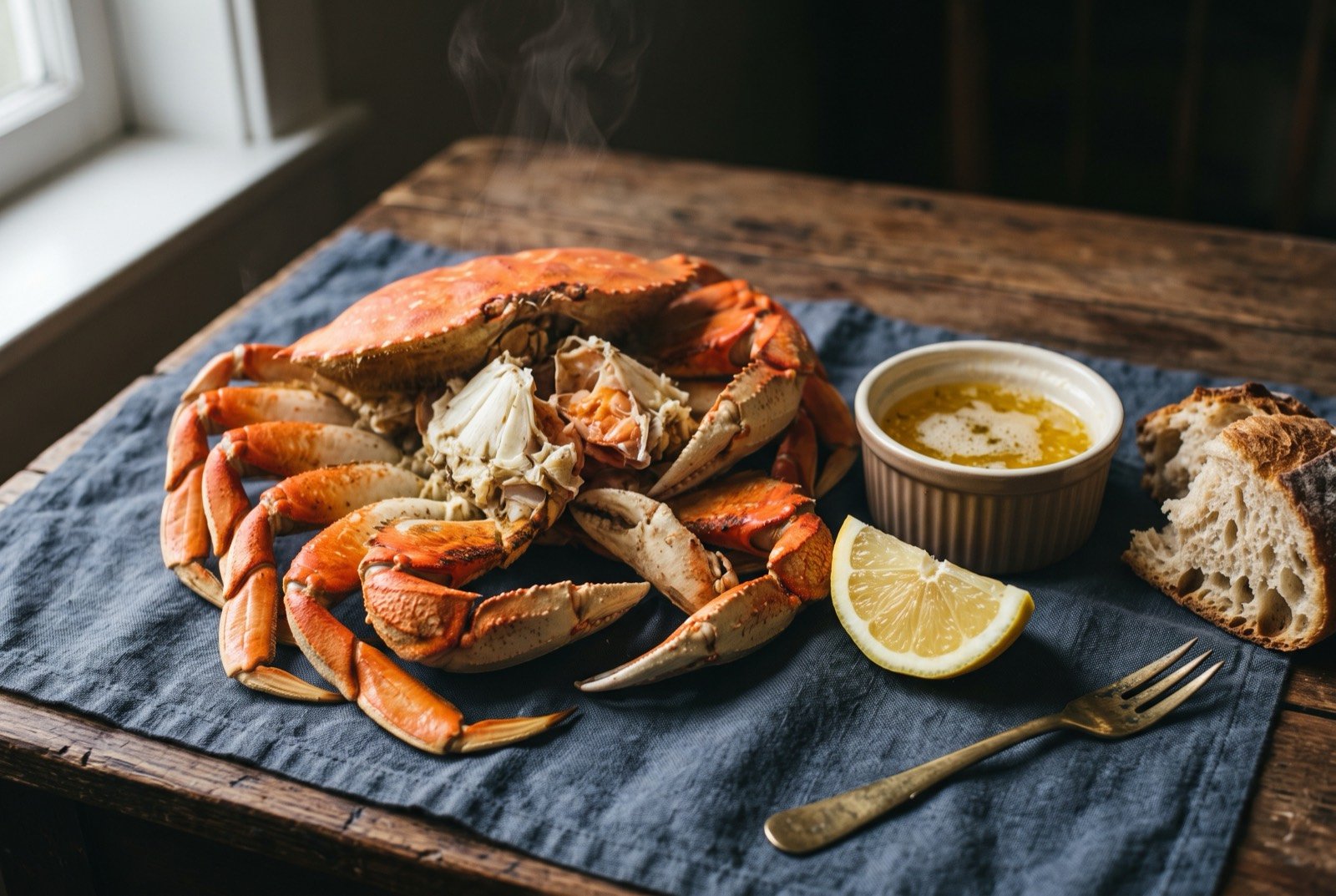
Two food worlds share a coastline, a Gold Rush and a real claim to having reinvented how the rest of America eats, and this chapter refuses to flatten either into the other. The Pacific Northwest is a maritime and agricultural world: a Dungeness crab fishery run to a biotoxin test rather than a calendar date, a wine country planted from nothing in living memory, a hazelnut industry confined to one narrow climate band, and a food identity its own chefs admit has no single signature dish. California is an invention economy: a Berkeley restaurant that turned sourcing itself into a philosophy in 1971, and city after city of immigrant reinvention, Cantonese, Japanese, Mexican, Vietnamese, Korean, each community remaking American food on its own terms rather than being folded into someone else's. Every dish as tradition built it, then what a modern chef would change.
Sources and review · What this chapter does not assert · How we research · Spotted something wrong?
A Sense of Place
This is a chapter about two food worlds that happen to share a coastline and a Gold Rush, not one Pacific cuisine with a wine list.
The Pacific Northwest: an ingredient-driven cuisine that admits it has no signature dish
The most honest single description of Pacific Northwest food found anywhere in this chapter's research comes from the region's own chefs, gathered by the Seattle Times for a dedicated investigative project asking, plainly, "what is Pacific Northwest cuisine?" Their answer: there is no equivalent of gumbo or a state dish, and the region's identity is ingredient-driven rather than dish-defined, built on what the coast, the forest and the valley actually produce, not on a fixed repertoire. James Beard, born in Portland in 1903 and raised there foraging native berries, nuts and wild mushrooms as a child while eating fish, clams and crab pulled straight from the Pacific, was on record in 1983 lamenting that no restaurant had yet properly celebrated the region's seafood and foraged ingredients as a cuisine in its own right. The turn came in the mid-1980s, and this chapter dates it precisely where the record allows: chef Jerry Traunfeld arrived in the Pacific Northwest from San Francisco in 1986 and found a regional cuisine only just emerging, and his tenure at The Herbfarm helped establish it as what the Seattle Times calls the premier dining experience in the region.
What actually organises the Pacific Northwest table, ecologically, is threefold. First, the Pacific itself: Dungeness crab, wild salmon, oysters, geoduck and razor clam, a fishery managed jointly by Washington, Oregon and California and now routinely disrupted by domoic acid testing and humpback whale entanglement protections rather than opened on a fixed date. Second, the volcanic, ocean-moderated valleys running inland from the coast, the Willamette Valley above all, whose Jory soil and maritime climate turned out, entirely against the prevailing wisdom of the 1960s, to suit pinot noir; and whose narrow band of tolerable winter cold and summer heat makes it, together with a handful of similar valleys, essentially the only place in America that can grow a hazelnut commercially. Third, the forest itself, chanterelle, porcini and matsutake mushrooms that cannot be farmed because they depend on a living mycorrhizal relationship with tree roots, and which sustain a genuine wild-harvest economy rather than a purely recreational one. Seattle and Portland, the region's two food cities, both trace their present identity to specific, dateable, and in Seattle's case deliberately manufactured, moments rather than to old inherited custom: Pike Place Market's fish-throwing theatre is a 1980s business decision, not a market tradition dating to 1907, and Portland's food cart pods are a Great Recession-era response to a lack of restaurant capital, not a longstanding street-food culture.
California: an invention economy built on sourcing and reinvention
California's food identity runs on a different logic entirely: not what the land alone provides, though it provides an extraordinary amount, California grows roughly 80 percent of the world's almonds and 99 percent of US walnuts from the Central Valley alone, but what waves of people arriving with nothing have made of it. Chinese immigrants arriving in the Gold Rush built San Francisco's Chinatown, the oldest in North America, against organised hostility that culminated in the federal Exclusion Act of 1882, and turned the restaurant trade into one of the only paths open to them, by the 1920 census a quarter of all employed Chinese Americans nationally worked as cooks, waiters or restaurant operators. Italian immigrant fishermen, mostly Ligurian, built the Dungeness crab and cioppino economy around San Francisco's old wharves from the mid-1800s, while Portuguese Azoreans, California holds the largest Azorean population in the United States, turned the crab feed into a parish fundraiser tied to the Holy Ghost Festival. Japanese immigrants built Little Tokyo and a genuinely sophisticated confectionery and produce trade, a community whose food economy was then violently interrupted by wartime incarceration, and whose postwar restaurant scene, sushi bars included, was rebuilt against that loss rather than continuing unbroken. Mexican immigrants and Baja-adjacent border culture gave San Francisco the Mission burrito and San Diego the battered fish taco. The fall of Saigon in 1975 sent tens of thousands of Vietnamese refugees through Camp Pendleton and into what became Little Saigon, Orange County, now the cultural capital of the global Vietnamese diaspora. And in 2008, a Filipino-American, a Korean-American chef trained in classical French technique, and a food truck met in a Hollywood parking lot at midnight and produced, in Kogi's Korean-Mexican tacos, one of the most precisely documented culinary inventions in modern American food history.
Sitting over all of it, and giving this chapter its second organising idea, is a specific, dateable philosophy: Alice Waters's Chez Panisse, opened in Berkeley in 1971, out of which grew the claim that sourcing itself, not technique, is 85 to 90 percent of cooking. That claim, and the direct line of chefs who took it in genuinely different directions, from Judy Rodgers's wood oven to Paul Bertolli's cured meats to Brandon Jew's deliberate collision of Cantonese, French and Californian technique in a single Chinatown kitchen, is the thread this chapter follows from the Berkeley hills down to the food trucks of Los Angeles.
A table of the defining logic
| Element | The Pacific Northwest | California |
|---|---|---|
| Defining resource | Dungeness crab, wild Pacific salmon, the Willamette Valley's volcanic soil | Sourcing itself, Central Valley produce, wave after wave of immigrant technique |
| Signature philosophy | Ingredient-driven, no fixed dish, honestly admitted by its own chefs | Market-driven and chef-led, formalised at Chez Panisse from 1977 |
| Occasion | The crab feed, the Holy Ghost Festival, the winter chanterelle and razor clam season | The taqueria counter, the food truck at midnight, the Chinatown banquet |
| Defining economic force | A tri-state fishery run by biotoxin testing, an agricultural climate niche | Immigration and reinvention, Gold Rush to 1975 refugee resettlement to 2008 |
| Reference dish | The Dungeness crab feed | The Mission burrito, or Kogi's Korean short rib taco |
The History in Layers
The deep root this chapter does not re-tread
Before any of what follows, the Pacific Northwest Coast and California's own acorn-culture nations, the Haida, Tlingit, Coast Salish and Nuu-chah-nulth on the coast, the Yurok, Karuk, Hupa, Pomo, Miwok and Ohlone inland, built one of the very few hunter-gatherer societies on earth to sustain permanent villages and food surplus without agriculture, managing salmon runs, cedar and acorn ecology with a sophistication this atlas has already given full treatment in its own volume, AM-29, Pacific Coast Indigenous Foodways. Cedar plank salmon, oolichan grease, herring roe on kelp, camas and acorn technique all belong there, and this chapter deliberately does not re-research or repeat any of it. Where settler-era practice visibly borrows from that tradition, restaurant cedar plank salmon being the clearest case, this chapter names the relationship and sends the reader to AM-29 rather than treating the adopted, commercialised version as though it were the original.
The Gold Rush and the port cities it built
San Francisco's Chinatown traces to 1849, when Chinese immigrant merchants held an early community meeting during the Gold Rush; an estimated 25,000 Chinese immigrants arrived in the Bay Area in those years hoping to strike it rich. The community endured serious, organised hostility, the Workingmen's Party agitation of the 1870s under Dennis Kearney, and the federal Chinese Exclusion Act of 1882, which banned further Chinese immigration outright. Chop suey, first documented in American newspapers from the 1880s, is genuinely contested in its origin: the popular story crediting the chef of Qing dynasty premier Li Hongzhang during his 1896 US visit is rejected by the historian Renqiu Yu, who found no evidence Li actually ate the dish in America and notes he travelled with his own chefs. The stronger etymological theory, from anthropologist E.N. Anderson, traces the dish to tsap seui, "miscellaneous leftovers," documented in Taishan, Guangdong province, the home region of most early Chinese immigrants to California; the dish was collectively adopted and standardised by Chinese-American restaurant owners across many cities, not invented by any single identifiable cook.
Isidore Boudin, from a family of master bakers from Burgundy, is credited with founding what is now Boudin Bakery in San Francisco in 1849, working the Gold Rush miners' carried sourdough starter into French baking technique. That founding story, and the widely repeated tale of the bakery's mother starter being rescued from the 1906 earthquake, rest on company lore and tourist-facing retellings rather than independent historical corroboration, and this chapter states that plainly rather than repeating it as settled fact. What is independently verified is the microbiology behind the bread's flavour: Lactobacillus sanfranciscensis, isolated and named in 1971, is genuinely the dominant bacterial species in traditionally maintained San Francisco starters. What is myth is the idea that San Francisco's fog uniquely produces it; the same bacterium has since been found in sourdough bakeries in France, Italy and China, and which strain dominates a given starter tracks the bakery's own handling practices, not the city's geography.
Alongside the Chinese and French bakers came Italian immigrant fishermen, mostly from Genoa and the Ligurian coast, who built the commercial Dungeness fishery around San Francisco's Meiggs Wharf and North Beach from the mid-1800s, and with it cioppino, a tomato, wine and seafood stew whose name most plausibly derives from ciuppin, Ligurian dialect for a lighter, less tomato-forward fish soup from the same immigrants' home region, though a competing and much-repeated folk etymology holds that fishermen literally asked each other to "chip in" catch to a shared pot. This chapter gives both, since neither is settled.
Wine, onions and the invention of an inland ecology
Two Pacific Northwest institutions were built, deliberately and against prevailing expert opinion, within living memory. David Lett planted the first pinot noir vines in the Willamette Valley on 22 February 1965, using roughly 3,000 cuttings gathered from California, after a two-year viticulture course at UC Davis convinced him, against the received wisdom of the time that Oregon could not successfully grow European wine grapes at all, that the valley's cool, maritime climate was closer kin to Burgundy than anyone had tried. His winery, The Eyrie Vineyards, released its first vintage in 1970, and Oregon pinot noir's international credibility dates to a specific event: the 1975 Eyrie Reserve placed in the top ten at the 1979 "Wine Olympics" blind tasting in Paris, then came second in a 1980 rematch, losing to a 1959 Burgundy by two-tenths of a point. Walla Walla's wine industry has an equally exact founding point: Leonetti Cellar, founded in 1977 by Gary and Nancy Figgins, whose Italian immigrant grandparents had kept their own vineyard, released its first wines in 1978, and its cabernet sauvignon was named best in America in 1982. The Walla Walla sweet onion, meanwhile, carries genuine but precisely describable federal protection, a US marketing order and certification trademark, not the EU-style Protected Designation of Origin some secondary sources claim, developed by Italian immigrant growers John Arbini and Tony Locati in the 1920s from a variety popularly said to have arrived with a French soldier from Corsica.
Internment, and the honest cost to Japanese-American food culture
Japanese immigration to California built substantial agricultural and culinary communities well before the Second World War, including Little Tokyo's own confectionery trade: Makoto Hagiwara is credited by his descendants with serving the first fortune cookies at the Japanese Tea Garden in Golden Gate Park from around 1894, adapting the Japanese cracker senbei by inserting a paper fortune, and Seiichi Kito's Fugetsu-Do in Little Tokyo, founded 1903, offers a rival, equally Japanese-American claim. That continuity was violently interrupted by Executive Order 9066: the forced removal and incarceration of roughly 120,000 Japanese Americans, most from the West Coast, into ten War Relocation Authority camps from 1942. Little Tokyo was reduced to what one account calls a ghost town; restaurants were forced to close outright. Inside the camps, meals were served cafeteria-style, roughly 500 people per mess hall across three shifts, and the diet was an abrupt, often unhealthy rupture from what incarcerated families had eaten, rice, fish, tofu and miso replaced by Army-surplus rations, canned sauerkraut, tinned sausages, mutton stew and increasingly SPAM, with documented health consequences including exacerbated diabetes. Families preserved what identity they could, many Issei brought their own chopsticks and shoyu into the mess halls, and a traditional mochitsuki, rice-cake pounding, was organised at Manzanar in December 1942. Little Tokyo's population density and built environment never recovered to prewar levels even by the 1960s. This chapter states the causal line directly: the postwar Japanese-American restaurant scene, including the sushi bars and the California roll below, was rebuilt against that loss, not a simple continuous tradition, and it would misrepresent the community's history to write around that fact.
Berkeley, 1971, and the claim that sourcing is the technique
Alice Waters, 27 and a former Montessori teacher, opened Chez Panisse in Berkeley in 1971 with roughly $10,000 of capital. She has been consistent that the ambition was modest rather than visionary, "it was as naïve as that," a community restaurant, a place for friends to gather, but she has also directly tied the restaurant to her own activism as a Free Speech Movement participant at Berkeley in the mid-1960s: "activism and the restaurant were all of a piece for me... this was a different kind of activism." Two named influences sit behind the food itself: Richard Olney, the American expatriate food writer in Provence, credited by Waters for teaching her "about seasonality, and about having a sense of time and place when I cooked," and Lulu and Lucien Peyraud, Provençal vineyard owners whose model of hospitality and seasonal eating she cites directly in her memoir. The restaurant did not start out as an ingredient-first showcase; it opened cooking a fairly conventional French provincial menu, and the pivot to what became identified as California cuisine happened gradually between 1977 and 1983, as farmers and foragers realised there was a market for seasonal, local produce and began selling directly to the kitchen.
Waters's own reduction of the idea is worth quoting exactly, since the whole modernist thread of this chapter runs from it: "finding the right ingredients is... 85 percent of cooking... and then it's so easy after that. You just let them be themselves." This chapter does not let that claim stand as sole authorship. Jeremiah Tower, hired at Chez Panisse in 1972 and credited by many with much of the restaurant's early culinary direction, left in 1978 after disputes with Waters and has publicly contested her later positioning as sole author of California cuisine. Wolfgang Puck's Spago, opened in Los Angeles in January 1982, fusing French training with Californian ingredients and Asian elements around a wood-burning oven, is an independent, semi-parallel origin point. The honest reading is at least three semi-independent starts in the 1970s and early 1980s, not one inventor.
The idea's spread has since drifted well past its own politics: "farm to table" is now a $112 billion global restaurant-marketing category, and Eater Austin's former editor Nadia Chaudhury has said the phrase is now rarely used with any precision because verifying that ingredients genuinely come from named farms is beyond most newsrooms' resources. A sharper critique, from a 2021 Jacobin essay, argues that Waters's preferred solution, that food should simply cost more so farmers can be paid better, creates a false opposition between consumers' and farmworkers' interests, and that a food politics genuinely of the left would prioritise cheap food for ordinary people rather than premium pricing as a proxy for virtue. This chapter treats that as a serious argument worth naming, not a footnote.
1975, 2008, and the reinvention of the taco
The fall of Saigon in April 1975 sent Vietnamese refugees through Camp Pendleton, the Marine Corps base in San Diego County, which processed around 50,400 people that year alone; many resettled in central Orange County, and a Vietnamese commercial district grew from about 30 businesses in 1979 to roughly 750 by 1988, formally designated Little Saigon that year. The Lê family, who left Vietnam by boat in 1979 and settled in San Jose, opened Lee's Sandwiches in June 1983, widely credited with introducing banh mi and Vietnamese iced coffee to a mainstream American audience.
Kogi Korean BBQ launched on 19 November 2008 in Los Angeles, founded by Mark Manguera, a Filipino-American who had married into a Korean family, and Caroline Shin, with Roy Choi, a Culinary Institute of America-trained chef with years of Michelin-calibre hotel kitchen experience, as chief chef. Manguera's specific inspiration was the marriage of Mexican and Korean food through his own family; the truck ran at midnight in a Hollywood nightclub parking lot, using the then-new platform Twitter to announce its location in real time, a marketing innovation credited with helping launch the modern American food truck movement more broadly. Within months it was serving up to 400 pounds of meat a day, and Choi was named Food & Wine's Best New Chef in 2010, the first food truck operator to receive that distinction. Wes Avila, a classically French-trained sous chef who could not cover rent on a restaurant salary, spent his last $167 on ingredients and began selling tacos from an unpermitted cart in the Arts District, growing Guerrilla Tacos into a brick-and-mortar restaurant by 2018; he is one of what the food writer Jonathan Gold's own city was described as producing, "a new wave of LA chefs: children of immigrants, classically trained in French cuisine, who blur the lines between high and low." Gold himself, the first restaurant critic to win a Pulitzer Prize for criticism, said plainly of his own project: "I am trying to democratize food and trying to get people to live in the entire city of Los Angeles."
The Flavour Arsenal
Dungeness crab. Metacarcinus magister, managed under a tri-state Washington-Oregon-California agreement and opened each season only once a meat-fill test, roughly 23 percent meat recovery by body weight in Washington, confirms the crab has fully hardened its shell after moulting. A good crab should feel heavy for its size, the buyer's own proxy for the same test.
Wild Pacific salmon. Five species, chinook, sockeye, coho, chum and pink, run on overlapping schedules from spring through winter. Its deep preparation belongs to AM-29; here it appears mainly as a Cascade PBS-style modern menu item and as the fish a restaurant cedar plank borrows its technique from.
Sourdough culture. Lactobacillus sanfranciscensis working symbiotically with wild yeast, fed on a starter-to-flour-to-water ratio of roughly 1:1:1 by weight for daily maintenance, built up to 1:2:2 or higher before a bake, at a feeding rhythm set by ambient temperature rather than the clock.
Hass avocado. Every commercially significant Hass tree traces to a single seedling planted in 1926 by Rudolph Hass, a Pasadena postal carrier, who let a graft failure grow on its own rootstock rather than pull it out; the patented variety now accounts for roughly 95 percent of California's commercially grown avocados and a majority of the fruit eaten worldwide.
California citrus. Concentrated in the San Joaquin Valley, organised since 1893 into what became Sunkist Growers, whose brand name dates to 1909; navel oranges are the largest category by acreage, with Tulare County the leading producer.
Central Valley produce. Roughly 80 percent of the world's almonds, 99 percent of US walnuts, 95 percent of the country's processing tomatoes, grown on around 1 percent of US farmland and increasingly dependent on groundwater the 2014 Sustainable Groundwater Management Act is only now trying to bring back into balance by 2040.
Oregon hazelnuts. The Willamette Valley alone accounts for 99.9 percent of US commercial hazelnut production, a climate niche so narrow that catkins can freeze at 15°F once elongated; the industry's root nursery stock traces to George Dorris's 1903 planting at what is now Dorris Ranch.
Marionberries. A deliberately bred cultivar, not a wild fruit: horticulturist George F. Waldo crossed the 'Chehalem' and 'Olallie' berries in 1945, releasing the result commercially in 1956. Oregon grows over 90 percent of the world's marionberry acreage and it is now the state's official pie.
Willamette Valley soil. Jory, a deep, iron-rich, red volcanic clay loam, anchors the Dundee Hills AVA, the sub-appellation most credited with establishing Oregon's pinot noir reputation; marine sedimentary soils elsewhere in the valley give darker, more structurally firm wines.
Walla Walla sweet onion. An heirloom variety not hybridised since 1905, protected by a US federal marketing order and a certification trademark rather than a European-style designation, developed into its modern sweet form by Italian immigrant growers in the 1920s.
Wild chanterelles. Oregon's official state mushroom since 1999, found among Douglas fir, hemlock and spruce above 1,000 feet elevation, foraged September to November and genuinely uncultivable, since the fungus depends on a living mycorrhizal relationship with tree roots.
Geoduck and razor clam. A recent, overwhelmingly export-driven Pacific Northwest industry, geoduck harvest running roughly 90 percent to China by value, and Washington's recreational razor clam digs a real, actively regulated seasonal institution dating festival roots to 1940.
Masa and the Mission burrito's tortilla. A large wheat flour tortilla, steamed rather than griddled for pliability, the structural technology that lets a Mission burrito hold far more filling than a standard Mexican burrito without tearing.
Nori and sushi rice. The material Ichiro Mashita's Tokyo Kaikan kitchen is credited with turning inside out, rice on the exterior, seaweed hidden within, specifically to overcome American diners' discomfort at the sight of nori.
Gochujang and the Korean marinade base. Soy sauce, sugar, garlic, sesame and a fruit-based tenderiser, the technique base Kogi's kitchen set directly against a Mexican salsa and slaw in a single dish.
Baja batter and cabbage slaw. A light, cold beer-thinned batter, deep-fried mild white fish, shredded cabbage and a thin, mayonnaise- or crema-based sauce, the format Ralph Rubio carried north from a San Felipe fish stand in 1974.
The Technique Ladder
The argument, from inside
Seven techniques, ranked roughly by skill investment, each explained by why it works, not only what it does.
Rung 1. Reading a starter by smell and rise, not the clock
A healthy sourdough starter doubles predictably at a given temperature; judging readiness by its dome and its faintly acidic, yeasty smell rather than a fixed hour count is the entry-level discipline behind every dish in this chapter that touches bread.
Rung 2. Boiling and shocking a Dungeness crab
Live crab into heavily salted, rolling boiling water for 18 to 20 minutes after the water returns to a full boil, per the Oregon Dungeness Crab Commission's own published guidance, then straight into cold water to halt the cooking before cleaning; the shock is not a garnish step, it is what stops residual heat from overcooking the meat inside a shell that is itself a poor conductor.
Rung 3. Dry brining
Judy Rodgers's Zuni Café method, salting a bird or a large cut one to three days ahead and leaving it uncovered in the fridge, draws moisture out through osmosis, dissolves the salt into it, and lets that concentrated brine reabsorb back into the flesh over the following days, seasoning it through rather than only on the surface, with none of the added water a wet brine leaves behind to steam the skin.
Rung 4. Live fire as a controlled-imprecision instrument
Rodgers built Zuni's entire repertoire around a wood-fired brick oven she required as a condition of taking the job; Gregory Gourdet's Kann in Portland is built entirely around live wood fire for both flavour and identity. The mechanism worth understanding is that coals radiate heat unevenly and change second to second, which is a discipline, reading and adjusting to a live fire rather than trusting a dial, not a limitation to be engineered away.
Rung 5. Steaming a flour tortilla for structural pliability
A tortilla wrapped in a damp towel and briefly heated, whether by microwave for a minute or two or by a hot damp press for thirty seconds, absorbs enough moisture to fold and roll without cracking, the specific technology that makes the oversized Mission burrito possible in the first place.
Rung 6. High, fast wok heat
The defining equipment of the historic Chinatown chop suey house, stir-frying a wide range of ingredients quickly against an assertive sauce, a technique that depends on getting far more heat into the pan than a domestic Western hob usually delivers, and on having every ingredient prepared and within reach before the pan goes on.
Rung 7. Curing and charcuterie as recovered, not novel, technique
Paul Bertolli's move from Chez Panisse into founding Fra' Mani Handcrafted Salumi was explicitly framed as recovering "pre-agribusiness" cured-meat flavour and method, a genuinely patient, low-and-slow discipline well suited to a dehydrator and the willingness to wait days rather than hours.
The Ferment and Preserve Bench
Three preparations, each a genuine technology this economy or tradition actually built, not a modern flourish.
The sourdough starter itself. A living wild fermentation, maintained on a strict feeding rhythm because it must be, the same principle behind every leavened bread this chapter treats, and the closest thing California has to a single, continuous culinary lineage running back to the Gold Rush.
Cured meat, in Bertolli's own recovered sense. Fra' Mani's founding mission, explicitly framed as recovering "pre-agribusiness" cured-meat flavour and method rather than inventing a novelty, is this chapter's clearest case of a preservation technology treated with the seriousness a modernist kitchen owes it.
Kimchi and pickled vegetables, the layer Kogi set against Mexican technique. Fermented napa cabbage on the Korean side, quick-pickled onion, cabbage and chile on the Mexican side, sit either side of the same taco without being merged into one thing, exactly the collision this chapter's whole California section keeps finding.
Sourcing in Britain
Dungeness crab, this volume's hardest gap. No UK retailer, specialist fishmonger or importer offering genuine Pacific Dungeness crab as a normal stocked item, fresh or frozen, could be found in this chapter's research. State that plainly: Dungeness crab, as such, is not available to a UK cook. The honest substitute is UK brown crab (Cancer pagurus) or spider crab (Maja brachydactyla), well supplied by The Cornish Fishmonger, W Harvey & Sons, The Cornish Food Box Company and Jacksons Fishmongers, though this chapter is explicit that it is a substitution rather than an equivalent species: Dungeness carries a sweeter, more delicate meat-to-shell ratio than the denser brown crab.
Geoduck, a real failure, and razor clam as the honest parallel. Geoduck is essentially unobtainable through ordinary UK retail; it is overwhelmingly an export commodity to China, Hong Kong and Japan. UK razor clams are caught around the British coast but rarely appear in ordinary fishmongers for the same reason, they command high prices in Asian export markets, so the majority leave the country; where available, through specialists such as Bradley's Fish and Fish Glorious Fish. The two are unrelated species with different textures, and this chapter draws the parallel honestly, as a shared economic story rather than a flavour substitution.
Wild Pacific salmon, a genuine but narrow win. Per the Marine Conservation Society's own buying guidance, keta, sockeye and pink are the three Pacific species readily available in the UK, most often tinned; chinook and coho are not commonly stocked. The Fish Society sells wild sockeye specifically, at roughly two to three times the price of standard supermarket farmed Atlantic fillets. Farmed Atlantic salmon dominates UK shelves by an overwhelming margin, and this chapter states honestly that a UK cook wanting the true Pacific article is buying a real but premium, species-limited, specialist-retailer item.
Sourdough starter and flour, straightforward. Dough Dough and Freshly Fermented both sell UK-cultivated "San Francisco style" starters, though the specific DNA-verification claim made by one retailer rests on that retailer's own marketing rather than independent confirmation, and, as established above, geographic exclusivity is itself a myth the science does not support; ordinary UK strong white bread flour is entirely adequate for feeding either.
Mexican ingredients, one of the strongest sourcing stories in the whole chapter. Cool Chile Co, trading since 1993 and based in London, imports dried chillies, herbs and masa harina directly from Mexico and makes its own preservative-free corn tortillas in London from genuine nixtamalised Mexican field corn. Mextrade in Surrey runs its own tortilleria; Mestizo Market in London stocks fresh tortillas and dried chiles. For everyday shopping, Waitrose's larger branches stock fresh jalapeño and serrano chillies and a reasonable range of tinned and jarred Mexican staples, and the Latin Village market near Seven Sisters in North London carries fresh tortillas, dried chillies and masa harina across several stalls.
Willamette Valley pinot noir and Walla Walla wine, real but niche. Both are genuinely stocked in Britain through wine-trade specialists rather than supermarket shelves: Hedonism Wines, VINVM and Flint Wines all carry named Walla Walla producers, and VINVM, Majestic Wine and Adnams carry Oregon and Willamette Valley bottlings. This chapter could not confirm specific stock at Berry Bros & Rudd or The Wine Society, and hedges accordingly rather than claiming either does or does not.
Oregon hazelnuts, chanterelles and marionberries. Hazelnuts are genuinely buyable in the UK, but this chapter could not confirm that any specific UK stock is Oregon-origin rather than Turkish or Italian, the two dominant global producers, and states that plainly: a UK shelf hazelnut is very likely not the Oregon article unless explicitly labelled. Chanterelles need no importing at all; Britain has its own genuine wild season, roughly July to November, peaking September to October, under beech in England and birch in Scotland, and this chapter actively steers the reader toward foraging or buying that domestic crop rather than chasing a Pacific Northwest import. Marionberries fail entirely as a UK retail item; an apparent "availability" claim traced, on verification, to a nursery selling potted plants to grow rather than fruit to eat. The honest substitute is ordinary UK blackberry, in season August to October, or loganberry for a more tart, complex flavour.
No dedicated gateway. Unlike several other cuisines this atlas has covered, no single specialist importer bringing Pacific Northwest or Californian speciality food into the UK as a coherent category could be found. A UK cook assembling this pantry shops across several separate specialists, seafood, wine, Mexican grocery, rather than through one dedicated source, and this chapter states that absence plainly rather than implying an ease of sourcing that does not exist.
Voices and Sources
Institutional and regulatory sources: the Oregon Dungeness Crab Commission and Washington Department of Fish and Wildlife, whose own published guidance anchors this chapter's crab material; USDA's Agricultural Marketing Service and the federal register for the Walla Walla onion marketing order; the Marine Conservation Society's Good Fish Guide; HistoryLink.org, the Seattle Times, and Cascade PBS for Pacific Northwest food-city history; and the National WWII Museum and PBS SoCal for the internment material this chapter treats without softening.
Named chefs and restaurateurs: Alice Waters, Jeremiah Tower, Judy Rodgers of Zuni Café, Paul Bertolli of Fra' Mani, Joyce Goldstein of Square One, David Tanis, and Wolfgang Puck of Spago, whose Berkeley and Los Angeles kitchens together carry this chapter's modernist argument; Gregory Gourdet of Kann and Ryan Roadhouse of Nodoguro in Portland, and Renee Erickson and Matt Dillon in Seattle, whose James Beard-recognised kitchens define what contemporary Pacific Northwest cuisine actually is; Brandon Jew of Mister Jiu's, Niki Nakayama of n/naka, Katianna and John Hong of Yangban, and the late Charles Phan of the Slanted Door, whose kitchens elevated Chinese, Japanese, Korean and Vietnamese technique in California on their own terms; and Roy Choi of Kogi, Wes Avila of Guerrilla Tacos, and Ralph Rubio, whose food trucks and taco stands carry this chapter's clearest documented invention stories.
Historians and critics: the late Jonathan Gold, whose Pulitzer-winning criticism is this chapter's clearest source on how Los Angeles's food culture actually works; historians Renqiu Yu and E.N. Anderson on chop suey's contested origin; historian Yasuko Nakamachi on the fortune cookie's Japanese roots; and the Chinese Historical Society of America and the Chinese Historical & Cultural Project, whose own institutional accounts this chapter has preferred over generalist retellings wherever the two conflict.
Things this chapter has deliberately not asserted
- That the fortune cookie is Chinese in origin. Every serious American claimant to inventing it was a Japanese immigrant confectioner, and its association with Chinese-American restaurants is a mid-twentieth-century commercial adoption, not a reflection of where the idea came from.
- That any single named chef, Ichiro Mashita, Ken Seusa or Hidekazu Tojo, definitively invented the California roll or inside-out sushi. At least three credible, competing claims exist, and this chapter has not picked a winner.
- That cioppino's name definitely derives from "chip in" rather than the Ligurian ciuppin, or the reverse. Both are widely repeated and neither is settled.
- That either El Faro or La Cumbre definitively invented the Mission burrito. Both claims are self-reported by the businesses concerned, and neither is independently, contemporaneously documented.
- That the Robert Cobb 1937 Cobb salad origin story is airtight. A credible, less-repeated rival account credits the Brown Derby's chef, Robert Kreis, with the dish in 1929.
- That Boudin Bakery's founding narrative, or the story of its mother starter surviving the 1906 earthquake, is independently documented rather than company lore repeated by tourist-facing sources.
- That contemporary Pacific Northwest smoking and curing technique can be traced, chef by chef, to a specific named Indigenous method or community. The connection is real in general terms but not documented at that level of specificity in any source this chapter reached.
- That the Walla Walla sweet onion holds EU-style Protected Designation of Origin status. It does not; what exists is a US federal marketing order and a certification trademark, a real but different form of protection.
- That a currently operating, critically documented case of elevated Vietnamese fine dining exists in Los Angeles specifically, at the same depth as San Francisco's well-documented Charles Phan example. This chapter's research found a real gap here rather than a name to fill it.
- That marionberries, Oregon hazelnuts of confirmed origin, or fresh geoduck can be reliably bought in the United Kingdom. Each of these fails as a UK retail item in ways this chapter states plainly rather than glossing over.
Reading a starter by smell and rise, not the clock
A healthy sourdough starter doubles predictably at a given temperature; judging readiness by its dome and its faintly acidic, yeasty smell rather than a fixed...
Boiling and shocking a Dungeness crab
Live crab into heavily salted, rolling boiling water for 18 to 20 minutes after the water returns to a full boil, per the Oregon Dungeness Crab Commission's...
Dry brining
Judy Rodgers's Zuni Café method, salting a bird or a large cut one to three days ahead and leaving it uncovered in the fridge, draws moisture out through...
Live fire as a controlled-imprecision instrument
Rodgers built Zuni's entire repertoire around a wood-fired brick oven she required as a condition of taking the job; Gregory Gourdet's Kann in Portland is...
Steaming a flour tortilla for structural pliability
A tortilla wrapped in a damp towel and briefly heated, whether by microwave for a minute or two or by a hot damp press for thirty seconds, absorbs enough...
High, fast wok heat
The defining equipment of the historic Chinatown chop suey house, stir-frying a wide range of ingredients quickly against an assertive sauce, a technique that...
Curing and charcuterie as recovered, not novel, technique
Paul Bertolli's move from Chez Panisse into founding Fra' Mani Handcrafted Salumi was explicitly framed as recovering "pre-agribusiness" cured-meat flavour and...
The dishes
- The Dungeness crab feed Pacific Northwest and California coasts, United States
- San Francisco sourdough bread San Francisco, California, United States
- Cioppino San Francisco, California, United States
- Mission burrito Mission District, San Francisco, California, United States
- Cobb salad Hollywood, Los Angeles, California, United States
- California roll Little Tokyo, Los Angeles, California, United States
- Kogi-style Korean short rib taco Los Angeles, California, United States
- Baja-style fish taco Baja California, Mexico
- Willamette Valley marionberry pie Willamette Valley, Oregon, United States
- Crab Louis Pacific Northwest and San Francisco, United States
Sources and review
- Reviewed
- Not yet reviewed from inside the tradition
- Cooked
- Not yet cooked and reported
Where this volume comes from
3 research briefs on file for this volume, researched to the rules on How we research. Published 3 September 2026. Last changed 8 September 2026.
The brief's own account of its sources
Overall mix, both parts. Of the roughly 75 sources drawn on across this brief, a strong core rests on primary or quasi-official bodies: the Oregon Dungeness Crab Commission, Washington Department of Fish and Wildlife, USDA's Agricultural Marketing Service and the federal register for the Walla Walla onion marketing order, the USPTO trademark record, HistoryLink.org, and a peer-reviewed genomics paper on *Lactobacillus sanfranciscensis*.