The Americas · Volume 30
Woodlands, Plains and Southwest Indigenous Foodways
The Three Sisters, the Bison and the Piki Stone
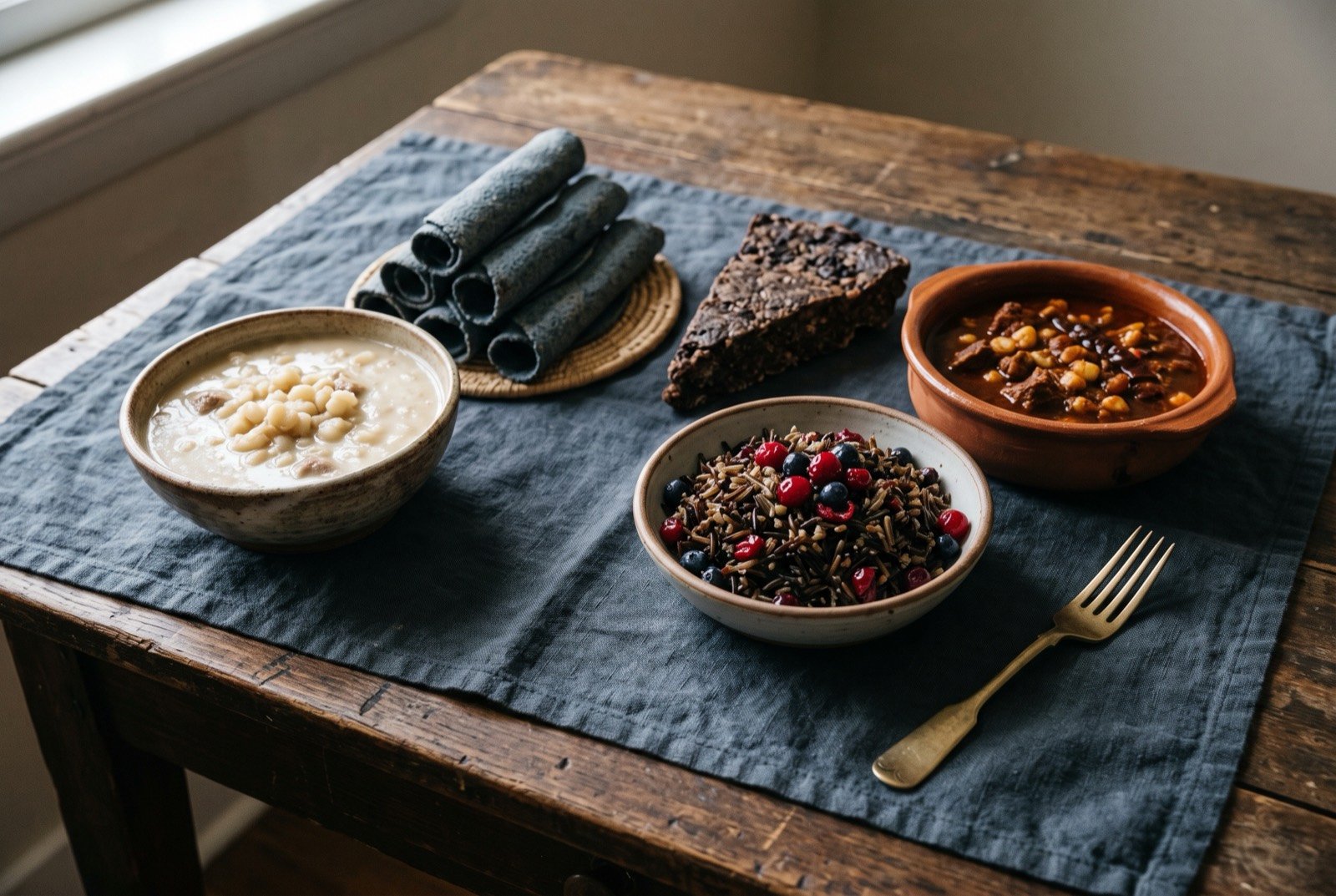
Three food worlds, not one, sharing a continent's interior and very little else. The Eastern Woodlands and Southeast built a civilisation on corn, beans and squash grown together in the same mound, a technique with a real agronomic logic behind it. The Great Plains built one on the bison, hunted communally on foot for millennia before the horse arrived, with an ethic of using the whole animal that is doctrine, not sentiment. The Puebloan Southwest built one on farming a desert without irrigation, corn planted eighteen inches deep to reach water no rain provides. What binds the three into one volume is not a shared cuisine, since Hopi piki bread and Lakota pemmican have almost nothing in common on a plate, but a shared and unfinished argument: these are living nations, still farming, still cooking, and in the case of wild rice, still fighting in tribal courts for the resources that make the food possible at all. Every dish as tradition built it, then what a modern chef would change, once as tradition built it, once rebuilt with the same rigour the food sovereignty movement is already applying, in restaurants and kitchens across this exact territory, right now.
Sources and review · What this chapter does not assert · How we research · Spotted something wrong?
A Sense of Place
Three ecologies, one continental interior
The Eastern Woodlands and the Great Plains are separated by more than distance. The Haudenosaunee, the Iroquois Confederacy of Mohawk, Oneida, Onondaga, Cayuga and Seneca, joined in the early eighteenth century by the Tuscarora as the sixth nation, occupy the temperate woodland belt of what is now New York State and southern Ontario and Quebec, an ecology suited to maize, bean and squash horticulture, supplemented by hunting, fishing and maple sugaring. The Muscogee, Chickasaw and Choctaw occupy the warmer Southeastern Woodlands, where a longer growing season built a ceremonial calendar directly around the ripening of corn. The Anishinaabe, Ojibwe or Chippewa, plus the related Odawa and Potawatomi, occupy the Great Lakes, where the defining food resource is not a cultivated crop at all but manoomin, wild rice, which grows naturally in shallow lakes and rivers and is gathered, not planted. The Great Plains nations, Lakota, Cheyenne, Blackfeet and others, occupy the grassland interior, an ecology unsuited to reliable agriculture but that supported vast bison herds; the culture here is built around communal hunting rather than horticulture, transformed after the reintroduction of the horse in the eighteenth century. The Blackfeet acquired their first horses around 1730 to 1740, from Shoshone raiders and then Flathead, Kutenai and Nez Perce trade partners. Before horses, Plains nations hunted bison on foot using buffalo jumps, a technique documented in continuous use for over 12,000 years, sometimes with several nations sharing a single site: Hidatsa, Shoshone, Lakota, Dakota, Nez Perce, Bannock, Arapaho, Salish, Cheyenne, Blackfeet, Crow, Gros Ventre, Cree and Assiniboine are all named as historic users of jump sites.
The Puebloan Southwest is a genuinely different food world again, not a drier variant of the Plains. Agriculture, not hunting, is the ecological spine, practised in one of the driest inhabited landscapes in North America, without irrigation. The Hopi mesas sit at roughly 6,000 feet with a growing season of only 120 to 160 days, high summer heat, and under 10 inches of rainfall a year. This constraint, not choice, produced the technique. Michael Kotutwa Johnson, an enrolled Hopi tribal member, dryland farmer near Kykotsmovi Village and agriculture researcher at the University of Arizona, plants corn up to eighteen inches deep, seeking residual soil moisture, eight to ten seeds per hole spaced further apart than a conventional row, clustered in bundles of five or six so the plants stand together against wind and shade each other's soil, with windbreaks of desert brush. Timing is decided in April to June by checking the soil directly, not by a fixed calendar date. He knows twenty-four indigenous Hopi corn varieties. Floodwater, ak-chin, farming, harvesting seasonal monsoon runoff and its sediment where it spreads at an arroyo mouth, is the Hopi's other core method, and is also the primary technique of the Tohono O'odham, who have used it for centuries in southern Arizona and northern Sonora to grow maize, tepary beans and squash. At Zuni, waffle gardens, sunken, walled square planting cells resembling a waffle grid, pool water and wind-blown soil for high-value crops, originally chile and tobacco specifically, a technique estimated at roughly 1,000 years old and now being actively revived, roughly one hundred modified gardens installed across the pueblo under the Zuni Sustainable Agriculture Project, led by Zuni environmental technician Daniel Bowannie.
The peoples, their logic, and the dishes that carry it
| Region | Peoples named in this chapter | Defining logic | Carried by |
|---|---|---|---|
| Northeast Woodlands | Haudenosaunee: Mohawk, Oneida, Onondaga, Cayuga, Seneca, Tuscarora | Corn, bean and squash horticulture; maple as the native sweetener | White corn and bean soup, maple sugaring |
| Southeast Woodlands | Muscogee, Chickasaw, Choctaw | A ceremonial calendar built around the corn harvest; wood-ash corn processing | Pashofa, sofkee, the Green Corn Ceremony |
| Great Lakes | Anishinaabe: Ojibwe, Odawa, Potawatomi | A gathered, not planted, grain, defended today as a legal right | Wild rice, manoomin |
| Great Plains | Lakota, Cheyenne, Blackfeet and others | Communal bison hunting and full-animal use as doctrine | Pemmican, dried meat |
| Puebloan Southwest | Hopi, Zuni, the Rio Grande Pueblos, Tohono O'odham | Farming an arid landscape without irrigation | Piki bread, tepary beans, chile |
This chapter is honest that its Southwest sourcing skews toward Hopi, Zuni and Santa Clara voices specifically, and is genuinely thinner on the other individual Rio Grande Pueblos, Taos, Ohkay Owingeh, San Ildefonso, Cochiti, Santo Domingo, Acoma, Laguna and Jemez. Where this chapter says "Pueblo" without naming a specific nation, that is often really Hopi, Zuni or Santa Clara material generalised, not evenly drawn testimony from all nineteen New Mexico and Arizona pueblos, and the reader should hold that in mind.
The History in Layers
Three Sisters agriculture and a real institutional revival
The Three Sisters system, corn, beans and squash grown together so the corn stalk supports the climbing bean, the bean fixes nitrogen the corn draws on, and the squash's broad leaves shade the soil against weeds and moisture loss, is documented as originating in central Mexico and reaching the Northeast by roughly 1000 CE. Iroquois white corn is described as a 2,000 year staple of the Haudenosaunee diet, and the corn-processing tradition behind it has a real, citable, in-tradition institutional history: the Iroquois White Corn Project was founded in 1997 by John Mohawk, a significant Seneca scholar and activist, and Yvonne Dion-Buffalo, on the Cattaraugus Reservation, went dormant after their deaths, and was re-established at Ganondagan, a New York State Historic Site with a direct Haudenosaunee cultural mission, in 2012.
Wild rice is a live fight, not a folk memory
Manoomin harvest rights for Ojibwe and Chippewa bands trace to the 1854 and 1855 treaties of cession, under which usufructuary rights to hunt, fish and gather, including wild rice, were explicitly retained even as land was ceded. In late 2018 the White Earth Band of Ojibwe, with the 1855 Treaty Authority, passed the Rights of Manoomin resolution, the first tribal law anywhere to grant legal personhood to a plant species, protecting wild rice's "inherent rights to exist, flourish, regenerate, and evolve." In August 2021 White Earth and manoomin itself were named plaintiffs in Manoomin et al. v. Minnesota Department of Natural Resources, filed in White Earth Tribal Court, the first rights-of-nature enforcement case heard in any tribal court, brought specifically to challenge the Line 3 pipeline's water withdrawal permits. Winona LaDuke, Anishinaabe, founder of the White Earth Land Recovery Project, has written that over 70% of wild rice's original territory has already been degraded by state and federal mismanagement, quoting Frank Bibeau of the 1855 Treaty Authority: "Treaties are the supreme law of the land and we Chippewa have constitutionally protected, usufructuary property rights to hunt, fish, trap and gather wild rice." Sulfate discharge from mining and pipeline activity, toxic to wild rice at levels well below general water-quality limits, remains a live regulatory fight in Minnesota and Wisconsin today. This history matters directly to how this chapter treats wild rice as an ingredient below: it is not simply a grain, it is a right currently being defended in court.
Pemmican, currency as much as food
Historian George Colpitts, author of Pemmican Empire, dates pemmican's origin to roughly five thousand years ago among Plains nations. In the historic fur trade era it functioned as genuine currency, traded at British posts alongside beaver pelts and bison robes, reportedly worth more by weight than the furs and hides being carried, since it alone could sustain voyageurs and traders paddling thousands of miles with no other reliable food source. Competition over the pemmican trade escalated into the armed Pemmican War, 1816 to 1821, fought between the Hudson's Bay Company, the North West Company and Métis buffalo hunters, worth naming as evidence of how seriously this food was valued as strategic infrastructure. Pemmican and its close companion, bannock, a fur-trade era flatbread introduced through the same trading-post economy, later became central to Métis cuisine specifically, a food world that sits outside this volume's own scope and belongs properly to a future volume on the fur-trade north.
The buffalo jump and the whole-animal ethic
Before the horse, Plains hunters built V-shaped drive lanes from stone cairns and brush to funnel a herd toward a cliff edge; a decoy hunter, sometimes disguised in a calf hide, lured the herd into the lane, and other hunters broke cover to stampede it over the edge, with waiting hunters finishing kills below. This is documented in continuous use for over 12,000 years. The whole-animal ethic that follows is affirmed directly by the InterTribal Buffalo Council, a federally chartered inter-tribal organisation formed in 1992, now some eighty-six member nations, which states plainly that Native nations use the bison "from beard to tail," hide for shelter and clothing, fat for soap, bone for tools, and frame the animal as honoured through song, dance and prayer, not simply harvested.
Chile, maize and a genuinely tangled Southwest history
Maize, beans and squash, introduced from Mesoamerica, reached the Southwest between roughly 3000 and 2000 years before present for squash and maize, and 800 BC to AD 300 for beans and cotton, well before European contact. Chile arrived later, via the Columbian Exchange, domesticated originally some 6,000 years ago further south, and was folded into Pueblo cooking, cultivated in irrigated waffle gardens as a high-value crop, well before, and independently of, the Hispanic New Mexican chile tradition that followed Spanish colonisation from the 1600s. Two currently farming Pueblo voices make this point directly, reported by NMAI Magazine, a Smithsonian National Museum of the American Indian publication: Ben and Debbie Sandoval, Taos Pueblo, Red Willow People, who run Tiwa Kitchen on the philosophy "we only eat what is grown on the pueblo," dry chiles in four to eight foot ristra chains, save seed annually and use up to twelve chile varieties in their stews; and Roxanne Swentzell, Santa Clara Pueblo, who has spent forty years breeding pueblo-adapted "flowering tree chile," a sweeter, medium-hot variety distinct from commercial Hatch-type chile. What this chapter cannot do, honestly, is draw a clean technical line between "Pueblo chile technique" and the Hispanic tradition that grew up alongside it in the same valleys for four centuries; the sourcing available names farms practising each, not a settled boundary between them, and the deeper Hispanic and Tex-Mex chile tradition, Hatch and New Mexico red and green, belongs properly to a future volume on the Rio Grande and Desert Southwest, cross-linked rather than re-treated here.
Posole sits in the same tangle, and this chapter would rather say so plainly than assert a history its own research could not support. Posole, in its Rio Grande Pueblo form, is widely described in general secondary sources as descending from a much older, purely Indigenous nixtamalised-corn tradition, hominy, with the pig and the specific stew format arriving via Spanish contact in the 1600s. This chapter could not find a Pueblo- or Zuni-authored source that separates "hominy as ancient Indigenous technique" from "posole the stew as a post-contact dish" as cleanly as that framing implies. What it does have, with real Zuni-authored detail, are two dishes built on white corn and chile that sit inside the same family, given below as this chapter's honest, sourced expression of that tradition, cross-linked to Mesoamerica's own fuller posole and barbacoa treatment (AM-01, AM-06) and to a future Rio Grande and Desert Southwest volume, rather than asserting a settled Pueblo posole history this chapter cannot back up.
Fry bread: real history, genuinely contested meaning
Fry bread's canonical origin traces to 1864 and the Navajo Long Walk, a roughly three hundred mile forced relocation of the Diné from Arizona to the internment camp at Bosque Redondo, New Mexico, land unsuited to the crops they had grown. The US government issued rations of white flour, salt, baking powder or processed sugar and lard, precisely the ingredients fry bread is made from, and Diné cooks turned them into a bread that helped prevent starvation. That same commodity-ration system, continuing well past the nineteenth century into the modern federal commodity food programme, went on to supply canned meats, processed cheese, powdered eggs, shelf-stable milk, flour, lard and vegetable oil to reservations broadly, and is widely tied by Native writers to the elevated rates of type 2 diabetes, obesity and heart disease documented in Native communities today. Fry bread is a Diné and Southwest origin point even though it has since spread pan-tribally into Woodlands and Plains powwow culture too, which is why its history belongs here rather than being treated as settled folklore.
Its contemporary meaning is genuinely, publicly contested among Native voices, and this chapter attributes rather than adjudicates. Sherman Alexie, Spokane and Coeur d'Alene, has written: "Frybread is the story of our survival." Historian Devon Mihesuah, enrolled Choctaw Nation of Oklahoma, describes herself as "a real activist against fry bread," calling it "a symbol of everything that is wrong with the colonized diet tribes have adopted." Hopi journalist Patty Talahongva calls it "Die Bread," linking it directly to diabetes and gallbladder disease rates. Suzan Shown Harjo, Cheyenne and Hodulgee Muscogee, has challenged its celebration since at least 2005, calling it "emblematic of the long trails from home and freedom to confinement and rations." Against this, Seminole Nation citizen and author Kevin Noble Maillard frames it as representing "a complex history of survival, relocation, and resilience," and culinary anthropologist Lois Ellen Frank's own gloss is more matter of fact: "Fry bread is the food that we made from the foods that we were given." This chapter does not give fry bread a Tradition and Elevation recipe pairing, for a reason explained directly in the Dishes section below, where it belongs to the argument this chapter is actually making rather than sitting as a footnote to it.
The Flavour Arsenal
Starches and staples
Maize, by colour and processing. Pueblo nations traditionally planted at least six corn colours, red, yellow, white, blue, black and multicoloured, each carrying particular cultural use. Blue corn is associated with the Hopi and the Rio Grande Pueblos specifically; Hopi blue corn landraces are drought-tolerant, deep-rooted and short, while Rio Grande Pueblo blue corn varieties are taller, five to seven feet, higher-yielding and less drought-hardy, a real ecological contrast between the two sub-traditions. Ground white corn is used for prayer and special occasions among the Hopi; Hopi sweet corn pudding marks baby-naming ceremonies; red corn marks ceremonies for young girls. Treat that fuller colour-to-ceremony mapping as broadly attested rather than pinned to one named authority beyond Michael Kotutwa Johnson's own comments on white corn and sweet corn specifically. Two distinct alkaline processing traditions turn raw corn into something a cook can actually use: wood-ash lye, the Northeast and Southeast's own method, oak, maple or poplar ash boiled in water, then corn boiled in the resulting lye until the hulls loosen and the kernels brighten, and mineral lime or cal, the method more associated with hominy and posole further south and across the wider Southwest. Both achieve the same underlying chemistry by different means, and this chapter treats them as one family with real internal variation, not one undifferentiated technique.
Wild rice, manoomin, gathered, not cultivated, from the shallow lakes and rivers of the Great Lakes, a genuinely distinct grain from anything a UK reader will find labelled "wild rice" on a supermarket shelf, see Sourcing below.
Tepary beans, Bawĭ in O'odham (Phaseolus acutifolius), domesticated in northwest Mexico from wild Sonoran Desert stock roughly 4,000 to 6,000 years ago, with archaeological remains at Hohokam sites including Casa Grande going back a thousand years. Central to O'odham cuisine and culture, carrying traditional stories connecting them to the Milky Way. Reintroducing teparies to the Tohono O'odham diet is credited in secondary reporting with reducing adult-onset diabetes in a population that has recorded roughly fifteen times the US national rate. Teparies are smaller, denser and slower-cooking than common beans.
Fats, proteins and preserves
Bison: meat fresh and dried, organs, fat rendered as tallow, bone marrow, hide, sinew, bone and horn. The whole-animal principle is doctrinal, not incidental, as the InterTribal Buffalo Council states directly above.
Wild berries: chokecherries and saskatoon berries especially on the Plains, for pemmican; blueberries, cranberries, wild strawberries and blackberries across the Woodlands and Great Lakes, for wild rice dishes and pemmican alike.
Sofkee, safke (Muscogee): white cracked corn cooked in a large volume of wood-ash lye water, the same nixtamalisation principle as Haudenosaunee hominy, applied here to a drinkable or spoonable fermented result rather than a solid hominy. Consistency ranges from a thin, sour drink to a thicker porridge depending on fermentation time and water volume, drunk both hot and cold, and a fixture of Muscogee, Seminole and related Southeastern nations' community gatherings. Covered as a technique on the ferment and preserve bench below, since no source with precise modern measurements could be found for it.
Aromatics and foraged foods
Maple sap and sugar, the Woodlands' native sweetener, predating cane sugar in this region entirely, and a genuine ancestor of a modern reduction technique. Trees were tapped by cutting V-shaped notches or inserting wooden or bone spiles, sap collected in birch bark containers; before metal kettles, reduction was achieved either by dropping fire-heated stones into the sap to slowly boil off water, or by cold-concentration, leaving sap out to freeze and discarding the ice, concentrating the sugars in the unfrozen liquid remaining. Maple sugaring is shared with two future volumes, Atlantic Canada and New England, and the Métis and fur-trade north, and this chapter treats it as its own point of origin, cross-linked rather than re-treated when those volumes exist.
Pinyon pine nuts: used by Pueblo, Navajo, Ute, Shoshone, Cahuilla and Paiute peoples for at least 2,000 years, roasted or ground into meal for bread, stews and atole, gathered from the ground or shaken onto laid-out hides; the autumn harvest remains a significant social occasion in some communities today.
Mesquite pods: ground into flour for ash cakes or sun bread, made into pinole, brewed as sun tea, or chewed raw as an energy snack. Jacob Butler, Community Garden Coordinator in the Salt River Pima-Maricopa Indian Community's Cultural Resources Department, gives a practical edibility test in the community's own newspaper, O'Odham Action News: if the pod dries your mouth it is not edible, if it tastes sweet it is safe, and only native mesquite species, velvet, screwbean and honey, are edible, not introduced Chilean mesquite. He frames the practice explicitly as tied to tribal sovereignty.
Prickly pear, I:ibhai: ripens summer through early October, harvested with tongs, twisting gently until the fruit releases easily, spines removed by rolling on gravel or by washing and brushing, eaten raw or juiced, pads used as a vegetable. Phillip Miguel, Sells, Tohono O'odham, author of From I'itoi's Garden: Tohono O'odham Food Traditions, distinguishes flavour by colour, greenish fruit sweeter and milder, purple fruit more bitter and tart, and states the harvesting ethic plainly: take only what a family needs, not until supply is exhausted.
Amaranth, beyond its own grain use, leaves as greens, seed popped or ground: the pink-magenta bracts of Hopi "Komo" amaranth are soaked overnight and mixed into cornmeal dough to colour pink piki, associated with the katsinas who bring rain and crop blessings.
The Technique Ladder
The argument, from inside
Six rungs, three from the corn-processing family that runs through this whole volume, three from technologies specific to one ecology.
Rung 1. Wood-ash and mineral-lime nixtamalisation
Two related but distinct alkaline corn-processing traditions, achieving the same underlying chemistry, loosening the hull and improving nutritional availability, by different means: hardwood-ash lye across the Woodlands and Southeast, juniper or greasewood ash-water judged by colour for Hopi piki, mineral lime or cal for hominy and posole further south. Explained together as one family, not one flattened technique.
Rung 2. Wild rice's three-stage harvest
Two people work a canoe through a rice bed during the wild rice moon, manoominike giizis, late August into early September, one poling, the other using two smooth cedar knocking sticks, no longer than around 38 inches per Great Lakes Indian Fish and Wildlife Commission harvest regulations, to bend stalks over the canoe and knock ripe grain loose, deliberately leaving unripe grain for a later pass and for reseeding. Parching follows, roasting over fire in a kettle or tub, continuously stirred, to dry the grain and loosen the hull. Then jigging or treading, a person in clean, soft-soled moccasins treading and twisting the parched rice in a lined pit, using a support post for balance, loosening the hull without crushing the grain. Then winnowing, tossing the threshed rice in a birch bark tray so wind carries away the chaff while the heavier grain falls back.
Rung 3. Maple sap reduction before metal kettles
Fire-heated stones dropped into sap to boil off water slowly, or cold-concentration by freezing and discarding the ice, a genuine, citable ancestor of a modern reduction technique.
Rung 4. Pemmican's pounding and fat-sealing
Dried meat pounded to a fine powder, combined with rendered fat at a well-corroborated, though not single-source-confirmed, roughly one-to-one ratio by weight, pressed into a rawhide parfleche, an indefinite-keeping preservation technology, not a flourish.
Rung 5. Hopi deep planting and dry farming
Corn seed planted up to eighteen inches deep to reach residual soil moisture, eight to ten seeds per hole, plants clustered in bundles of five or six against wind, no fixed calendar date, planting decided by checking the soil itself.
Rung 6. Piki stone cookery
A superheated stone, roughly 700°F, seasoned between batches with roasted, ground watermelon or sunflower seed oil, batter spread by bare hand in a single continuous stroke, a genuinely seconds-long cook time, real, non-Mesoamerican-derived technique distinct in both apparatus and speed from anything else in this chapter. --- Part Two
The Ferment and Preserve Bench
Three preparations, each a genuine indigenous preservation or fermentation technology, distinct from the fully quantified Dishes above and worth naming on their own terms.
Nixtamalisation, wood-ash and mineral-lime. Covered in full above and on the technique ladder: hardwood-ash lye across the Woodlands and Southeast, juniper or greasewood ash-water for Hopi piki, mineral cal or lime for hominy and posole further south. A genuine preservation and nutrition technology as much as a cooking step, since alkaline processing improves the nutritional availability of the corn it treats.
Sofkee, safke, Muscogee. White cracked corn fermented in wood-ash lye water, the fermentation time and water ratio judged by the cook, thinner and more sour with longer fermentation, thicker and milder with less. No source with precise modern measurements could be found, and this chapter names it as a real, well-documented technique honestly, rather than inventing a quantified recipe that does not exist in the sourcing available.
Maple sap reduction. Fire-heated stones dropped into sap to slowly boil off water, or cold-concentration by freezing and discarding the ice, the Woodlands' own pre-kettle answer to reduction, and the direct ancestor of the sugar-making tradition still practised across the same territory today.
Sourcing in Britain
This chapter's sourcing section is short, and it is short honestly rather than padded. Of the ingredients this volume actually needs, only two are genuinely straightforward for a British cook.
Maple syrup, real and grade-specific, is no sourcing problem at all. Waitrose stocks multiple grades including No.1 Canadian Dark and a "Maple Crest Syrup Very Dark"; Ocado carries St Lawrence Gold, including a Late Harvest Grade A. Widely available at normal UK supermarket prices, and the darker, more robust grades this volume's flavour profile wants are genuinely on the shelf, not only the palest own-brand syrup.
Blue corn flour and masa, this chapter's strongest positive finding. Mextrade sells Blue Corn Flour, Masa Harina, 500g, £3.80, single-ingredient, correctly describing the anthocyanin colouring and complex, earthy flavour. Mexgrocer sells Maseca Blue, 1kg. LemonSalt sells Naturelo Blue Corn Flour, 1kg. This is Mexican-market blue masa harina, nixtamalised for tortillas, not a Puebloan-grown Southwest US heirloom variety specifically, and it should be understood that way, but the colour, the anthocyanin chemistry and the culinary behaviour are the real thing, honestly buyable at a real price.
Everything else on this volume's own terms is genuinely difficult, and this chapter says so rather than manufacture a workaround. No UK stockist of genuine hand-harvested Great Lakes manoomin was found; the producers who do this properly, Native Harvest and the White Earth Land Recovery Project among them, sell into the US and Canadian market with no evidence of UK shipping. What UK supermarkets sell as "wild rice" is, without exception in what this chapter checked, cultivated paddy-grown rice, usually a minority component of a blend, and no UK retailer's own packaging made that distinction explicit. A supermarket wild-rice blend, dark grains picked out, is the nearest a British cook can get, and it should be understood plainly as a different, paddy-grown product, not manoomin. Real, farmed bison does exist in Britain, The Buffalo Farm in Fife, Scotland, sold via Real Food Hub, is a genuine, checked source, but it is UK-farmed like cattle, not wild American bison and not from any Native-owned operation, and this chapter states that distinction plainly rather than let a British cook assume otherwise. Dried, uncooked tepary beans have no confirmed UK stockist at all, only seed, sold by the heritage seed company Real Seeds for growing, not eating; a British cook cannot currently buy this bean to cook. Dried posole corn is unconfirmed, though tinned Mexican hominy is genuinely easy via UK Mexican grocers. Culinary sumac is freely available, but what is sold in Britain is the Middle Eastern species, Rhus coriaria, not the North American staghorn or smooth sumac this volume's own tradition uses, a defensible substitution given the close, similarly tart flavour, but a substitution, not the real thing. Chokecherries are simply unavailable. Saskatoon berries, unexpectedly, can be grown here, and Muir Fruits in Aberdeenshire is a real, checked, commercial UK grower.
No UK restaurant, pop-up or supper club cooking specifically Woodlands, Plains or Southwest Indigenous North American food was found, and this chapter states that as plainly as it would state any other honest gap. The only UK restaurants using the word "Native" are about British foraged and wild food, unrelated to this chapter's subject. This mirrors this atlas's own precedent in its Guyana and Suriname volume, of stating plainly that no UK Surinamese restaurant above home-cook level exists; the same gap applies here, arguably more starkly, since even a home-cook-level UK presence was not found.
The honest substitute framework, and where it comes from. Sean Sherman's own published approach is not to prescribe fixed one-for-one substitutes, but to tell cooks outside his own region to look at what Indigenous food exists in their own ecology rather than import his region's ingredients wholesale; his cookbook's own stated intent is "not to use the exact same ingredients... but to look around and see what is out their back door." That licenses this chapter's own honesty rather than a fake equivalence: a UK supermarket wild-rice blend for manoomin, standard yellow cornmeal or plain masa harina where blue corn's colour and mineral flavour will not be matched, UK-farmed bison or, failing that, well-hung British beef in place of wild bison, standard dried pinto or borlotti beans in place of tepary beans with the texture noted as genuinely different, tinned Mexican hominy for dried posole corn, and Middle Eastern sumac for the wild North American species. None of these are the real thing, and this chapter would rather a reader know that than cook in the belief that they have found it.
Voices and Sources
On the ground, in the United States: the Chickasaw Nation's own cultural pages, for pashofa; Ganondagan and the Iroquois White Corn Project, founded by Seneca scholar John Mohawk; the 1854 Treaty Authority and the Great Lakes Indian Fish and Wildlife Commission, for wild rice's treaty history and harvest technique; the White Earth Band of Ojibwe's own tribal court documents on the Rights of Manoomin case; Winona LaDuke's own first-person writing; the Muscogee Nation's own tourism pages, for sofkee; the InterTribal Buffalo Council's stated mission; the Penn Museum's Expedition magazine, for piki, likely co-authored by a Hopi source, and for the Zuni prepared foods essays, written by Zuni high school students under a Zuni editor; O'Odham Action News, the Salt River Pima-Maricopa Indian Community's own tribal newspaper, for mesquite and prickly pear; the Native Seeds/SEARCH tepary bean writing; the 1972 Pueblo Indian Cookbook, sampled by Comanche and Cherokee Smithsonian staffer Clydia Nahwooksy; NMAI Magazine, a Smithsonian National Museum of the American Indian publication, for the chile material; and Michael Kotutwa Johnson, enrolled Hopi tribal member and University of Arizona dryland farming researcher, quoted directly across two pieces on Hopi agriculture.
The food sovereignty movement: Sean Sherman, Oglala Lakota, The Sioux Chef, NATIFS and Owamni, this chapter's clearest and most quoted voice on decolonising the diet; Lois Ellen Frank, Kiowa heritage, Red Mesa Cuisine and Foods of the Southwest Indian Nations; Nephi Craig, White Mountain Apache, Café Gozhóó; Karlos Baca, Tewa, Diné and Ute, and the I-Collective; Roxanne Swentzell, Santa Clara Pueblo, whose Pueblo Food Experience is the single clearest documented case of the "remove colonial ingredients, rebuild from precontact staples" project this chapter's own Elevation sections follow; Winona LaDuke, again, for wild rice sovereignty specifically; Elena Terry, Ho-Chunk Nation, Wild Bearies; Brian Yazzie, Diné, Intertribal Foodways; Devon Mihesuah, Choctaw Nation of Oklahoma, historian and food scholar; and Loretta Barrett Oden, Citizen Potawatomi Nation, whose own, gentler framing of food as inherently meant for sharing this chapter has kept as a genuine, named counterweight to the movement's stricter critics, rather than smoothing the disagreement away.
Things this chapter has deliberately not asserted
- That posole, as a specifically Pueblo dish with its own distinct technique and ceremonial history, is settled and fully documented. This chapter could not find a Pueblo- or Zuni-authored source separating ancient hominy technique from the post-contact stew format as cleanly as general secondary sources imply, and presents the Zuni white corn and chile stew above as its honest substitute rather than a fabricated posole recipe.
- That fry bread's contested modern meaning has a single correct answer. Named Native voices, Sherman Alexie, Devon Mihesuah, Patty Talahongva, Suzan Shown Harjo, Kevin Noble Maillard and Lois Ellen Frank, hold genuinely different, sourced positions, from proud survival food to a symbol of colonial harm, and this chapter has not chosen a side. It has also deliberately not given fry bread a Tradition and Elevation recipe pairing, since the food sovereignty movement's own explicit ingredient exclusions, no wheat, no lard, make plain that fry bread is not what that movement is actually elevating.
- That the ristra, chile strung and hung to dry, is a purely Spanish-introduced technique laid over older Pueblo sun-drying. This rests only on non-Native secondary sourcing, and this chapter treats it as plausible rather than settled.
- That a clean technical line exists between Pueblo chile cultivation and technique and the later Hispanic New Mexican chile tradition. Four centuries in the same valleys have left this genuinely hard to separate, and this chapter names farms practising each rather than claim a boundary its own research could not draw.
- That the exact pemmican ratio given above, roughly one part dried meat to one part fat by weight, comes from a single named Plains nation's own recipe. It is a well-corroborated convergent estimate across several sources, not a settled, single-sourced figure.
- That Elizabeth Hoover, frequently cited elsewhere in food sovereignty scholarship, is an Indigenous voice. She is not: she publicly confirmed in 2023 that she had wrongly claimed Mohawk and Mi'kmaq identity throughout her career, and this chapter has not drawn on her work as an in-tradition source as a result.
- That this chapter's Southwest material speaks evenly for all nineteen New Mexico and Arizona pueblos. Its sourcing skews toward Hopi, Zuni and Santa Clara voices specifically, and Taos, Ohkay Owingeh, San Ildefonso, Cochiti, Santo Domingo, Acoma, Laguna and Jemez are named but not evenly represented in what this chapter could source.
- That any UK ingredient given as a substitute above, a supermarket wild-rice blend, standard cornmeal, UK-farmed bison, common dried beans, tinned hominy, Middle Eastern sumac, is equivalent to the real thing it stands in for. Each is named honestly as a substitution, not an equivalence.
Wood-ash and mineral-lime nixtamalisation
Two related but distinct alkaline corn-processing traditions, achieving the same underlying chemistry, loosening the hull and improving nutritional...
Wild rice's three-stage harvest
Two people work a canoe through a rice bed during the wild rice moon, manoominike giizis, late August into early September, one poling, the other using two...
Maple sap reduction before metal kettles
Fire-heated stones dropped into sap to boil off water slowly, or cold-concentration by freezing and discarding the ice, a genuine, citable ancestor of a modern...
Pemmican's pounding and fat-sealing
Dried meat pounded to a fine powder, combined with rendered fat at a well-corroborated, though not single-source-confirmed, roughly one-to-one ratio by weight...
Hopi deep planting and dry farming
Corn seed planted up to eighteen inches deep to reach residual soil moisture, eight to ten seeds per hole, plants clustered in bundles of five or six against...
Piki stone cookery
A superheated stone, roughly 700°F, seasoned between batches with roasted, ground watermelon or sunflower seed oil, batter spread by bare hand in a single...
The dishes
- Pashofa Chickasaw and Choctaw Nations, Oklahoma
- Wild Rice with Maple and Berries Menominee Nation, Wisconsin
- Pemmican Great Plains, United States and Canada
- Haudenosaunee White Corn and Bean Soup Haudenosaunee Confederacy, New York State
- Piki Bread Hopi Nation, Arizona
- Zuni White Corn and Chile Stew Zuni, New Mexico
- Green Chile Fry Pueblo Nations, New Mexico
- Three Sisters Harvest Bake Pueblo Nations, New Mexico
- Tepary Bean Stew Tohono O'odham Nation, Arizona
Sources and review
- Researched
- No outside sources linked
- Reviewed
- Not yet reviewed from inside the tradition
- Cooked
- Not yet cooked and reported
Where this volume comes from
3 research briefs on file for this volume, researched to the rules on How we research. Published 3 September 2026. Last changed 8 September 2026.
The brief's own account of its sources
Woodlands and Plains. Roughly nine to ten of the roughly twenty-five sources used are Indigenous-authored or run by a tribal institution: the Chickasaw Nation's own cultural pages for pashofa; Ganondagan and the Iroquois White Corn Project, founded by Seneca scholar John Mohawk; the 1854 Treaty Authority; the White Earth Band of Ojibwe's own tribal court documents on the Rights of Manoomin case; Winona LaDuke's first-person writing; the Great Lakes Indian Fish and Wildlife Commission's harvest brochure and regulations; the Muscogee Nation's own tourism and cultural pages on sofkee; the