East Africa and the Islands · Volume 16, Two Cuisines, One Volume
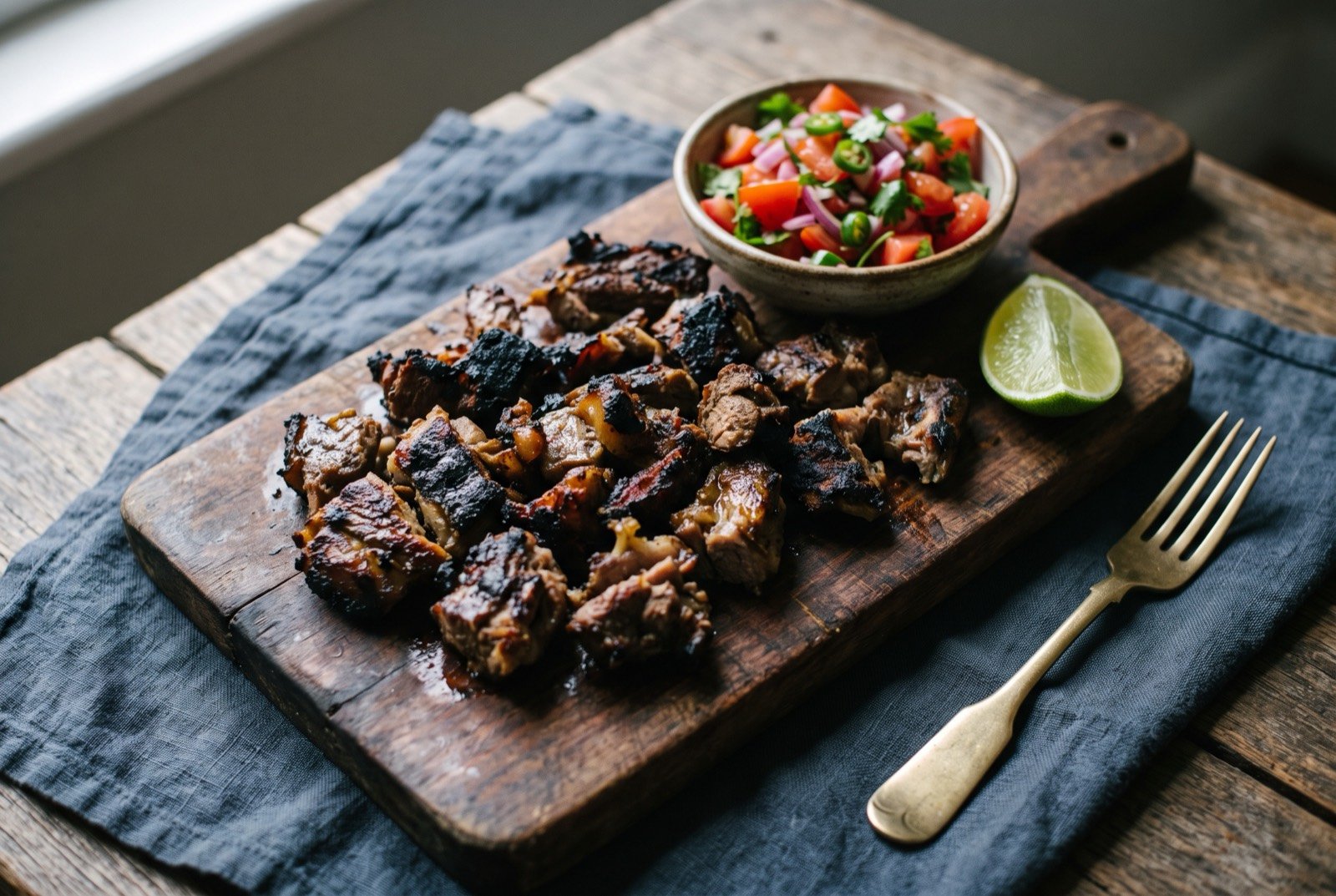
Nyama Choma with Kachumbari
Serves 4 to 6
Illustration
- Time
- 1 hour 30
- Researched
- 6 sources cited
As tradition built it
Serves 4 to 6 · 1 hour to 1 hour 30
Ingredients
- 1.5kg goat, bone in: a mix of ribs, shoulder and leg, cut into large pieces
- 15g coarse salt
- 200ml water plus 10g salt, for the mop
- 2 red onions (250g), sliced as thinly as you can manage
- 4 ripe tomatoes (350g), deseeded and diced
- 1 green chilli, finely chopped
- 20g coriander leaf, chopped
- 2 limes Juice of 2 limes
- 4g salt
Method
- Build a charcoal fire and let it burn down to grey-ashed coals with no flame. You want the grill 30 to 40cm above them, and a hand held at grill height should be comfortable for 6 to 7 seconds.
- Salt the goat lightly all over and put it on. Cook 60 to 90 minutes, turning every 8 to 10 minutes and brushing with the salted water each turn.
- Doneness cues: 88 to 92 degrees at the thickest part of the shoulder, the meat visibly shrinking back from the rib bones, and a rib that twists free with light pressure. Goat is not steak and is not served pink.
- For the kachumbari: put the sliced onion in cold water for 5 minutes, then drain and squeeze. Salt the diced tomato separately and let it drain in a sieve for 10 minutes. Combine onion, tomato, chilli and coriander, dress with lime and the salt, and rest 15 minutes.
- Chop the meat across the grain on a wooden board into rough bite-sized pieces, bone and all, and serve with kachumbari, ugali and a small dish of salt.
Notes
The meat
Kachumbari
What a modern chef changes
Method
- A 24-hour dry brine at 1.2 per cent (rung 5). Weigh the goat, salt it at 1.2 per cent of its weight, and leave it uncovered on a rack in the fridge for 24 hours. The salt diffuses inward and the surface dries to a tacky pellicle, which browns faster and more evenly when the char phase comes. Drop the fire-side salting entirely.
- Two-zone cooking on the Big Green Egg (rung 5). Heat deflector in, Egg stabilised at 120 degrees, meat on the grid, dome closed, until the shoulder reads 88 degrees: 2.5 to 3 hours. Then pull the meat, remove the deflector with the vents wide open, let the Egg climb past 300 degrees, and return the meat direct for 4 to 6 minutes, turning constantly. You get a full hour and a half of collagen conversion the traditional fire struggles to hold steady, then a char phase that is over before the interior notices.
- Fuel (rung 5). Hardwood lump charcoal plus two thumb-sized pieces of olive wood added at the start of the low phase. Kenyan choma is usually cooked over acacia charcoal, whose smoke is clean and slightly sweet; olive is the closest thing widely sold in Britain, and it is a great deal closer than oak or hickory.
- Acid timing in the kachumbari (rung 6). Dress with lime only at the moment of service, and grate the zest of one lime over the finished bowl. Lime's aroma lives in volatile terpenes that dissipate within minutes of contact with salt and tomato acid, so a kachumbari dressed an hour ahead is sour but no longer smells of lime.
Notes
Four named changes.